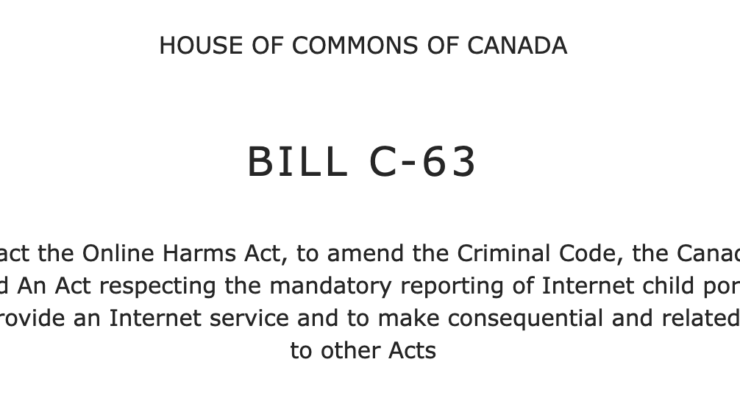










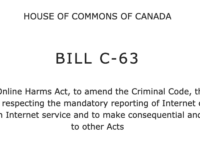
The Online Harms Act has sparked widespread debate over the past six weeks. I’ve covered the bill in a trio of Law Bytes podcast (Online Harms, Canada Human Rights Act, Criminal Code) and participated in several panels focused on the issue. Those panels are posted below. First, a panel titled the Online Harms Act: What’s Fact and What’s Fiction, sponsored by CIJA that included Emily Laidlaw, Richard Marceau and me. It paid particular attention to the intersection between the bill and online hate.
Latest Posts
The Law Bytes Podcast, Episode 199: Boris Bytensky on the Criminal Code Reforms in the Online Harms Act
The Online Harms Act – otherwise known as Bill C-63 – is really at least three bills in one. The Law Bytes podcast tackled the Internet platform portion of the bill last month in an episode with Vivek Krishnamurthy and then last week Professor Richard Moon joined to talk about the return of Section 13 of the Canada Human Rights Act. Part three may the most controversial: the inclusion of Criminal Code changes that have left even supporters of the bill uncomfortable.
Boris Bytensky of the firm Bytensky Shikhman has been a leading Canadian criminal law lawyer for decades and currently serves as President of the Criminal Lawyers’ Association. He joins the podcast to discuss the bill’s Criminal Code reforms as he identifies some of the practical implications that have thus far been largely overlooked in the public debate.

AI Spending is Not an AI Strategy: Why the Government’s Artificial Intelligence Plan Avoids the Hard Governance Questions
The government announced plans over the weekend to spend billions of dollars to support artificial intelligence. Billed as “securing Canada’s AI Advantage”, the plan includes promises to spend $2 billion on an AI Compute Access Fund and a Canadian AI Sovereign Compute Strategy that is focused on developing domestic computing infrastructure. In addition, there is $200 million for AI startups, $100 million for AI adoption, $50 million for skills training (particularly those in the creative sector), $50 million for an AI Safety Institute, and $5.1 million to support the Office of the AI and Data Commissioner, which would be created by Bill C-27. While the plan received unsurprising applause from AI institutes that have been lobbying for the money, I have my doubts. There is unquestionably a need to address AI policy, but this approach appears to paper over hard questions about AI governance and regulation. The money may be useful – though given the massive private sector investment in the space right now a better case for public money is needed – but tossing millions at each issue is not the equivalent of grappling with AI safety, copyright or regulatory challenges.

The Law Bytes Podcast, Episode 198: Richard Moon on the Return of the Section 13 Hate Speech Provision in the Online Harms Act
The public debate surrounding Bill C-63, the Online Harms Act, has focused primarily on Human Rights Act and Criminal Code reforms. The Human Rights Act changes include the return of Section 13 on hate speech, which was repealed by the Harper government after criticisms that it unduly chilled freedom of expression. To help understand the history of Section 13 and its latest iteration, this week Professor Richard Moon, Distinguished University Professor and Professor of Law at the University of Windsor joins the Law Bytes podcast. The Canadian Human Rights Commission asked Professor Moon to conduct a study on Section 13 in 2008 and his report is the leading source on its history and application. In this episode, we discuss that history and consider the benefits and risks of inserting it into Bill C-63.

Tweets Are Not Enough: Why Combatting Relentless Antisemitism in Canada Requires Real Leadership and Action
The Jewish holiday of Purim over the weekend sparked the usually array of political tweets featuring some odd interpretations of the meaning of the holiday and expressing varying degrees of support for the Jewish community. But coming off one of the worst weeks in memory – cancelled Jewish events due to security concerns, antisemitism in the mainstream media, deeply troubling comments on the floor of the House of Commons, and the marginalization of some Jewish MPs in government – the time for generic statements of support does not cut it. The Globe and Mail has noted the “dangerous slide into antisemitism” and called for a House motion unequivocally condemning antisemitism. This post provides further context to that piece, arguing that such a motion is necessary but insufficient since it is leadership and real action from our politicians, university presidents, and community groups that is desperately needed.

Recent Posts
 Debating the Online Harms Act: Insights from Two Recent Panels on Bill C-63
  The Law Bytes Podcast, Episode 199: Boris Bytensky on the Criminal Code Reforms in the Online Harms Act
  AI Spending is Not an AI Strategy: Why the Government’s Artificial Intelligence Plan Avoids the Hard Governance Questions
  The Law Bytes Podcast, Episode 198: Richard Moon on the Return of the Section 13 Hate Speech Provision in the Online Harms Act
  Tweets Are Not Enough: Why Combatting Relentless Antisemitism in Canada Requires Real Leadership and Action
