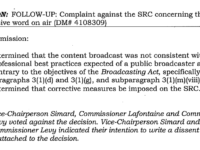
Days after Bill C-11 passed in the House of Commons, the CRTC released its decision involving Radio-Canada and the use of the N-word in a broadcast. The decision sparked an outcry in Quebec and raised concerns that the Commission did not feel constrained by the Charter of Rights and Freedoms in its decision. Indeed, given that the majority of the Commission ignored the Charter and freedom of expression altogether, the decision signalled how Bill C-11 could be used to regulate Internet content the CRTC deems contrary to Broadcasting Act policy objectives. Two of the lingering questions with the case involved timing and who had been involved: the complaint had reached the CRTC in 2020, yet the decision was released nearly 18 months later only after Bill C-11 passed the House of Commons. I asked the CRTC for the full commission minutes to better understand who was involved in the case and when the issue was debated and decided. The Commission responded that all of this information was only available through the Access to Information Act. While I find this level of secrecy astonishing – there is no reason for the Commission to not publish who was involved in decisions and to make its minutes publicly available by default – I filed the request.
Archive for September 14th, 2022

Recent Posts
 What If the U.S. Demanded This? The Cloud Provider Conditions Behind Canada’s EU Digital Pivot
  Ontario is Done Waiting for Universities to Act on Campus Antisemitism
  Is Compromise on Encryption Possible? Why Bill C-22’s “Minor Opening” Leaves the Central Question Unanswered
  The Wrong Target: Why the CBC Should Be Asking About the Yom Kippur Protesters, Not the Journalist Who Reported on Them
  Buried in Bill C-39: The Enabling Digital Trade Act Brings Canada Its First Federal Electronic Trade Documents Law
