
Just one week after Canadian Heritage and CRTC officials provided assurances to a Senate committee that the Commission’s regulatory powers over freedom of expression were constrained by the Charter of Rights and Freedoms, the CRTC yesterday released a ruling in which the majority ignored the Charter altogether in regulating content on Radio-Canada. The decision signals how Bill C-11 could be used to regulate Internet content the CRTC deems contrary to Broadcasting Act policy objectives. It also continues a disturbing trend of revelations that have come in the aftermath of Canadian Heritage Minister Pablo Rodriguez cutting off debate to rush the bill through the House of Commons: officials later admitting that the $1B claim of benefits is merely an “illustrative” estimate, CRTC Chair Ian Scott opening the door to indirect algorithmic regulation, and now the release of a decision on content regulation that dates back to November 2020.
Blog
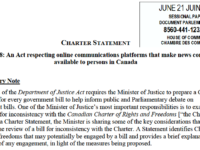
The Missing Bill C-18 Charter Statement: Why Did the Justice Department Remove the Document Confirming the Online News Act Includes Payments for Internet Linking?
Last Tuesday, Justice Minister David Lametti tabled his department’s Charter statement for Bill C-18, the Online News Act. A link to the statement appeared briefly on the department’s website, but by the end of the week reference to the Bill C-18 Charter statement was removed from the Justice site altogether. As of this morning, there is still no reference to the statement, even though it is a public document having been tabled in the House of Commons. In fact, I have now obtained a copy of the Charter statement and posted it publicly here with an embed below. The department will presumably re-post the statement at some point and it would be useful to confirm that it remains unchanged and provide an explanation for the online removal (I asked and did not get a response). [UPDATE: Hours after this blog post went live, the government posted the Charter statement.]

CRTC Chair Ian Scott Confirms Bill C-11 Can Be Used To Pressure Internet Platforms to Manipulate Algorithms
The Senate Standing Committee on Transport and Communications held an exceptionally important hearing as part of its Bill C-11 pre-study (which is about to change into a Bill C-11 study) last night featuring Canadian Heritage officials and CRTC Chair Ian Scott. I will have a second post on the officials, who struggled to provide clear answers to basic questions on everything from how to identify what counts as Cancon for user content (Youtube’s Content ID was suggested) to the absence of thresholds for what is covered by the bill (there are no thresholds and the government wants the ability to also target small streamers). But the key moment of the day came in questioning Scott about the discoverability and the potential for algorithmic manipulation.

Bill C-11 Enters a Danger Zone: Government Shifts from Ignoring Witnesses on User Content Regulation to Dismissing Criticisms as “Misinformation”
The Standing Committee on Canadian Heritage heard from a total of 48 witnesses as individuals or representing organizations during its study of Bill C-11 (excluding the CRTC and government officials). Of those 48, at least 16 either raised concerns about the regulation of user content in the bill or disputed government claims about its effect. Liberal, NDP and Bloc MPs proposed and voted for amendments in Bill C-11 raised by a single witness or organization, but somehow the testimony of one-third of the witnesses, which included creators, consumer groups, independent experts, Internet platforms, and industry associations. was ignored.
The government’s decision to ignore the overwhelming majority of testimony on the issue of regulating user content damages the credibility of the committee Bill C-11 review and makes the forthcoming Senate study on the bill even more essential. But the government went beyond just ignoring witness testimony yesterday in the House of Commons. It now claims those views constitute “misinformation.” Tim Louis, a Liberal MP who is on the Standing Committee on Canadian Heritage and sat through hours of testimony, said this in the House of Commons yesterday:

The Groundhog Day Privacy Bill: The Government Waited Months to Bring Back Roughly the Same Privacy Plan?!
Innovation, Science and Industry Minister François-Philippe Champagne yesterday unveiled Bill C-27, the updated privacy reform law. While Champagne described it is a “historic day”, the bill is better described as a case of Groundhog Day, since it looks an awful lot like the last privacy bill that died with last year’s election call and which never even advanced to the committee stage. I wrote earlier this week about the government’s seeming indifference to privacy and this bill doesn’t do much to change the analysis as the bill raises many of the same questions and will likely face similar opposition.

Recent Posts
 What If the U.S. Demanded This? The Cloud Provider Conditions Behind Canada’s EU Digital Pivot
  Ontario is Done Waiting for Universities to Act on Campus Antisemitism
  Is Compromise on Encryption Possible? Why Bill C-22’s “Minor Opening” Leaves the Central Question Unanswered
  The Wrong Target: Why the CBC Should Be Asking About the Yom Kippur Protesters, Not the Journalist Who Reported on Them
  Buried in Bill C-39: The Enabling Digital Trade Act Brings Canada Its First Federal Electronic Trade Documents Law
