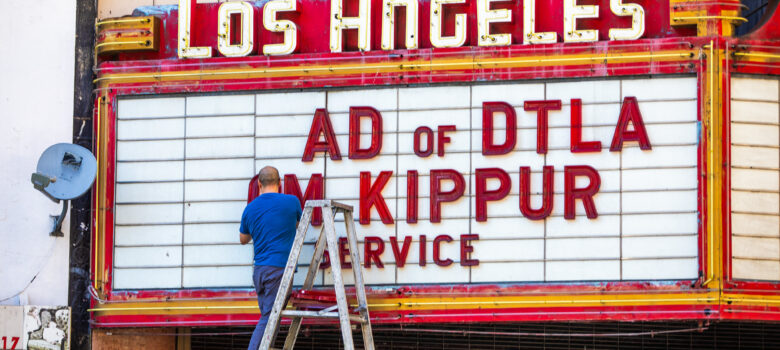
Last week, CBC journalist Neil Herland was reportedly pulled from the air and brought before a disciplinary hearing after posting a tweet thread about being taunted on his way to the Song Shul’s Yom Kippur services at the Meridian Arts Centre in Toronto. The thread included video of the protesters shouting “Zionist alert,” “you’re going to hell” and “baby killer” at people walking in to pray as well as context on the rise in antisemitism, the terror attack at the Sons of Jacob synagogue in Belleville the night before, and the presence of a guest speaker at the service. Herland’s tweet thread sparked opposition, with some defending the protesters on the grounds that the location is a public facility and not a full-time synagogue and that the speaker was Mark Regev, who once served as a spokesperson for the Israeli government. I tweeted about the response last week, noting that the thread was accurate and that I did not understand the concern. That tweet has been viewed over 280,000 times, leading to plenty of angry responses. This post unpacks the arguments and explains why I still don’t see the issue with the tweet thread. If anything, the focus should be protesters who may have violated the Criminal Code.
Many complainants started by emphasizing that the Meridian Arts Centre is not a synagogue or highlight the ticket cost for services (Herland described it as a synagogue service in the first tweet, with references to the synagogue that could be taken to mean the Song Shul in later tweets). As I pointed out in a later thread, the venue argument does not survive even mild scrutiny. High Holiday services are routinely held in rented venues (I attended Yom Kippur services in one) because synagogues overflow and independent congregations have no building of their own. Paying for a seat is standard because synagogues run on dues and tickets, not a collection plate. Indeed, the Song Shul has held Yom Kippur services at this same venue since at least 2018, complete with guest speakers incorporated into the service. Other faiths do much the same thing. Toronto’s biggest Eid prayers are held at the Enercare Centre, and churches across the country meet in performing arts centres and Cineplex theatres.
Given that this was a synagogue service, critics have shifted to Regev as the guest speaker. Herland described him as an Australian-born academic who previously served as Israel’s ambassador to the United Kingdom, which is what he is. Regev served as the international spokesperson for the Israeli Prime Minister’s Office from 2007 to 2016, ambassador in London from 2016 to 2020, and a senior adviser to Netanyahu in 2020 and 2021 with a brief return after the October 7th attack. He now chairs the Abba Eban Institute at Reichman University and co-hosts a podcast. The protester campaign alleged “material support of war crimes” and demanded that the Public Safety Minister bar him from Canada, which the government did not do. In fact, no court anywhere has found anything of the kind. Two activists in Melbourne launched a private prosecution in 2024, but the Commonwealth Director of Public Prosecutions withdrew it within two months.
Given that Regev was the public face of Israeli government messaging for many years, some may want to protest. But Bill C-9, the Combatting Hate Act, which received Royal Assent in June and has been in force since July 18, makes it an offence to intimidate or obstruct people accessing a place of worship. Further, section 176 of the Criminal Code makes it an offence to wilfully disturb an assemblage of persons who meet for religious worship (s. 176(2)) or, at or near such a meeting, to wilfully do anything that disturbs its order or solemnity (s. 176(3)). Note that the Criminal Code provision focuses on the gathering, not the building. The new Bill C-9 offences may not cover a rented hall (the building must be “primarily used” for worship) but the conduct may well be an offence under section 176. Toronto’s bubble zone bylaw would not have helped, since it protects only designated places of worship that apply for a zone. Regardless, the legal policy is clear: intimidation, obstruction or disturbing those attending religious services is prohibited regardless of whether one objects to what is said or who is saying it. That principle does not stop protest, but it does mean there are consequences for those who disturb or intimidate worshippers. Yet on that day, Toronto police kept the protesters only five metres from the door and made no arrests.
In February 2017, a group of protesters gathered outside Masjid Toronto during Friday prayers, calling for a ban on Islam and blocking some worshippers from entering. That same week, the mosque apologized after it emerged that a supplication delivered there had called for Al-Aqsa to be purified “from the filth of the Jews.” Both incidents were referred to the police hate crime unit. The public response treated the words spoken from the mosque’s own pulpit as a matter for the police, not as a reason to target the people praying inside. Years later, a crowd outside Yom Kippur services harassed and intimidated those entering the services, yet some defend the conduct.
The bottom line is that Herland’s thread was accurate and the protest itself raises concerns about violating the law. In fact, the congregation said his video “accurately documented the siege outside our synagogue” and called the tweets “journalistically accurate.” The CBC is wrong to discipline a Jewish journalist for reporting a firsthand account of antisemitic intimidation on the way into Yom Kippur services and the police appear to have been wrong in standing aside and letting it happen.




On this issue we are in agreement although inviting Mark Regev was in poor taste given the Gaza genocide.
The protestors were in the wrong. Legally and morally.
Congrats on not conflating antisemitism and antiZionism.
What Gaza genocide? If you have the IQ of a cockroach, then you know, there is no genocide, not that it matters to people like you, the lie suffices to support your hatred of the Jews.
Genocide denial is so very Zionist. You get genocide denial prize. Now slither back under your rock.
It’s an excellent article. Though there’s simply no reasoning with virulent antisemites.
This raises an interesting point about the responsibilities of journalists and media organizations when reporting on controversial public events. I found the discussion about where accountability should be directed particularly thought-provoking, especially when reporting itself becomes part of the wider debate. The distinction between questioning the reporting and examining the underlying event is worth considering.
‘Bill C-9 offences may not [ahem, DO NOT] cover a rented hall (the building must be “primarily used” for worship) but the conduct may well be an offence under section 176. Toronto’s bubble zone bylaw would not have helped…’
This phrasing is a tad slanted, to suggest that a law may or may not cover a situation when you know it does not. The Toronto bubble bylaw phrasing is clearer, and that has already been widely denounced as overreach in protest suppression by groups that care more for civil rights than Zionism—and even by the city’s lawyers. The section 176 argument is more interesting, as it is a real stretch if at least plausible.
But the defence of Herland is a lost cause. His comments were not accurate or just a stretch but dishonest and inflammatory. He directly contravened the CBC code of conduct. A clearer firing offence is hard to imagine without a non-consenting goat involved. On air.
The misframing of a podcast and podium mouthpiece for Israel-right-or-wrong zealots was more subtle. Is he an academic who dabbles in being a IDF spokesperson or is that like calling Ehud Barak a former politician who was a passing acquaintance of Epstein and is generally in favour of Zionism. To me it is transparently slanted.
What to make of the claim that the religious frills around a political speech such as this negates its primary political nature? Transpose it to a project that is not your hobby horse. Say a Christian fascist to a crowd at an Easter Masonic hall gathering, and is introduced by a church leader who also says the lord prayer. Surely, his bigotry and support of violent ethnic terror is still hate speech.
Crucially, it doesn’t cease being political just because you are sympathetic to it and falsely pretend it flows from the culture of said religious community.
A lot of blather, and you could’ve simply told us you’re an antisemite.
Before I retired, I was a newspaper owner and journalist, so I speak to this issue with some understanding of it. CBC is completely in the wrong. The man’s reporting was showing the accurate and it was timely, and it was within the bounds of proper journalism.
Of course, people like you don’t want to hear this, because to you anything that supports the Jews must be a lie, must be hatred.
The only hatred here is coming from people like you. I wish I knew what we could do about people like you. Sometimes, unfortunately, the freedom is given to our citizens are abused, as you have abused them by lying to us.
zgj