Last week’s Canada-EU summit in Montreal delivered several new collaborative initiatives as part of Canada’s pivot toward the EU, but among the most notable from a digital policy perspective was the conclusion of negotiations on a Canada-EU Digital Trade Agreement. E-commerce or digital trade chapters are by now common in Canadian trade agreements (including in CUSMA and the CPTPP), but this is Canada’s first standalone digital trade agreement. The possibility of a DTA has long been of interest, as Canada formally requested to join the Digital Economy Partnership Agreement in May 2022, and Global Affairs Canada launched a consultation that same year on developing a model Canadian digital trade agreement. That consultation process did not produce a public model, which means the Canada-EU DTA may emerge as the standard even though it is based on the European approach. While the text is unlikely to be released for months (officials said it is going through a “legal scrub”), there is plenty of room to speculate about what it contains since this will be the third EU DTA and it is likely to follow a similar approach.
The EU concluded its first standalone DTA with Singapore in July 2024, and it took effect on February 1, 2026. The EU signed a second agreement with South Korea this past June. The Singapore text covers the standard digital trade issues:
- a commitment to cross-border data flows linked to a ban on data localization requirements
- protection against forced disclosure of source code
- a permanent ban on customs duties on electronic transmissions
- a prohibition on requiring prior authorization simply because a service is offered online
- legal recognition of electronic contracts, signatures and trust services
- online consumer protection
- anti-spam rules
- open internet access
- commitments to endeavour toward paperless trading and electronic transferable records
The EU DTA model excludes audiovisual and broadcasting services, along with information held or processed by or on behalf of a government, which ensures that data residency rules for government data fall outside its scope. The EU’s negotiating directives for the Canadian agreement identified the same subjects and insisted that the EU’s personal data protection rules were not open to negotiation. The European Commission’s release on the Canada-EU DTA describes a framework for trusted data flows, rules on e-contracts, e-signatures and e-invoices, and consumer protections that require commercial messages to identify the sender and allow recipients to stop them. These are all consistent with the EU-Singapore DTA.
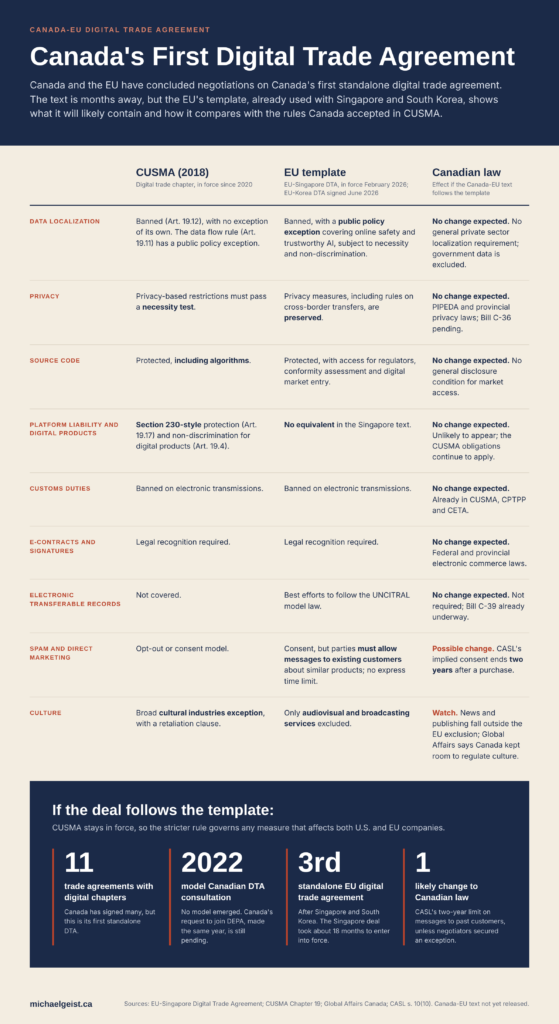
If this sounds familiar, it is because Canada already has trade agreements that cover similar terrain, including the CUSMA digital trade chapter, which I described in 2018 as setting a new standard for digital trade agreements. In fact, the EU model is less demanding in several respects. For example, its privacy approach states that nothing prevents a party from adopting or maintaining privacy measures, including rules on cross-border transfers, provided that its law includes general mechanisms for protected transfers. By contrast, CUSMA contains a necessity test for privacy-based restrictions. The EU’s localization ban includes an exception for legitimate public policy objectives, specified in a footnote as including “online safety, cybersecurity, safe and trustworthy artificial intelligence” and protection against disinformation, subject to necessity and non-discrimination conditions. CUSMA’s localization provision has no exception of its own, a choice I argued at the time surrendered Canadian policy flexibility. The Singapore agreement also contains no equivalent to the Section 230-style intermediary liability provisions found in CUSMA or its non-discrimination rule for digital products, and it is unlikely that they appear in the Canada-EU DTA. The DTA would not displace Canada’s existing CUSMA obligations, so Canada would be bound by both U.S. and EU digital trade rules, with the stricter one governing any measure affecting companies from both.
Based on the provisions in the EU model, the European DTA is likely to require few changes to Canadian law. Canadian privacy law should meet the EU DTA standard, federal and provincial laws already recognize the validity of electronic documents and signatures, and our telecommunications laws back open internet access. Canada has yet to enact electronic transferable records legislation, but Bill C-39 would establish a federal electronic trade documents law.
One possible exception involves Canada’s anti-spam law. CASL requires consent before sending commercial electronic messages. The EU model similarly requires consent, but Article 13(2) of the Singapore agreement provides that each party “shall allow” a business that collected a customer’s contact details during a sale to send messages about “their own similar goods or services,” without including a time limit. CASL treats an existing business relationship as implied consent for only two years after a purchase and six months after an inquiry. Unless Canadian negotiators secured an exception, a message to a customer three years after a purchase would be permitted under the Canada-EU DTA but run afoul of the CASL standard. Some additional issues will depend on the fine print. For example, Canada typically insists on a broader cultural exemption than the exclusion for audiovisual and broadcasting services found in the EU model, which could raise issues with legislation such as the Online News Act, though Global Affairs says the agreement preserves Canada’s ability to regulate in areas including culture.
Four years after the government consulted on a made-in-Canada digital trade template, Canada’s first DTA is likely to follow the European model, featuring terms broadly consistent with existing Canadian law. It could also move quickly, since the Singapore agreement entered into force within about 18 months of conclusion. Given Canada’s ongoing request to join the DEPA, this agreement could be the first of several, with other countries’ templates rather than a Canadian model setting the terms.