
Industry Minister Mélanie Joly met earlier this week with the CEOs of seven telecom companies, including Quebecor and Telus, leading to a statement that Canadians should have “real choice, strong competition.” But Joly again did not mention a fourth wireless carrier, a policy objective both Conservative and Liberal governments have pursued in one form or another since 2007. Her first statement on Quebecor’s proposed takeover of Telus emphasized sovereign networks, Prime Minister Mark Carney suggested that an oligopoly with fewer players can lead to more competition under certain circumstances, and the Globe and Mail reports that the government has privately signalled that it may be willing to abandon its commitment to a four-player market. I have previously written on why sovereignty is the wrong response to the bid and why Europe does not make the case for a three-player market, but Canada’s track record on wireless competition is worth revisiting, as this would represent a major reversal with implications for consumer costs.
The infographic below captures the positions of seven prior and current industry ministers, but the history is perhaps best told through a single company. In 2009, then Industry Minister Tony Clement overruled the CRTC to pave the way for Wind Mobile to launch as a new entrant. Four years later, Christian Paradis blocked Telus from acquiring Mobilicity and promised “at least four wireless providers in every region of the country,” a policy James Moore later invoked when approving spectrum transfers that included Wind. The company was ultimately rebranded as Freedom Mobile after Shaw bought it, and when Rogers sought to acquire Shaw, François-Philippe Champagne refused to let the wireless licences go with it, instead approving their transfer to Quebecor’s Videotron on the basis that it would allow for a fourth national carrier for the first time in Canadian history and that a “strong fourth competitor does lead to lower prices.” Now Quebecor wants to buy Telus, which would undo in a single deal what ministers from two parties spent fourteen years building.
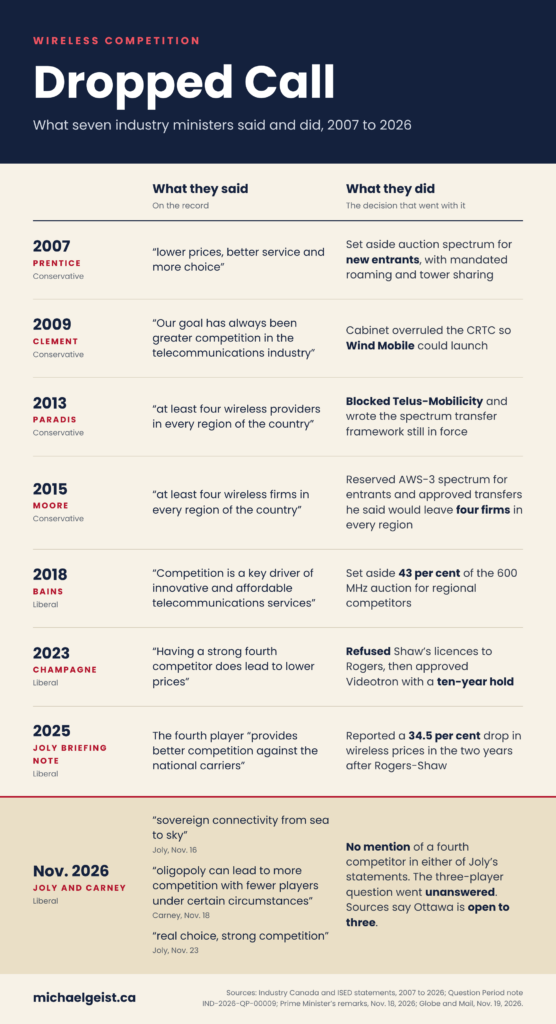
Dropped call infographic
The government has not always lived up to the rhetoric, as Moore suggested in 2014 that the marketplace would decide how many carriers survive, Navdeep Bains approved Bell’s acquisition of MTS in 2017, and Champagne would allow the Rogers-Shaw merger to proceed. Yet in each of those cases the government still insisted that a fourth competitor remain in the market. Even with Bell-MTS, it sought to preserve a fourth option by requiring Bell to transfer spectrum and customers to Xplornet, though that wireless service shut down in 2022. In fact, just last year a Question Period briefing note prepared for Joly identified the new fourth player as a source of added competition for the national carriers, while separately reporting that wireless prices had fallen by 34.5 per cent in the two years following the Rogers-Shaw transaction.
The government has suggested that the Quebecor-Telus deal is a matter for the Competition Bureau and the CRTC, but the government is responsible for approving spectrum licence transfers. On the same day Champagne approved the Freedom transfer, he ordered a review of the 2013 spectrum transfer framework and imposed a moratorium on high-impact transfers of commercial mobile spectrum, which remains in place until a revised framework is implemented. As a result, ISED will not consider a transfer of the Telus licences until it brings new rules into effect, which the Telecom Competition Roadmap released last month said will closely scrutinize transactions that raise concentration concerns. ISED has said it will launch the consultation on those rules this year. Quebecor’s proposal calls the government’s recent policy direction a positive signal while acknowledging that the moratorium remains in place and needs ISED’s approval, making it more forthcoming about Joly’s role than she has been.
Three years ago, the government approved the transfer of Freedom Mobile’s licences to Videotron on the express basis that Canada would finally have a fourth national wireless competitor. By the government’s own account, that policy has largely succeeded, which makes the apparent willingness to abandon it all the more surprising. Joly still talks about competition, but as the government considers shifting the goalposts on its policy objectives, it seems ready to accept higher consumer prices and weaker competition in the name of sovereign networks.