
Industry Minister Mélanie Joly met earlier this week with the CEOs of seven telecom companies, including Quebecor and Telus, leading to a statement that Canadians should have “real choice, strong competition.” But Joly again did not mention a fourth wireless carrier, a policy objective both Conservative and Liberal governments have pursued in one form or another since 2007. Her first statement on Quebecor’s proposed takeover of Telus emphasized sovereign networks, Prime Minister Mark Carney suggested that an oligopoly with fewer players can lead to more competition under certain circumstances, and the Globe and Mail reports that the government has privately signalled that it may be willing to abandon its commitment to a four-player market. I have previously written on why sovereignty is the wrong response to the bid and why Europe does not make the case for a three-player market, but Canada’s track record on wireless competition is worth revisiting, as this would represent a major reversal with implications for consumer costs.
Post Tagged with: "Wireless"

Apples to Orange: Why Europe Doesn’t Make the Case for a Three-Player Wireless Market in Canada
Days after Quebecor unveiled its bid to acquire Telus, the Globe and Mail reports that the government has privately signalled it is open to reversing its policy commitment to four national wireless players, returning to a three-company oligopoly. That would be a remarkable shift, given that when then-Minister François-Philippe Champagne approved the transfer of Freedom Mobile’s spectrum to Videotron in March 2023, he described it as a chance to create the fourth national player governments had pursued for decades. Yet three years later, Prime Minister Mark Carney suggests an oligopoly can sometimes produce more competition with fewer players, while Quebecor CEO Pierre Karl Péladeau cites Europe as an example where government policy has led to three dominant providers. It appears we will hear a lot about Europe, but this is an apples-to-“Orange” comparison (sorry). Unlike Quebecor’s proposal, Europe’s three-player markets include mobile virtual network operators (MVNOs) that buy wholesale access to the networks, have featured merger approvals with serious binding commitments, and have no bar on foreign ownership.

What Happened to Competition? Why Sovereignty Is the Wrong Answer to Quebecor’s Bid for Telus
Rogers v. Rogers, the exceptional one-person play, recently ran in Ottawa, giving attendees a chance to relive the battle over control of Rogers and competition law’s role in Canada. Prioritizing wireless competition seemed like an obvious policy position at the time, but it appears to have been short-lived. This week, Quebecor unveiled a $31 billion proposal to acquire Telus, which, if completed, would reduce the number of national wireless carriers from four to three and unwind the very remedy the government relied upon to justify approving the Rogers-Shaw merger in 2023. Industry Minister Mélanie Joly released a Telecom Competition Roadmap less than three weeks ago that declared “cross-Canada competition” to be the government’s objective, but her statement on the bid refers to competition only in the name of the Competition Bureau. The statement still mentions prices Canadians can afford, but it says nothing about maintaining the fourth national competitor the government has repeatedly claimed was essential to making wireless prices more affordable. Instead, the new priority is “sovereign connectivity from sea to sky,” which doesn’t make a ton of sense as the organizing principle for the largest telecom transaction since Rogers-Shaw.

The Law Bytes Podcast, Episode 220: Marina Pavlović on the CRTC’s Plans to Address Consumer Frustration Over Wireless Contracts
Consumer frustration with just about everything associated with Canadian communications services is well known. The list of concerns is long: high prices, contracts that lock in consumers but not providers, gaming prices to make comparison shopping difficult, and confusing consumer codes among them. As politicians have begun to take notice, the CRTC has suddenly become more active with several consultations and new consumer focused initiatives. My colleague Marina Pavlović, a law professor at the University of Ottawa, has been at the forefront of consumer rights law and communications services for many years. She joins the Law Bytes podcast to talk about the ongoing consumer challenges and the latest CRTC developments.
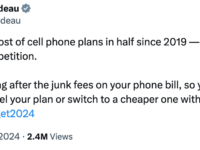
The Law Bytes Podcast, Episode 202: David Soberman on the Reality Behind Claims Canadian Wireless Prices Have Been Cut in Half
Prime Minister Justin Trudeau recently claimed that “we’ve cut the cost of cell phone plans in half since 2019 – in part by increasing competition.” Is that true? What is the real state of Canadian wireless competition and how does pricing compare with other countries? To help answer those questions, this week David Soberman, a Professor of Marketing at the Rotman School of Management at the University of Toronto and the Canadian National Chair of Strategic Marketing joins the Law Bytes podcast. Professor Soberman’s research is focused on understanding how the operation of markets is affected by the exchange of information between organizations and customers, relationships within the distribution channel and the introduction of innovations to markets.

Recent Posts
 Doubling Down on Metadata: Senate Committee Completes Bill C-22 Review With Limited Changes to Lawful Access
 The Bill C-22 Surveillance Map: Public Safety Wants Providers to Keep Location Data They Don’t Collect or Retain Today
 Dropped Call: Unpacking the Government’s Apparent Reversal on a Fourth Wireless Carrier Policy
 No Compromise: Senate Heads to Clause-by-Clause on Bill C-22 After Police Reject a Necessary and Proportionate Standard
 The Law Bytes Podcast, Episode 284: Lawful Access Comes to the Senate – My Appearance on Bill C-22 Before the Senate National Security Committee
