Bill C-34, which would ban social media accounts for under-16s, is now before the Standing Committee on Canadian Heritage, which just approved plans to hold at least 16 hours of hearings starting the week of November 16th. The government’s position on the bill became clearer during several days of debate last month at the House of Commons, revealing a shift in how MPs describe the ban (it’s now euphemistically called an “exemption model”), how they defend the decision to leave dozens of key issues to future regulations (one implausibly claimed that addressing all the issues would create a 1,500 page bill), and what they think of mandated age verification (some admitted to concerns about it). The takeaway was that the ban and the uncertainty in its implementation will be difficult to defend at committee.
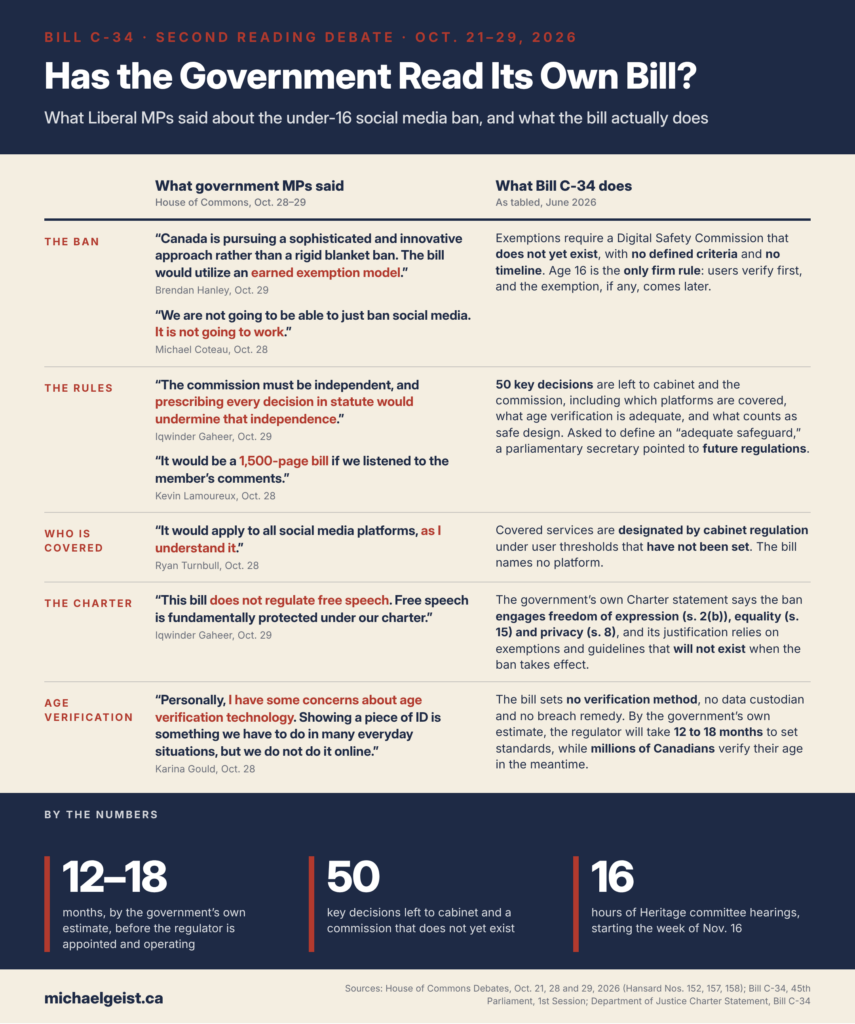
Liberal MPs themselves repeatedly described the bill as a ban during the debate, with Kevin Lamoureux calling it “a ban on social media content for children under the age of 16” and Guillaume Deschênes-Thériault saying “our approach with Bill C-34 is to ban people under the age of 16 from having accounts.” Yet Liberal MP Michael Coteau told the House that “we are not going to be able to just ban social media. It is not going to work,” while Liberal MP Brendan Hanley claimed that “Canada is pursuing a sophisticated and innovative approach rather than a rigid blanket ban. The bill would utilize an earned exemption model.”
But beyond the mixed messaging, the reality is that the government’s implementation plan is less an earned exemption model than one that requires banning first and exempting later (if at all). The bill has no defined criteria for an exemption, no timeline, and relies on a Digital Safety Commission that does not exist. The plan will therefore require millions of Canadians to age-verify to hold accounts on social media services, and only after its users are verified might a service obtain an exemption.
The debate confirmed the timing problem using the government’s own plans. Conservative MP Jacob Mantle told the House that “by the government’s own estimates, it would likely take between 12 and 18 months, or more, for the regulatory body to be appointed, pass regulations, make orders or provide guidance,” with the result that “millions of Canadians would be required to verify their age immediately, even though regulated platforms may later be exempt from age verification.” Conservative MP Tamara Kronis added that the bill contains no expiry for restrictions described as temporary and no guarantee that the exemption process will be operating when the restrictions begin, and the government has said it intends to bring the ban into force without waiting for the regulator. Government MPs did not respond, ignoring the reality that millions of Canadians would still need to age-verify, since the standards will only be established a year or more after the ban starts.
The government also defended leaving much of the substance of Bill C-34 to regulation. When opposition MPs noted that there were at least 50 major decisions left to cabinet and the commission to decide, Liberal MP Karina Gould replied that “there will always be factors that we cannot foresee” and that “the principles and objectives that will guide its work have now been clearly established, and that is what matters most.” Lamoureux suggested that a bill which answered the opposition’s questions “would be a 1,500-page bill,” and Liberal MP Iqwinder Gaheer argued that “prescribing every decision in statute would undermine” the commission’s independence. Yet the effects of the uncertainty became apparent when Liberal MP Karim Bardeesy was asked to define what an “adequate safeguard” meant. He responded vaguely that “there are going to be lots of places that do that, like through the commission and through the regulations that may come out of the act.”
At times it appeared that the government MPs were unfamiliar with the details of the bill. For example, Liberal MP Ryan Turnbull told the House it “would apply to all social media platforms, as I understand it.” He understood it wrong, given that cabinet regulation designates regulated services under thresholds that have not been set.
The Bill C-34 Charter statement was posted days before the debate began, but government MPs offered little analysis. Gaheer told the House that “this bill does not regulate free speech. Free speech is fundamentally protected under our charter,” a position seemingly contradicted by the government’s own Charter statement, which states that the under-16 ban engages freedom of expression, equality rights and privacy. In fact, Mantle rightly noted that neither the minister’s nor the parliamentary secretary’s opening speech even mentioned the Charter and concluded that “even if the so-called safeguards… would make this bill constitutional, the problem remains that none of those protections would be operational when the bill is passed.”
Concerns about age-verification technologies arose in unexpected places. Gould, in a speech supporting the bill, said “personally, I have some concerns about age verification technology. Showing a piece of ID is something we have to do in many everyday situations, but we do not do it online,” and Liberal MP Jacques Ramsay said that nobody wants Canadians handing over ID to watch a video. But questions about which age verification methods will qualify, who will hold the data, and what happens after a breach went unanswered.
The Bill C-34 hearings will therefore open this month with concerns that the under-16 social media ban will apply as soon as cabinet designates the covered social media services, the Digital Safety Commission will not be operational for a year or more, and the exemptions and guidelines that will not exist when millions of Canadians are required to age verify in order to establish social media accounts. Culture Minister Marc Miller told the House that there is “a legitimate debate to be had here and in committee” over whether the exemption rules are set by the regulator “or perhaps even by committee.” The House did not come close to resolving the issue, leaving it to committee to address a bill that, in its current form, is virtually guaranteed to face a legal challenge and years of litigation before it has any effect.
Related posts:
 The Exemption Illusion: Why the Government’s Plan to Fast Track Bill C-34’s Kids’ Social Media Ban Means No Standards, No Privacy Review, and No Enforcement
 The Commission: How Bill C-34 Creates an Internet Super-Regulator That Will Touch the Lives of Millions of Canadians
 Soft Ban or Hard Verification Requirement?: Why Bill C-34’s Social Media Ban Exemption Gets the Incentives Wrong and Comes Too Late to Matter
 Regulator First, Rules Later: Bill C-34 Debate Shows the Government Wants a Digital Safety Commission Before It Figures Out What It Will Do