
The most contentious aspect of the government’s Bill C-34 social media ban for under-16s is that millions of Canadians will need mandated age verification to create social media accounts. The bill tacitly acknowledges that this raises privacy concerns, as it includes a mandatory consultation with the Privacy Commissioner and leaves the future Digital Safety Commission to set the necessary standards. But as I wrote in June, the problem is that the government plans to bring the ban into force before the Commission even exists, meaning the age verification will proceed without established standards or the privacy consultation the bill itself requires. The United Kingdom, which is pursuing a similar ban with a spring 2027 start date, has adopted the opposite approach by asking Ofcom, its regulator, to assess what effective age verification would look like before Parliament sets the rules. The resulting report, released this week, is the most candid regulatory account of a social media ban to date. Ofcom identifies four methods capable of establishing whether someone is 16 or over and it finds that each of them requires using photo ID either directly or as the backstop given the ineffectiveness of age estimation for younger users.
The report distinguishes between what technologies work for under-16s and for those under-18. For under-16 cohort, Ofcom identifies four approaches: photo ID matching, digital identity services, banking-based checks, and facial age estimation. The three additional methods it accepts for those under-18 (credit card checks, mobile operator checks, and email-based age estimation) do not work for those under-16. Ofcom also notably rejects using parental consent as a model, citing evidence that “some parents may provide incorrect age information for the purpose of assisting children to circumvent age restrictions.”
Ofcom’s summary explains why photo ID is essentially unavoidable for teenagers:
16- and 17-year-olds are more likely than over-18s to need access to a photo ID and those without would likely need to take steps to obtain one to access age-restricted services. This is because, of the methods identified in this rapid assessment for highly effective age assurance at 16, photo ID is either required as part of the method itself, or as the likely backstop for other methods, such as facial age estimation.
All require documents, except for facial age estimation. However, since even the best algorithms have an error rate of nearly two years for teenagers, a 15 year old can easily be estimated as being 17. Therefore, Ofcom establishes a “challenge age” set above the threshold that goes beyond age estimation, concluding that the challenge age “would likely need to be over 18 for the 16 age gate, meaning 16- to 17-year-olds would likely need to prove their age using age verification.” In other words, teenagers will require verification that relies on photo-based documents.
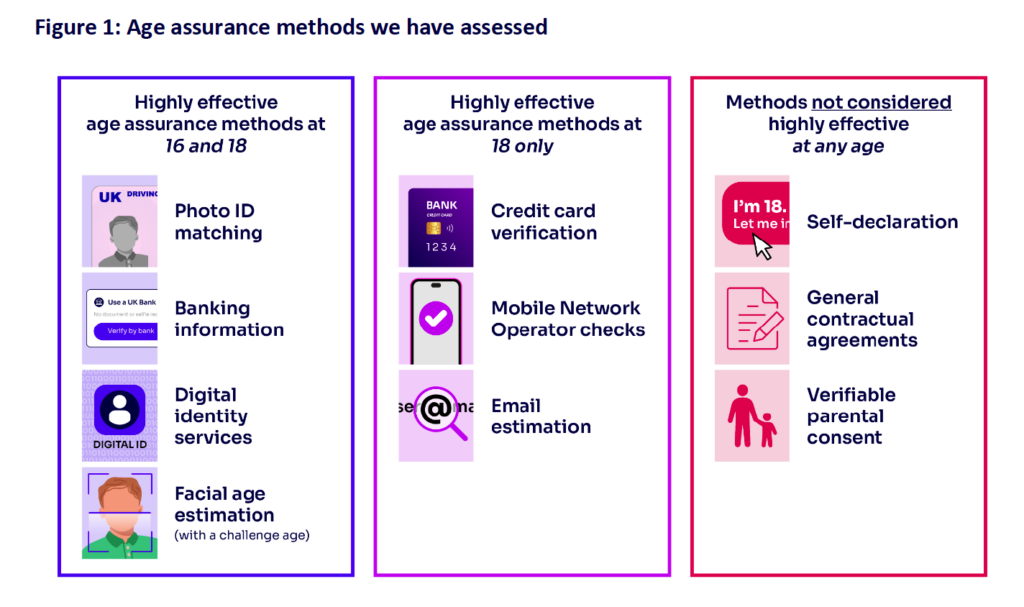
Ofcom, How age checks at age 16 can work to underpin UK’s social media ban https://www.ofcom.org.uk/online-safety/protecting-children/how-age-checks-at-age-16-can-work-to-underpin-uks-social-media-ban
Ofcom estimates that 94 per cent of people aged 16 and over in the UK hold a passport or a drivers licence, but those numbers drop dramatically in less affluent areas and leaves around 150,000 16 and 17 year olds without any relevant document. The regulator also acknowledges that many adults will have to prove their age to use social media services, since the only way to keep under-16s out is to age verify everyone. While it insists that age verification “can be delivered in a way that protects users’ privacy and complies with data protection law,” the system is still likely to require many adults to provide identity documents, conduct facial scans, or hand over financial and account data to verification vendors.
Once the system is fully established, Ofcom admits that “no age assurance method is completely robust against circumvention by children” and predicts that circumvention rates will rise once the social media ban is in place, resulting in more account sharing and more adult-assisted workarounds. In fact, its own research found that a quarter of children had used a VPN in the previous six months. To counter circumvention, it hopes to rely on user reporting, location tracking to detect VPN usage, and age inference models that profile user behaviour to identify accounts that belong to underage users. This despite the fact that the UK’s privacy regulator warns that inference “should not be used to make up for a weak or non-existent age gate.”
None of this will surprise anyone who has paid attention to the age verification issue, as it is widely accepted that the technologies carry real privacy risks. Yet the difference between the Canadian and UK approaches shows how seriously each country takes those risks. When the UK government announced its ban in June, it immediately asked Ofcom to assess the technology and committed to regulations, detailed guidance, and an impact assessment before the ban takes effect. While Canada’s Bill C-34 contains the structure for a comparable process, the government’s stated plan is to bring the ban into force before any of the safeguards or standards exist.
The government’s Charter statement defends the age verification requirement by pointing to the Section 27(2) conditions on collecting and destroying personal information and to the continued application of privacy law. But the Ofcom study shows what a proper assessment involves and points to the need to do the work before the ban takes effect. To do otherwise invites a constitutional challenge, since it would require tens of millions of Canadians to verify their age to use social media services without technical standards, the required privacy consultation, or an operational Commission to assess compliance.
Related posts:
 Yet Another Trade Battle Brewing: Why a Kids’ Social Media Ban Could Put Canada on a Collision Course With the U.S.
 The Exemption Illusion: Why the Government’s Plan to Fast Track Bill C-34’s Kids’ Social Media Ban Means No Standards, No Privacy Review, and No Enforcement
 The Commission: How Bill C-34 Creates an Internet Super-Regulator That Will Touch the Lives of Millions of Canadians
 Big Money, Bigger Design Changes: What the Meta Settlement Means for Canada, Bill C-34, and the Age Verification and Privacy Risks That Remain







Pingback: Feds Want to Ban Kids From Social Media, But Adults Could Need ID Too
So that’s it, they say “jump” and “we” say “how high”?
No referendum or vote on this societal changing surveillance/tracking/control powers?
“Ofcom also notably rejects using parental consent as a model, citing evidence that “some parents may provide incorrect age information for the purpose of assisting children to circumvent age restrictions.”… but that’s the point, it’s up to the parent to decide not a stranger, a company, the government or an agent of it. “I’m the parent here, bug off!”
“While it insists that age verification “can be delivered in a way that protects users’ privacy and complies with data protection law,””…
What about respecting the universal declaration of human rights article 19, “Everyone has the right to freedom of opinion and expression; this right includes freedom to hold opinions without interference and to seek, receive and impart information and ideas through any media and regardless of frontiers.”…notice the “without interference”. Or must we go through hell once again to recognize that “aaah, yes, that’s why those rights were there.”
“protect uses privacy” : What about protecting people anonymity.
Societal segregation for those who don’t have a camera, spy/tracking device such as a smartphone, and much more?
Canada has really been going hard on the whole concept of “throw a random law at the wall and see what sticks”. There are ways to study the laws you are proposing (I mean, for crying out loud, we can have two government committees to examine it), but the government has ultimately viewed them as obstacles getting in the way of their legislative agenda’s more than anything else.
I mean, we’ve seen this with the Digital Services Tax. Sensible people pointed out that it was a bad idea and the government ignored the experts and passed it anyway only to have to reverse course when the warnings of the predictable US response came to fruition.
We’ve also seen this with the Online News Act where experts warned that Meta would drop news links. The government ignored the experts and Meta dropped news links anyway.
The government argued that the Online Streaming Act was a simple law that was no big deal and, years later, we’re still waiting for the CRTC regulatory process to complete (and the numerous lawsuits against the Online Streaming Act wasn’t helping matters, either).
This cycle of ignore experts, pass laws, then walk back when the consequences come to fruition is in the process of happening again with Lawful Access and, of course, age verification/online harms laws. I just shake my head at all of this, but we really are in an era of government legislative guesswork.
Pingback: Law and Media Round Up – 2 November 2026 – Inforrm's Blog
I read a lot of criticism but would like to hear more about solutions. Unfortunately a majority government has a certain amount of power, but is the Senate review not being used effectively. Mr. Geist, while criticism is good, and I commend your efforts, I would like to hear more proposed solutions. Is the EU GDPR not workable in a Canadian context?
Thanks for breaking down the Ofcom report. The finding that photo ID ends up being unavoidable for younger teens is the part that deserves the most attention, and it makes the case for setting clear standards before any ban takes effect.
Understanding the different age verification methods is important as online platforms work to create safer digital environments for younger users. Anyone navigating digital services or needing assistance with account-related questions may also find Destiny contact number useful for getting the right support.