The government quietly released details on Sunday of how it will allocate the $600 million it promised in June when it announced plans to kill the CRTC’s Online Streaming Act ruling on Internet streamer contributions. The plan largely copies the CRTC’s 2024 base contribution decision, with public tax dollars replacing streamer contributions at a rate far higher than the Commission expected. The windfall is seemingly another by-product of a policy the government is making up as it goes along: cancel the CRTC decision and use back-of-the-napkin math for $600 million, then rely on the same CRTC decision for allocations with the public paying cultural groups far more than the streamers would have been required to contribute. The government plan, booked for a single year ending in March 2027, notably includes $91.5 million for the broadcaster news funds that the streamers have been fighting in court. Five months after the bombshell decision, the government still has not released its promised policy direction to the CRTC, yet it has adopted the Commission’s framework for how it will divide the money.
The allocation plan closely tracks the CRTC’s initial decision, Broadcasting Regulatory Policy CRTC 2024-121. The Commission directed audiovisual streamers to pay 2% of Canadian revenues to the Canada Media Fund, 1.5% to the Independent Local News Fund, and the remaining 1.5% to the Indigenous Screen Office and a group of certified independent production funds, while audio streamers were to pay 2% to FACTOR and Musicaction, 1.5% to a new commercial radio news fund, and smaller amounts to the Canadian Starmaker Fund, Fonds RadioStar, the Community Radio Fund of Canada and the Indigenous Music Office. All these recipients appear in the government’s list, and the music funds are even divided on the same 60/40 split the CRTC established.
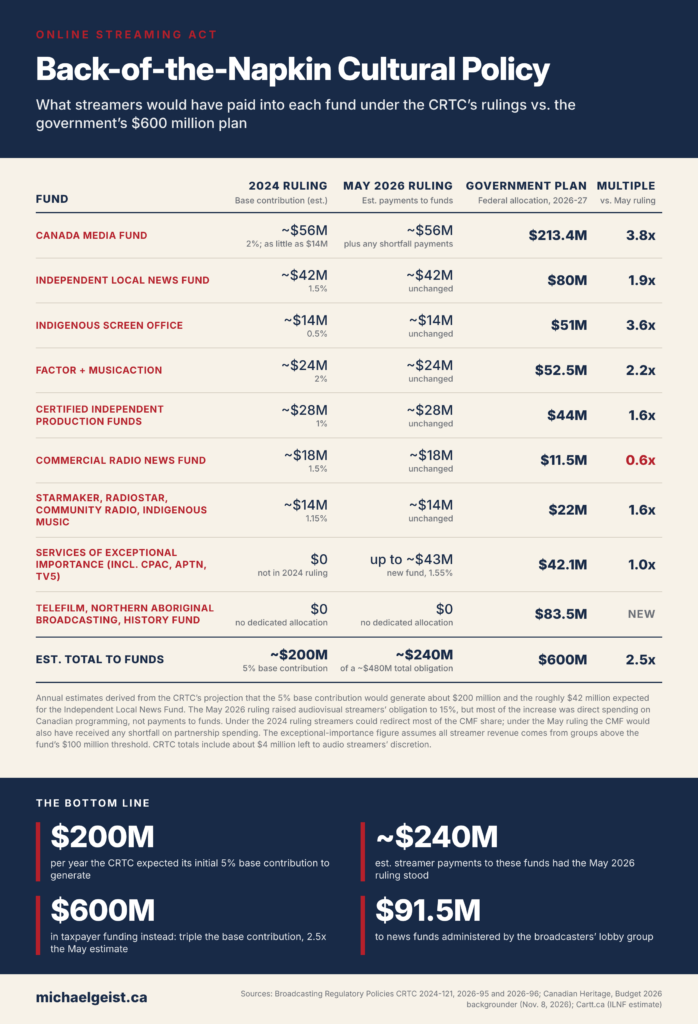
While the recipients are the same, the allocation amounts are far higher than under the CRTC’s initial base contribution. For example, the CMF was slated to get about $56 million from streamers (under the 2024 decision it could have been as little as $14 million, since the CRTC initially allowed streamers to redirect most of it to their own Canadian programming) but it now gets $213.4 million. The Indigenous Screen Office gets $51 million vs. an estimated $14 million, and FACTOR and Musicaction $52.5 million against an estimated $24 million. Only the commercial radio news fund receives less than its estimated streamer share. Another $42.1 million goes to services such as CPAC, APTN and TV5, described as a bridge toward the fund the Commission created in May, and the remaining $83.5 million goes to Telefilm Canada, Northern Aboriginal Broadcasting and the Canada History Fund, none of which had a dedicated allocation in the contribution framework.
The base contribution was always an initial step, but the Commission’s May decision that sparked the government’s reversal would have had limited impact on how much these funds received. It would have increased audiovisual streamers’ obligation to 15% of Canadian revenues, but most of the additional 10% would have gone to Canadian programming rather than into funds. Had that decision remained in place, I estimate the streamers’ total obligation at roughly $480 million a year, of which roughly $240 million would have been directed to funds: the $200 million base contribution, including a now-mandatory $56 million for the CMF, plus up to $43 million for the new services of exceptional importance fund. The CMF could have received more, since any shortfall on the decision’s partnership spending requirement was to be paid to it, but the allocations to the other funds were unchanged.
Back of the napkin cultural policy
How did this happen? The government chose $600 million as it scrambled to soften the blow of its quick decision to cancel the CRTC ruling. But the initial $600 million appears to have been pulled out of thin air, most likely by tripling the CRTC’s estimate that its base contribution would generate $200 million per year, much like the 5% streamer contribution was tripled to 15%, even though the higher rate applied only to audiovisual services. The net effect is that the public contribution exceeds even the streamers’ full obligation under the May decision, and now appears to exceed what both the regulated industry (broadcasters and broadcast distributors, whose contributions Howard Law estimates at a little over $200 million a year) and the streamers would have contributed to these funds combined. Indeed, the government’s backgrounder acknowledges that the money goes beyond replacing the streamers, describing the CMF allocation as also offsetting declining cable and satellite contributions.
The increased news funding, coming immediately after Budget 2026 and its allocations to the news sector, stands out. The Independent Local News Fund receives $80 million and the Commercial Radio News Fund $11.5 million, both delivered through the Canadian Association of Broadcasters. The streamers’ 1.5% contribution to the ILNF was worth about $42 million a year, and the Motion Picture Association-Canada challenged it at the Federal Court of Appeal, arguing that its members have no connection to news production. The government shrugged and cut a cheque for nearly double the annual amount. The main beneficiary will be Corus, whose 15 Global stations the CRTC added to the fund last year subject to a 45% cap, which could mean as much as $36 million for a single company’s newsrooms if the same cap applies to the new money.
None of this is new money beyond what I described on Friday, since the $600 million was already counted in the roughly $1.5 billion in culture and news spending in Budget 2026, alongside a journalism labour tax credit extension worth tens of millions a year to Bell, Rogers, Corus and Quebecor. But the government’s backgrounder reveals that money promoted as support for Canadian culture includes more than $90 million for news funds administered by the broadcasters’ own lobby group. I noted in June that the government could not keep its story straight on whether it would fund news at all. Months later, the government has more money for news than even the CRTC envisioned.
All of this is happening while the promised policy direction meant to reset the regulatory framework remains unpublished. The Department of Justice told the Federal Court of Appeal in July that the proposed direction would be published in the Canada Gazette “in the coming weeks.” Nearly four months later, it is nowhere to be found, Budget 2026 still refers to it in the future tense, and Culture Minister Marc Miller grows prickly when asked about it.
There is something to be said for funding cultural policy from general revenues rather than cross-industry subsidies. But the government’s improv policy approach has ultimately committed taxpayers to hundreds of millions of dollars, created a windfall for broadcasters and news groups, and mirrored the same allocation approach found in the decisions the government rejected. The minister’s office now says the funding will be annual, though the amount could change once the CRTC finalizes new rules. After starting at an inflated $600 million, the sector will be back demanding public support at a rate far beyond what the CRTC’s levy was ever expected to raise for those groups.
Related posts:
 Improv Policy: The Government Doesn’t Know What To Do About Its Online Streaming Act Mess
 The Law Bytes Podcast, Episode 274: Mark Musselman on What Stakeholders Really Think About the Government’s Reversal of the CRTC Online Streaming Act Decision
 Starting Over: Court Filing Confirms the CRTC’s Streamer Contribution Decisions Are Dead With a Full Online Streaming Act Reset to Come
 From Making Web Giants Pay to Making Taxpayers Pay: Government Announces Plan to Kill the CRTC’s Online Streaming Ruling