
The Senate national security committee concluded its clause-by-clause review of Bill C-22 yesterday, sending it back to the full Senate with 11 amendments, but leaving most privacy and security concerns unchanged. The good news is the committee added a much-needed “necessary and proportionate” requirement (over the objections of the bill’s sponsor and law enforcement witnesses) and it tightened the definition of systemic vulnerability. But the committee also doubled down on mandatory metadata retention, defeating an amendment to limit retention to data providers already collect, refusing on a 6-6 tie vote to reopen the issue, and leaving even a proposed observation on the issue out of its report.
As I wrote yesterday, Public Safety officials told senators on Tuesday that limiting retention to metadata providers already collect “would undermine one of the key goals of the legislation,” citing cell tower signalling as an example of the data they want kept. Senator Colin Deacon opened Wednesday’s meeting by asking to revisit his amendment, noting that colleagues had told him they “did not fully understand” his arguments because of a rushed process the night before. Six senators voted to reopen the debate, including committee chair Senator Marty Deacon and Senator Rebecca Patterson, both of whom had voted against the amendment on Tuesday, but the motion failed on a 6-6 tie. The government’s commitment to broad metadata collection became even clearer during the hearing, as RCMP Assistant Commissioner Richard Burchill told senators that for any electronic service provider “100% there is metadata going through your systems” and that a provider saying collection does not fit its business model “becomes problematic with what we’re trying to accomplish with the bill.” Put differently, providers would be left to either collect and retain the data or exit the country.
During discussion on the observation text that accompanies the committee’s report, another effort to include metadata was opposed, with Senator Pierre Dalphond responding that “the whole purpose of this legislation is to provide for the retention of data,” while Senator Baltej Dhillon, the bill’s sponsor, objected that it presented only one side of the testimony and described retention as “the essential part of this bill.” Note that metadata retention wasn’t even included in Bill C-2, the government’s first lawful access bill, yet it is now described as essential and the bill’s whole purpose.
Senators voted on 19 amendments over two days, approving 11. Six successful amendments came from Dhillon, who repeatedly conveyed the government’s position to the committee, and two more were technical fixes to forms the government accepted. In other words, the government supported eight of the 11. That left only three amendments that passed over the sponsor’s objection, all on the first day: the necessary and proportionate requirement (10-2), the revised systemic vulnerability definition (8-5), and a new annual report on the use of subscriber information orders (7-6). By the second day, each of the sponsor’s amendments passed on a voice vote, and every other amendment was defeated.
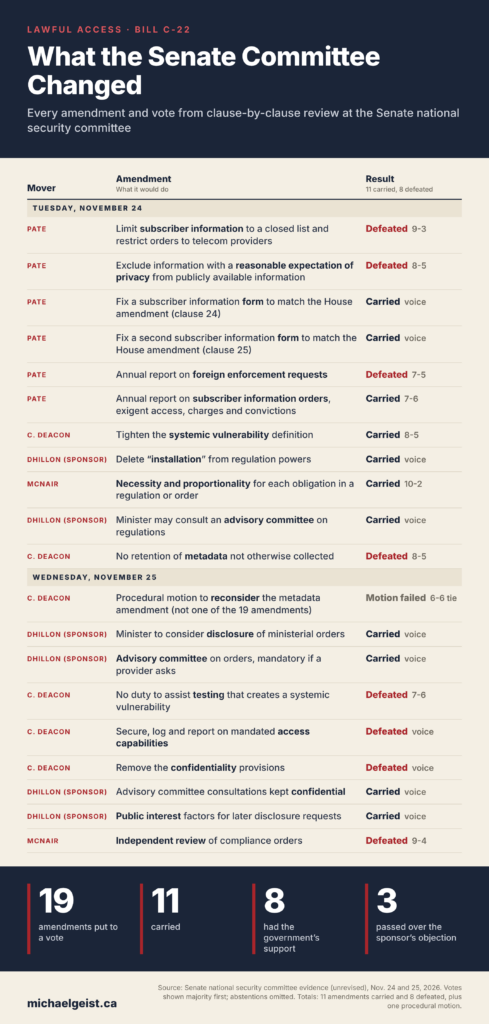
The amended definition of systemic vulnerability drops the requirement that a risk be based on recognized international technical standards and now covers data alteration, but it retains the exclusion for risks that relate only to people subject to a warrant, leaving room to order providers to build access capabilities into their systems. Officials did not hide their view of even that change, as Public Safety’s Shannon Hiegel warned that it would “allow for any form of encryption to be a reason that we couldn’t get access to information.” On Wednesday, the committee voted 7-6 against an amendment that would have exempted providers from assisting with testing that introduces a systemic vulnerability, and also rejected a requirement that providers secure and log the use of mandated access capabilities. Officials initially argued the testing provision applied only to core providers or those already subject to a ministerial order, but when Senator Paula Simons asked where the bill says that, Public Safety’s Richard Bilodeau admitted that any electronic service provider with a lawful access capability could be scoped in.
Instead, the committee adopted the sponsor’s proposal for an advisory committee that the Minister must consult before issuing a ministerial order (if a provider asks), with the findings sent to the Intelligence Commissioner, who must approve the order. But while that gives providers a way to put technical objections on the record, the system inspires limited confidence given that the Minister chooses the committee’s members, its advice is not binding, and its work remains confidential. A proposal for independent assessments of compliance orders by a technical expert and a retired judge was rejected, as was an attempt to remove the secrecy provisions that apply to ministerial orders.
The most significant development was adding the necessary and proportionate requirement. It passed 10-2 with only the sponsor and the Legislative Deputy to the Government Representative opposed. The amendment requires the Cabinet and the Minister to be satisfied that every obligation imposed by regulation or ministerial order is necessary and proportionate. While Australian officials told senators that the equivalent test in their law is a positive safeguard, Canadian officials warned that it “gives the Federal Court a foothold,” and it is unclear whether the government will ultimately approve or reject the change.
As for the Criminal Code provisions in Part 1, they emerged virtually unchanged. Senator Kim Pate’s amendment to implement the Privacy Commissioner’s recommendation to restrict the new subscriber information production order to telecommunications providers was defeated 9-3, with Dhillon confirming the breadth of the power by noting that police seek subscriber information from “daycare centres, schools and health service providers.”
The full Senate must now consider the committee’s report, with senators still able to amend the bill at third reading. Assuming the committee’s amendments are approved (the government-backed ones will surely pass), the revised bill will return to the House of Commons.
Related posts:
 No Compromise: Senate Heads to Clause-by-Clause on Bill C-22 After Police Reject a Necessary and Proportionate Standard
 The Lawful Access Privacy Risks: Unpacking Bill C-22’s Expansive Metadata Retention Requirements
 Three Fixes for Lawful Access: Making the Case for Amending Bill C-22 at the Senate National Security Committee
 More Surveillance Demands to Come?: Government Admits Bill C-22’s Lawful Access Provisions Could Be Expanded