The government’s plan to address online safety was introduced yesterday with Bill C-34, the Safe Social Media Act, featuring an under-16 social media ban, pornography age verification, AI chatbot rules, and platform regulation that I argued amount to an everything-all-at-once approach built on a “trust us” bet. My initial guide to the bill highlighted many key issues, but this follow-up examines just how much has been left for later. In many respects, Bill C-34 is best understood as version 1.0 of the Safe Social Media Act with a framework that establishes institutions, sets penalty ceilings, and fixes the age of 16 in the statute. But the bill leaves nearly everything that will determine how the law actually works, including which services are covered, when the ban applies and to whom, what counts as adequate age verification, and what design features platforms must build, to what amounts to a version 2.0 that will be developed later through multiple regulatory processes.
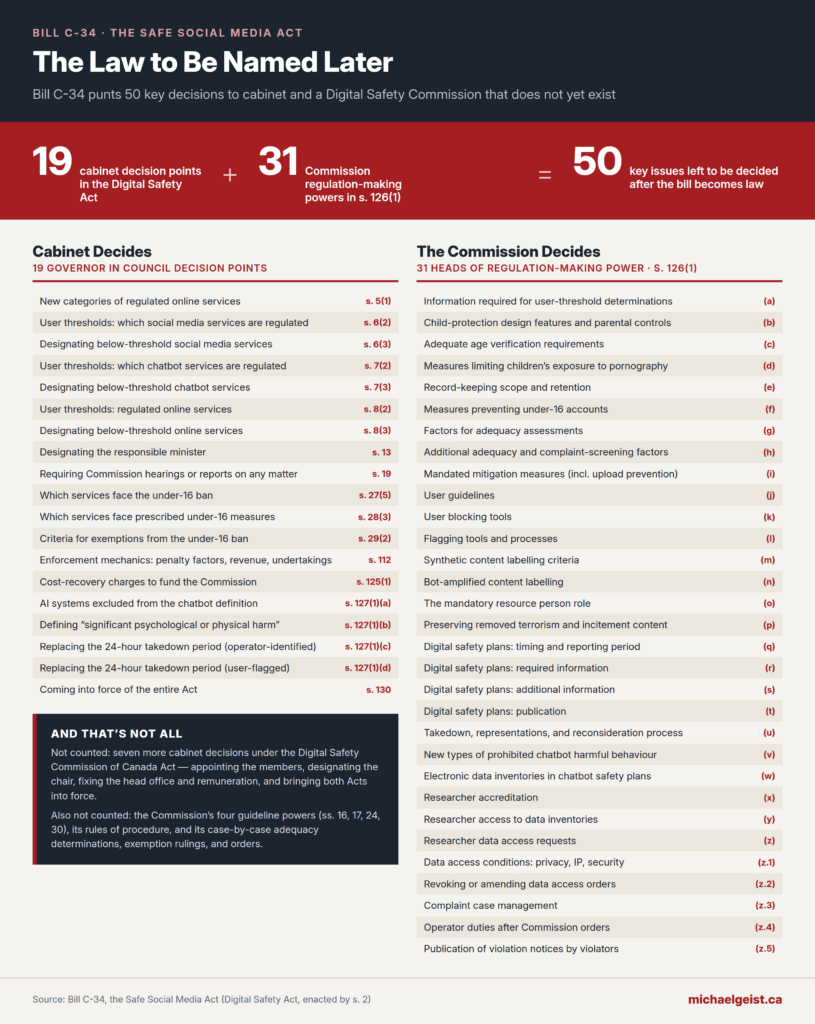
The actual count is remarkable: the Digital Safety Act contains 19 distinct decision points reserved for the Governor in Council and a further 31 separate heads of regulation-making power are handed to the new Digital Safety Commission under Section 126(1) alone. That is 50 key issues to be decided after the bill becomes law and that does not include the Commission’s guideline powers, procedural rules, case-by-case adequacy determinations and exemption rulings, or the seven additional cabinet decisions under the Digital Safety Commission of Canada Act, starting with the appointments needed to bring the Commission into existence. In other words, much of how the law will function is left to the DSC that does not yet exist, has no members, no chair, no staff, and even no funding model, since the cost-recovery charges that will finance it are also left to future cabinet regulation.
A closer look at what remains uncertain reveals that even the most basic questions are left unanswered by the bill. For example, in a bill titled the Safe Social Media Act, to what social media services does the law apply? The answer for the moment is none. A social media service only becomes a “regulated social media service” once it meets a user threshold that does not exist in the bill, since Section 6(2) leaves the types of services, the user numbers for each type, and even the methodology for counting users to Governor in Council regulations. The same structure applies to chatbot services under Section 7 and to the open-ended third category of “regulated online services” under Section 8, a category that itself only comes into being if cabinet creates it by regulation under Section 5, and only then following a Commission analysis conducted at the Minister’s direction. In other words, the full scope of the legislation runs through a chain of decisions in which Parliament plays no direct role.
The under-16 social media ban is contingent on multiple future decisions. Even after cabinet makes the threshold regulations that determine which services are regulated at all, Section 27(4) provides that the age verification obligation:
applies only in respect of regulated social media services — or regulated social media services that fall within classes of regulated social media services — specified in regulations made under subsection (5).
The bill contains no criteria to guide which services cabinet will specify. Once a service is specified, the question of what counts as “adequate” age verification or age estimation falls to the Commission, which must be satisfied that the measures are effective and privacy-protective, applying additional requirements the Commission itself will set by regulation under Section 126(1)(c). A service seeking to escape the ban can apply for an exemption, but the criteria the Commission must consider are left to yet another set of cabinet regulations under Section 29(2), supplemented by Commission guidelines under Section 30. Four layers of future rule-making before there is any certainty on how the social media ban will be applied and how services might qualify for an exemption.
The AI chatbot regulatory regime is similar, with the added twist that its scope can move in both directions. Cabinet can shrink the definition of a chatbot service by regulation, since Section 2(7) excludes any artificial intelligence system “that exclusively serves a purpose specified in the regulations,” while the Commission can expand the list of prohibited harmful behaviours by adding “any other type of behaviour specified in the regulations” under Section 53(e). Whether a given AI system is inside or outside the regime, and what duties it faces once inside, are both moving targets.
Even the provisions that appear fixed turn out to be flexible. The 24-hour takedown requirement for content that sexually victimizes a child or intimate content communicated without consent is a default that the cabinet can replace with “a period of a different length” by regulation under Sections 127(1)(c) and (d). One of the bill’s most important speech safeguards, the Section 12(1) assurance that nothing in the Act requires operators to proactively search content, comes with an exception that the Commission itself controls: Section 12(2) provides that Commission regulations “may require the operator of a regulated service to use technological means to prevent content that sexually victimizes a child or revictimizes a survivor from being uploaded to the service.” And the definition of “significant psychological or physical harm,” which determines the scope of mandatory transparency disclosures, is contingent on a cabinet regulation under Section 127(1)(b). On top of all of this, both statutes come into force only on days fixed by order in council, which means the government controls not just the content of the rules but when the entire system takes effect after it is enacted.
This degree of delegation guarantees that implementation will take years. The sequence of required events is staggering: cabinet must designate a minister, appoint three to five Commission members, designate a chair, and establish a head office before the Commission can function, with a transitional provision in the Digital Safety Commission of Canada Act confirming that until at least two other members are in office, the chairperson alone constitutes the Commission and may exercise all of its powers under both Acts. The Commission must then hire staff, set procedural rules, and begin the regulatory work. But it doesn’t end there since every Commission regulation must be pre-published in the Canada Gazette with an opportunity for the public to comment. The most sensitive issues require mandatory consultation requirements with either the Privacy Commissioner of Canada or the RCMP: the Commission cannot issue its law enforcement notification guidelines or any age verification guidelines, nor make regulations on child-protection design features, age verification requirements, anti-pornography measures, or the under-16 account restrictions, without first consulting the Privacy Commissioner of Canada and considering the Commissioner’s recommendations, and it must also consult the RCMP before issuing the notification guidelines.
For a government that promised swift action to protect kids online, the uncomfortable reality of Bill C-34 is that it has enacted the promise and deferred the law, and the version that ultimately governs Canadians’ online lives will take years to be implemented with many of the rules written by a Commission that at the moment does not even exist.
Related posts:
 Everything All At Once: Bill C-34 Combines Platform Duties, a Kids’ Social Media Ban, AI Chatbot Regulation, and a Powerful Digital Safety Commission Into a Risky “Trust Us” Bet
 Yet Another Trade Battle Brewing: Why a Kids’ Social Media Ban Could Put Canada on a Collision Course With the U.S.
 Everything You Wanted to Know About a Kids’ Social Media Ban (But Were Rightly Afraid to Ask): A FAQ on Age Verification and Mandated ID for Everyone
 You Can’t Put the Toothpaste Back in the Tube: Why the Government’s Reported “Temporary” Plan for a Kids’ Social Media Ban Would Mean Mandated ID for Everyone







It’s like they met in a bubble, disregard science data, experts, tech, children voices (they too have rights), parents, charters, studies that show vast majority having no real problem with social medias (overusage at most), listed only to the extreme and emotionally charged cases. Then said to themselves we must do something and fall in line.
A small question that this nightmare doesn’t ask: due to these ban, where can young people go to speak/express/exchange/trends/etc with their peers or who ever they decide? Peers that can be located world wide not just in their close social bubble.
Why go with this nightmare of 100 pages, regulators,boards, tsar of what goes and doesnt, brand/tag/id for all, rights violations, inevitable personal and private data leaks, profiling, villified type of contents, id gate/age verification (btw, there’s already parental controls out there), and more. No, lets just add another brick to the surveillance state, ’cause “think of the children”. Some countries out there will be proud of us, we use different excuses but the end result is the same.
Was/is it too hard to respect parents intelligence and give them more/better tools, education, self determination and dignity?
Here’s what I expect the government/regulator to layout before regulating anything:
1 What will be regulated
2 The harms that are caused by the item to be regulated.
3 The frequency of harm
4 The research supporting the claim that the indicated harms are caused by the item to be regulated.
5 Details on how the harms will be monitored
6 The proposed solution
7 The possible harms the proposed solution will cause (ie identity theft)
8 The costs of the solution and who will pay them
9 How the solution will be monitored for effectiveness
10 The effectiveness of the solution in other countries, including how easy it is to circumvent
If they can’t provide this information then they shouldn’t regulate it.
Pingback: Canada Wants to Ban Kids from Social Media. But the Fine Print Affects Everyone | iPhone in Canada
What is really going on here is they are forcing adults to sign into their social media and pretty much everything else online, using their government issued id. Meaning net anonymity is gone. You will need your driver’s license to sign in to almost everywhere. This is nothing to do with protecting children this is more to do with controlling the lives of all adults. Banning social Media for children under 16 means regulating social media for everyone older. If you think that will make the internet safer than you are diluting yourself.
yeah, and if you’re not a “normie” for which the internet is limited to 9 sites (google, youtube, facebook, instagram, chatgpt, reddit, wikipedia, x and whatsapp), but I do use/visit freely 100s of sites (adult with and without sexual content , social media, medical, encyclopedia, astronomy, physics, history, etc) I now have to create 100s of accounts, each with their email and each with their verification process? wtf.
We can’t look at these Bills in isolation of each other. They are desited to work together to reduce our privacy rights. Coupled with Bill C-22 and “metadata” retention laws… this is a recipe for the complete deletion of free speech. Even this “chat” we are having could be considered “social media”.
Pingback: Law to be named later: Bill C-34 punts 50 key decisions to cabinet and a Digital Safety Commission that does not yet exist | TCE News
I have learned in Bill C-34 that short steps help you stay safe, especially when obstacles appear close together.
“The bureaucracy is expanding to meet the needs of the expanding bureaucracy…”. -Oscar Wilde
“Canada is ill governed and over governed…” -Rene Levesque
Pingback: Starmer moves towards Digital ID controls with youth social media ban – Melanie Bennet | Journalist
All these bills in Canada are designed to seem disparate, but are part of an international implementation of the collective West’s goal of information control. State sponsored narratives on wars including their (NATO’s) war on Russia in Ukraine. They want the good old days of TV News back, where the message is controlled and dissenting voices are silenced as hate speech and people get arrested for telling uncomfortable truths.