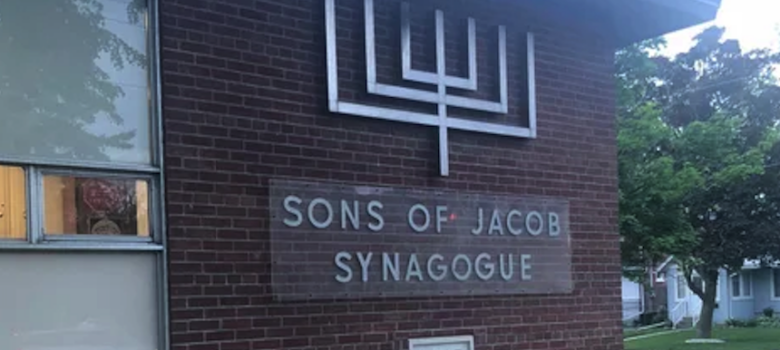
I came out of Yom Kippur services on Monday evening to the news of a terror attack on Sunday night at the Sons of Jacob synagogue in Belleville, Ontario. Reports indicate that the shooter drove up in a truck and fired on a police officer stationed outside the synagogue, leading to several minutes of gunfire. The officer was shot and is now in hospital. By sheer luck, the congregation was ten minutes late starting their service, meaning that the gunfire that left roughly 20 holes in the sanctuary window missed its intended target.
The good fortune that a massacre was averted does not lessen the impact of gunfire targeting a synagogue packed with congregants on the holiest day of the year. Shootings and firebombings at Canadian synagogues have become commonplace over the past three years. When I said in March that many in the community had come to view a Bondi Beach-style attack in Canada as a question of not if, but when, the comment garnered surprise, yet six months later it nearly happened, with a police officer averting a disastrous loss of life.
The officer was there because Jewish life in Canada now requires it. My experience at synagogue over Rosh Hashanah and Yom Kippur included bag checks, ticket checks at the door, and police outside guarding the entrance and grounds. Indeed, the High Holiday ticket that was once a fundraising device is now seemingly a security screening device.
Last week, I spoke at an exceptional conference on antisemitism, where the frustration with Canadian leadership was palpable. I wrote in March 2024 that tweets are not enough, and two and a half years later the Canadian version of thoughts and prayers remains the standard response to violence against Jews. In fact, some seem almost completely indifferent to community fears. As Yom Kippur began on Sunday evening, NDP leader Avi Lewis posted that he was reflecting on the fact that “we failed to do our part to stop an ongoing genocide committed in our name,” casting the holiest day of the Jewish year as an occasion for Jews to take collective responsibility for Gaza. It was a shameful message on any day, and it reflects a party whose hostility toward the majority of the Canadian Jewish community seemingly has no limits.
Prime Minister Mark Carney delivered the usual response, stating that Jewish people must be able to worship safely and promising support for law enforcement. But actions speak louder than words. Months after Carney effectively replaced the national antisemitism envoy with a Ministerial Advisory Council tasked with reassessing the drivers of antisemitism and developing a whole-of-government response, it hasn’t produced a thing and is hard to take seriously as a response to a national antisemitism crisis.
The lack of urgency reflects a broader reluctance to call this what it is. Much of Monday’s coverage placed the shooting “near” a synagogue or half a block from one, and the Prime Minister wrote of a shooting that “took place outside” it, all while photos of the bullet holes in the sanctuary’s stained glass circulated online. When the spokesperson for Ontario’s Special Investigations Unit was asked whether this was a terrorist attack aimed at the Jewish community, she responded that common sense would say it probably was, which is more than most political leaders managed. I wrote last December that if leaders will not call out antisemitism without qualifiers, they cannot address it. This was a terror attack on Jews at prayer, and it should be investigated and described as one, with an absolute commitment to ensuring that the Canadian Jewish community, like any other, can gather without fear of violence.




On Yom Kippur, our Rabbi spoke first of the security measures in place to protect the congregation. That is what had become of Jews gathering together in Canada on the holiest day of the year.
My facebook feeds are filled with pro-Palestinian/anti-Israel/anti-zionist posts from ultra left wing politicians, influencers and self proclaimed experts, criticizing Israel for ‘killing babies’ while claiming that you can be anti-Israel without being anti-semitic Yet the comments following the posts are even more disturbing, often blaming zionists (aka Jews) around the world for supporting Israel.
How should we confront this resurgence of anti-semitism in the age of global social networks?
Is it realistic to expect our local governments to pass laws to protect our Jewish communities from people who internalize this trash and then act out their anger by protesting in the streets, harassing jewish students at school, and vandalizing jewish institutions and businesses?
The bigger problem is now we deal with a pro genocide community that cannot come to its senses.
How do we deal with genocide deniers in our midst?
And this is a good case of Bill C-9