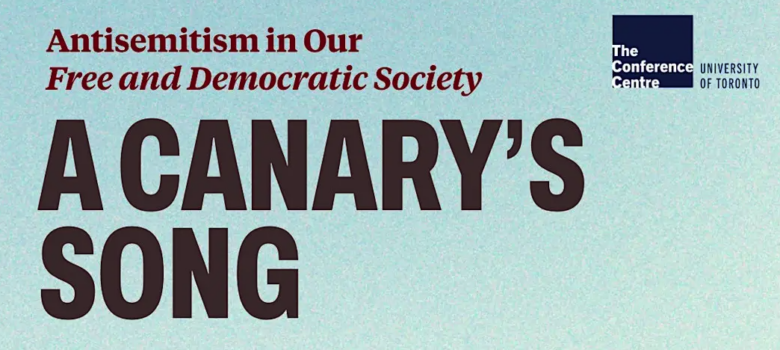
Peter Biro’s A Canary’s Song: Antisemitism in Our “Free and Democratic Society” conference was held earlier this week at the University of Toronto Conference Centre as the University stepped up after Massey College demanded that it vet the conference Biro had proposed, organized, and committed to fund. Biro resigned his senior fellowship rather than accept the demands, which led to national media coverage and well-deserved criticism of the college. I was honoured to participate in the exceptional event alongside an incredible lineup of experts in a packed, sold-out room.
Biro organized the day around a single question, namely what the resurgence of antisemitism reveals about the health of our democracy. For me, the fireside discussion between Ambassadors Deborah Lipstadt and Deborah Lyons, the former U.S. and Canadian leads on antisemitism, was the highlight of the day, drawing on years of confronting the problem from inside government to explain why the current moment is different and why institutional responses have so often fallen short. Irwin Cotler’s closing address gave the day its moral and legal grounding, and panels on the intersection of antisemitism with law, institutions, and antizionism sparked a level of candour rare in Canadian public discussion. The full conference is available online and well worth the investment of time to watch in full.
I spoke on the panel addressing legal responses, alongside Mark Sandler on the criminal law and Alan Kessel on international law. My presentation drew on my recent Globe and Mail column, which focused on “awful but lawful” content that causes real harm yet remains protected expression. The platforms themselves say much of this content violates their own rules and then fail to enforce them, with CyberWell finding that nearly half of policy-violating antisemitic content stayed online after notification. I emphasized that rather than regulating lawful speech, Bill C-34 can hold platforms accountable to their published commitments, much as regulators have long treated privacy policies as enforceable promises. My presentation is embedded below.






This is another deceptive article from someone who clearly knows what he is doing.
Claiming that antigenocide = anti-israel = antisemitism is a way to chill criticism and pin the crimes of Israel onto all Jewish people, before telling them to now defend themselves because this criticism is a threat to them.
By definition, that act of collectively punishing Jewish people and making them responsible for the currently unfolding genocide is grossly antisemitic.
This shameful conference included some other active antisemites in the audience, as anyone will be able to see from watching the recording.
The author supports an event that triggers an existential fear within Jewish people while silencing everyone else.
This should make any thinking person recoil in disgust.
Anyone accusing Israel of genocide is simply ignorant of the definition of the word and is unable to do the most simple math calculations. Canada is full of gaslit fools.
See you and your kind are the problem. Genocide denial is very problematic.
The only ones denying the genocide are vile bigots.
We have a community of genocide deniers in our country.
What is to be done about it?
I partially agree. Israel appears to want simply to take Gaza by force and resettle it. Killing a lot of people is part of the plan, but not to kill all of them and it’s not Israel’s core objective. Genocide isn’t the right term. Ethnic cleansing is closer. How about…”macro-pogrom”?
The goal is maximum territory with minimum non Jewish people.
Ethnic cleansing or genocide; the perps are not too concerned about how they get there.
Stop making things up.
You either haven’t been paying attention at the collective punishment of the Jewish people by leftists or you are intentionally being dishonest.
Thank you for sharing this perspective. Holding platforms to their self-published rules strikes a delicate balance between protecting expression and mitigating online harm, though enforcement metrics will remain key.