Canada’s largest media companies came together recently to file a copyright infringement lawsuit against OpenAI, the owners of ChatGPT. I wrote about the suit, suggesting that the primary motivation behind the suit was likely the hope to kickstart settlement discussions with the hope of a licence. Robert Diab, a law professor at Thompson Rivers University, raised similar thoughts in his own piece on the lawsuit. Robert joins the Law Bytes podcast to discuss the case and its implications for copyright and AI in Canada.
Latest Posts

The Law Bytes Podcast, Episode 222: Robert Diab on Canadian Media’s Copyright Lawsuit Against OpenAI

Government Finally Splits the Online Harms Bill: Never Too Late To Do The Right Thing…Or Is It?
Justice Minister Arif Virani yesterday finally bowed to public pressure by agreeing to split Bill C-63, the Online Harms bill. The move brings to an end the ill-conceived attempt to wedge together Internet platform responsibility with Criminal Code provisions and the potential weaponization of the Canada Human Rights Act that had rightly sparked concerns from a wide range of groups. I wrote about the need to drop those provisions two days after the bill was introduced last February. By the time the fall had rolled around, it was hard to find anyone who supported the bill in its current form.
Canadian Media Companies Target OpenAI in Copyright Lawsuit But Weak Claims Suggest Settlement the Real Goal
Canada’s largest media companies, including the Globe and Mail, Toronto Star, Postmedia, CBC, and Canadian Press, came together last week to file a copyright infringement lawsuit against OpenAI, the owners of ChatGPT. The lawsuit is the first high profile Canadian claim lodged against the enormously popular AI service, though there have been similar suits filed elsewhere, notably including a New York Times lawsuit launched last year. While the lawsuit itself isn’t a huge surprise, the relatively weak, narrow scope of the claims discussed below are. Unlike comparable lawsuits, the Canadian media companies claim is largely limited to data scraping, which may be the weakest copyright claim. Moreover, the companies say they have no actual knowledge of when, where, or how their data was accessed, an acknowledgement that doesn’t inspire confidence when there is evidence available if you know where to look.
So why file this lawsuit? The claim is sprinkled with the most obvious reason: the Canadian media companies want a settlement that involves OpenAI paying licence fees for the inclusion of their content in its large language models and the lawsuit is designed to kickstart negotiations. The companies aren’t hiding the ball as there are repeated references along the lines of “at all times, Open AI was and is well aware of its obligations to obtain a valid licence to use the Works. It has already entered into licensing agreements with several content creators, including other news media organizations.” The takeaway is that Canadian media companies want to licence their stuff too, much like the licensing agreements with global media companies such as News Corp, Financial Times, Hearst, Axel Springer, Le Monde, and the Associated Press.
The Law Bytes Podcast, Episode 221: Inside My Canadian Heritage Committee Appearance on Freedom of Expression
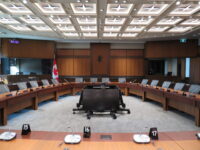
The Standing Committee on Canadian Heritage has for the past month been conducting a study on protecting freedom of expression. The counters of the study aren’t entirely clear. In fact, after I was invited to appear, I asked for some sense of what the committee was looking to address. There wasn’t much detail, which has really left it open for witnesses to cover whatever issues they like. I chose to focus my time on two issues: the expression implications of Canadian digital policy and the chilling effect of antisemitism. The two issues have really dominated my attention in recent months. Digital policy – including Bills C-11, C-18, C-63, and S-210 for years now and the antisemitism issues an enormous concern post October 7, 2023.
This week’s Law Bytes podcast takes the listener into the hearing room and the wide range of questions from Liberal, Conservative, and Bloc MPs my opening statement sparked.

When Antisemitism Isn’t Taboo: Reflecting on the Response to Nazi-Era Hate on the Streets of Montreal
Last week, as Concordia students staged a “strike” to protest the ongoing Israel-Hamas war in Gaza, video captured someone giving a Nazi salute to nearby Jewish students while repeatedly declaring the “final solution is coming your way.” Antisemitism has become far too common, but this incident, which had unmistakable Holocaust echoes, still had the capacity to shock. Soon after, the culprit was identified as Mia Abdulhadi, the co-owner of two Second Cup coffee cafe franchises improbably located in the Montreal Jewish General hospital.
The Concordia events later gave way to violent riots in Montreal, but this particular case has been hard to shake. Part of it stems from the affirmation of the campus antisemitism concerns that have been voiced for many months by Jewish students and faculty. Despite the denials, the reality is that the line between legitimate protest and the use of reprehensible antisemitic slurs was blurred long ago. University presidents have acknowledged as much, yet largely failed to respond. The net effect – as evidenced last week – is that the Jewish community has faced intolerable discrimination on campus and is too often left to fear for its own safety.

Recent Posts
 The Law Bytes Podcast, Episode 280: A Fall Update on Where Things Stand on Canadian Digital Policy Reforms
  The Wrong Ban: The Heritage Committee Backed a Targeted Ad Ban for Kids and Stopped Short of a Social Media Ban, Yet the Government Chose the Reverse
  Regulator First, Rules Later: Bill C-34 Debate Shows the Government Wants a Digital Safety Commission Before It Figures Out What It Will Do
  Making the Case Against Its Own Bill: What the Government’s Bill C-34 Charter Statement Reveals About the Constitutional Vulnerability of the Social Media Ban
  “Position Has Not Changed”: The Canadian Government Reaffirms That Antisemitism Includes Anti-Zionism
