
The Federal Court of Appeal delivered its long-awaited decision the York University v. Access Copyright case yesterday, setting aside the lower court ruling that I had described as “a complete victory” for Access Copyright. The latest ruling will not leave York University and the education community completely happy given the court’s fair dealing analysis, but winning on the mandatory tariff issue removes both the threat of mandated payments to Access Copyright as well as the possibility of a copyright infringement lawsuit by the copyright collective. That represents an enormous win both for York and for a fair approach to copyright licensing that ensures users have licensing choice.
Post Tagged with: "fair dealing"

Taking Value out of the Copyright Tariff Process: The Copyright Board’s Access Copyright Post-Secondary Tariff Decision
In March 2010, Access Copyright filed a tariff proposal with the Copyright Board to cover copying at post-secondary institutions in Canada. The proposed rate was $45 per year per university student and $35 per year per college student. The proposal represented a dramatic increase in the fees paid under the Access Copyright licence, which, when combined with Supreme Court of Canada jurisprudence on fair dealing in the 2004 CCH decision and the growing investment in digital materials, sparked concern among the Canadian education community. In 2012, the Supreme Court of Canada re-emphasized the broad and liberal approach to fair dealing as user’s right and the government would expand the fair dealing purposes to explicitly include education.
The Access Copyright tariff proposal progressed slowly before the Copyright Board, but on Friday, more than nine years after it was first filed, the Board issued its ruling. It established a retroactive tariff for the years from 2011-2014 of $24.80 per university student ($9.54 for college students) and $14.31 per university student ($5.50 for college students) for the years 2015 to 2017. Access Copyright welcomed the decision, arguing that it outlined a reasonable framework for copying in post-secondary institutions.
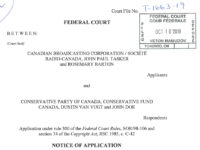
The CBC Lawsuit, Fair Dealing and Future Reform: The Unexpected Arrival of Copyright in Election 2019
As the 2019 federal election winds toward voting day next week, copyright has unexpectedly arrived on the scene. Cultural groups have lamented for weeks that none of the national political parties have discussed copyright, placed it in their platforms, or otherwise committed to reforms. The likely reason – neatly articulated by OpenMedia’s Laura Tribe in this week’s Lawbytes podcast – is that there are no sharp divisions between the parties on copyright that might provide an electoral advantage. Instead, the government conducted an extensive copyright review which led to the Industry Committee’s June 2019 report. That committee, which heard from hundreds of witnesses representing all perspectives, generated a report that received all-party support and provides a roadmap for future reforms (the notable exception being on crown copyright).

CBC vs. CPC: Why the CBC’s Attempt to Use Copyright to Stifle Expression Backfired Badly
The CBC’s copyright infringement lawsuit against the Conservative Party over the use of seven short video clips in a campaign ad and several Twitter postings sparked a torrent of criticism as even CBC supporters wondered what executives were thinking. My Globe and Mail op-ed notes that the public broadcaster claimed it was defending the independence of its journalists and journalism, yet the opposite predictably occurred, with many believing that the lawsuit itself demonstrated a political bias.

What Was the CBC Thinking?: A Closer Look at the Video Clips in its Copyright Lawsuit Against the Conservative Party
The CBC decision to sue the Conservative Party for copyright infringement over seven clips that were either used in a campaign ad or posted to Twitter has unsurprisingly garnered considerable attention. While the CBC claims that its lawsuit was designed to defend perceptions of independence of its journalists and journalism, the opposite has predictably occurred with many believing that the lawsuit itself (filed eleven days before the election after the content was removed) demonstrates bias against the Conservative party. Not only does the lawsuit fuel perceptions of bias, but it causes enormous damage to CBC journalists – Rosemary Barton and John Paul Tasker – who are both named as plaintiffs in the lawsuit. The CBC now says it will file an application to remove them from the suit, but it is hard to understand how anyone at the public broadcaster thought it was a good idea to have one of its lead news anchors and a parliamentary reporter sue a political party.

Recent Posts
 Is Compromise on Encryption Possible? Why Bill C-22’s “Minor Opening” Leaves the Central Question Unanswered
  The Wrong Target: Why the CBC Should Be Asking About the Yom Kippur Protesters, Not the Journalist Who Reported on Them
  Buried in Bill C-39: The Enabling Digital Trade Act Brings Canada Its First Federal Electronic Trade Documents Law
  A Definition That Meets the Moment: Federal Government Recognizes Antisemitism Includes Anti-Zionism
  Nobody Can Say They Weren’t Warned: Canada’s Threat Assessments Predicted the Belleville Yom Kippur Attack
