Faced with a bill that would leave political parties subject to weaker privacy rules than virtually any other major organization in Canada, the Senate voted yesterday to amend the bill by including a sunset clause on the privacy provisions that gives that the government three years to come up with something better. The change is designed to allow the new rules, which as the Senate heard repeatedly from experts and privacy commissioners are not real privacy rules at all, to apply immediately but expire in three years. This will have the effect of killing a B.C. privacy challenge that sparked the legislation in the first place. The bill heads back to the House of Commons, where the government can either accept the change and have the bill pass or reject the change and send it back again to the Senate. If it is sent back, the Senate is unlikely to oppose the privacy elements in the bill again.
The Senate debate ran for hours over two days this week. There were few Senators defending the actual privacy provisions. At best, some made weak claims that this was needed to provide a national standard – that being no real standard at all. When that failed to persuade, they turned to “institutional” arguments, focusing on the need for the appointed Senate to simply rubber stamp legislation passed by the elected House. Yet the votes that would follow would only involve at most 61 Senators. There are 105 Senate seats, of which seven are currently vacant. That means only 62% of sitting Senators voted. If there are institutional concerns, perhaps the Senators should start with how many of their colleagues don’t show up to vote on legislation.
The Senate debate yesterday was the discussion that the House refused to have as the political parties joined together to pretend that the privacy provisions did not exist at all. The privacy provisions were not subject to any study, the committee studying the bill refused to hear from witnesses on the privacy provisions, and the government reversed itself on whether there were any Charter implications with political privacy rules. Having taken the time to actually do the job of studying the legislation, the full Senate debate focused almost exclusively on the privacy provisions in the bill and most found themselves unable to defend the indefensible.
That left the question of what to do about it. Senator Clement proposed deleting the privacy rules altogether. That was defeated with 23 in favour, 42 against, and 5 abstentions. Up next, Senator Simons (who coined the “nobody wants this” term), proposed inserting the privacy provisions drawn from Bill C-65, which was a previous government plan that died on the order paper. That bill contained more extensive privacy rules than those found in the Bill C-4. But that too was defeated, with 19 in favour, 39 against, and 3 abstentions.
Senator Dalphond then proposed the sunset provision amendment, stating:
The principle is simple. The current situation is untenable for political parties. We understand that and we accept it. The provisions will come into force shortly, upon Royal Assent, but if you do nothing, then in three years’ time, you’ll end up back in the same position that you now find untenable. You therefore have three years to find a solution to improve the system for protecting Canadians’ rights.
That is what I am proposing. The sunset provision will achieve, upon Royal Assent, the results expected by the government, the House of Commons and the political parties: the exclusion of provincial privacy laws, the likely end to the proceedings in B.C. and the barring of the introduction of similar proceedings in other provinces, so they get the shield they are looking for.
However, during the proposed three-year period, the government, after consultation with the political parties, would have to propose provisions on privacy rights resulting in a more robust privacy regime. The initiative would thus remain with the other place, the political parties and the government.
This would mirror the comments of the bill’s sponsor, Senator Cuzner — I’m getting his attention — in this chamber and before the Committee on Legal and Constitutional Affairs, when he said, “Part 4 does not preclude further legislation specifying more comprehensive privacy standards for federal political parties.”
Failing a new bill within the next few years, Part 4 would cease to have effect. These provisions would then be repealed, and the current provisions of the Canada Elections Act would come into force again. In other words, there would be a strong incentive for the political parties — the House of Commons and the government — to address this issue should we improve that system, that national regime that we’re setting in place? If so, how should we improve it in order to make it a true national regime, not only for the political parties, but also a regime that is better at protecting at least the minimum rights of Canadians in terms of privacy, adjusted to the context of federal political parties?
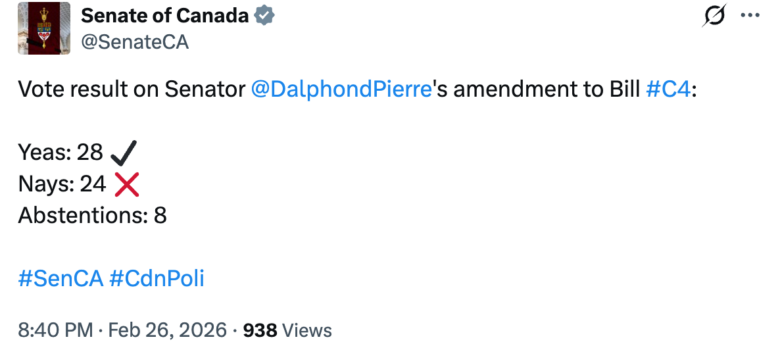
Senator Dalphond’s amendment proceeded to pass: 28 in favour, 24 against, and 9 abstentions.
With the Senate having passed the amended version of Bill C-4, it now returns to the House. If the government rejects the sunset clause amendment, it will provide ample evidence that it has no intent of actually developing serious privacy rules for political parties. And that will tell Canadians all they need to know about how the government and opposition parties view privacy: given a choice between political benefit and Canadians’ privacy, the parties take self-interest every time.
Related posts:
 How the Liberal and Conservative Parties Have Quietly Colluded to Undermine the Privacy Rights of Canadians
 Time for the Government to Fix Its Political Party Privacy Blunder: Kill Bill C-4’s Disastrous Privacy Rules
 Government Reverses on Privacy and the Charter: Department of Justice Analysis Concludes Political Party Privacy Bill Raises No Charter of Rights Effects
 The Law Bytes Podcast, Episode 247: My Senate Appearance on the Bill That Could Lead to Canada-Wide Blocking of X, Reddit and ChatGPT







How can we improve it to establish a genuine national framework that not only serves political parties but also effectively protects Canadians’ basic privacy rights in the context of federal political parties?
Pingback: Canada’s three main federal political parties are working together to fight voter privacy rights