













Second reading debate on Bill C-34, the Safe Social Media Act, began yesterday in the House of Commons, with the government pressing opposition MPs on whether they support creating the Digital Safety Commission, its proposed Internet regulator. While there was some broad acknowledgement that someone needs to administer the regulatory plan, it was striking to see the government focus on the regulator rather than the regulation. Liberal MP Kevin Lamoureux asked Conservative critic Rachael Thomas whether “in principle, the Conservative Party recognizes the value of having such a commission” and later asked Bloc critic Martin Champoux whether his party sees “the principle of having that commission as a positive thing.” When Culture Minister Marc Miller was asked what standards a platform would need to meet for an exemption to the under-16 social media ban, he responded that the way to protect kids is “to make sure we have a regulator in place that can put together precisely these guidelines.” That is a bug, not a feature of a bill that, as I wrote when the bill was tabled, punts roughly 50 key decisions to cabinet and a commission that does not yet exist. The initial debate confirms that the government plans to build the regulator first and work out the details later.
Latest Posts

Making the Case Against Its Own Bill: What the Government’s Bill C-34 Charter Statement Reveals About the Constitutional Vulnerability of the Social Media Ban
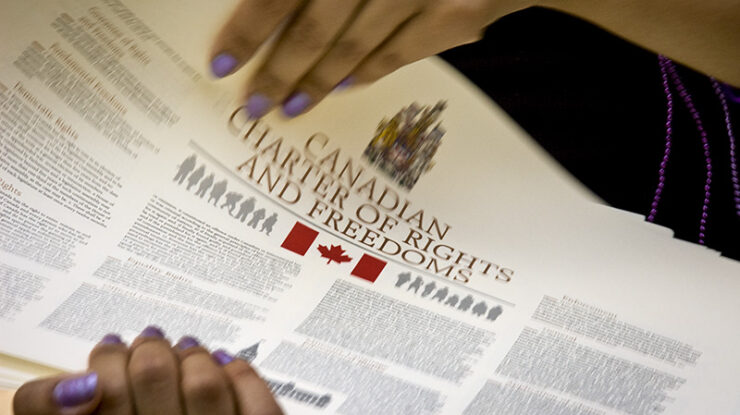
More than four months after Bill C-34 was introduced (and about ten days after I posted about it), the government released its Charter statement for the Safe Social Media Act. While there was no doubt the government would insist its bill is Charter-compliant, the question was how it would defend the under-16 social media ban, which I have argued is unconstitutional and whose French counterpart the Constitutional Council struck down in August. On that front, the statement is noticeably weak, citing no evidence, case law, or foreign comparisons. In fact, by identifying less restrictive alternatives to the ban, it effectively concedes that less intrusive safeguards can adequately address the risks the ban is meant to target. In other words, this Charter statement makes the case against the government’s own bill.

“Position Has Not Changed”: The Canadian Government Reaffirms That Antisemitism Includes Anti-Zionism
Last month’s Public Safety progress report on the National Commitments to Combat Antisemitism notably included statements recognizing that antisemitism includes anti-Zionism. The National Council of Canadian Muslims wrote to the department to object and is now circulating a reply from Minister Gary Anandasangaree that former Special Representative on Combatting Islamophobia Amira Elghawaby touted as showing that the “Government of Canada Clarifies Anti-Zionism is not Anti-Semitism.” The reality, however, is that the response did no such thing: it does not retract or amend the report, states twice that the government’s position has not changed, and links anti-Zionism to the denial of Jewish self-determination.

The Law Bytes Podcast, Episode 279: My Keynote on Digital Sovereignty: Control, Choice, and Connection
The Law Bytes podcast returns after a brief hiatus in late summer and early fall by turning to the debate on data and digital sovereignty. Last week, I was pleased to deliver the dinner keynote speech at the NREN Assembly, an annual gathering hosted by CANARIE that brings together staff and leadership from CANARIE and all thirteen provincial and territorial partners of Canada’s National Research and Education Network. With their kind permission, this week’s episode features the keynote in full, titled Digital Sovereignty: Control, Choice, and Connection.

The What, Me Worry? Consultation: Media Quietly Tells Government It Wants Even More Funding With Little Concern for Independence Risks
The government’s ever-increasing financial support for the news media was the subject of a non-public consultation earlier this year, with Canadian Heritage asking funding recipients what they think of the programs, what more needs to be done, and whether they have concerns about the risks to the independence of the press that can come with greater reliance on public funding. If you ask groups whether they want more money, they invariably say yes, so it may not surprise to learn the industry supports expanding the media funding programs and sees little reason to worry about independence concerns. The consultation, which focused on the Local Journalism Initiative (LJI) and Canada Periodical Fund (CPF), was not posted on the department’s public consultations page. Instead, the department circulated it to departmental contacts and stakeholders that “included current CPF clients and LJI delivery organizations,” and encouraged them to share it within their networks. Because I was included on that list and provided my thoughts, I received the summary of the results this week, which I have posted here, since the government has yet to make it publicly available.

Recent Posts
 Regulator First, Rules Later: Bill C-34 Debate Shows the Government Wants a Digital Safety Commission Before It Figures Out What It Will Do
  Making the Case Against Its Own Bill: What the Government’s Bill C-34 Charter Statement Reveals About the Constitutional Vulnerability of the Social Media Ban
  “Position Has Not Changed”: The Canadian Government Reaffirms That Antisemitism Includes Anti-Zionism
  The Law Bytes Podcast, Episode 279: My Keynote on Digital Sovereignty: Control, Choice, and Connection
  The What, Me Worry? Consultation: Media Quietly Tells Government It Wants Even More Funding With Little Concern for Independence Risks
