
News

Facebook by Franco Bouly (CC BY-ND 2.0) https://flic.kr/p/6rk2Qf

B.C. Court of Appeal Rules Facebook’s Fine Print Trumps Privacy Law

One week after the B.C. Court of Appeal ruled that it could order Google to remove websites from its global index, the same court (but different judges) ruled that a privacy class action lawsuit against Facebook could not proceed in the province because the Facebook terms and conditions provide that all disputes must be resolved in a court in Santa Clara, California. The decision should provide a wake-up call to users and policy makers because an absolute approach to terms and conditions not only means that Canadian courts may be unable resolve consumer disputes involving companies like Facebook, but that Canadian law will not apply either.

The current Facebook terms and conditions state:

You will resolve any claim, cause of action or dispute (claim) you have with us arising out of or relating to this Statement or Facebook exclusively in the U.S. District Court for the Northern District of California or a state court located in San Mateo County, and you agree to submit to the personal jurisdiction of such courts for the purpose of litigating all such claims. The laws of the State of California will govern this Statement, as well as any claim that might arise between you and us, without regard to conflict of law provisions.

While this appears to be slightly different from the terms that governed the dispute before the B.C. courts (it referenced courts in Santa Clara county), the key takeaway from the decision goes well beyond a proposed class action lawsuit over a Facebook “sponsored stories” program that no longer exists. The trial judge rightly noted that the heart of the case is whether online terms and conditions override domestic legal protections (in this case, the B.C. Privacy Act).

Read more ›

June 22, 2015 9 comments News
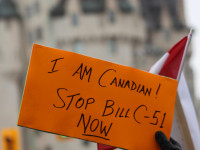
Stop Bill C-51 #IAmCanadian by Mike Gifford (CC BY-NC 2.0) https://flic.kr/p/riAaQD

Why the Liberal Party Defence of Its Support for Bill C-51 Falls Flat

Bill C-51, the anti-terrorism bill, became law yesterday as it received royal assent. As polls continue to suggest that the Liberal support for the bill is shifting potential voters to the NDP, Liberal leader Justin Trudeau has conducted several interviews defending his position as the “right move for Canadians.” Trudeau’s arguments, which have been echoed by other Liberal MPs such as Marc Garneau, boils down to three key claims: he doesn’t want to play politics with security, there are elements in Bill C-51 he likes including greater information sharing, and he will fix the problems with the bill if elected.

For those Canadians looking for an alternative to the Conservative position on Bill C-51, Trudeau’s defence falls flat.

Read more ›

June 19, 2015 41 comments News
Spotify on iPad air & Bose qc15 by Julien Sabardu (CC BY-NC-ND 2.0) https://flic.kr/p/qY32kW

SOCAN Reports Canadian Internet Music Streaming Copyright Revenues Soar 525%

SOCAN, Canada’s largest music copyright collective, released its annual report this week, reporting record revenues and a massive increase in earnings from Internet streaming services. SOCAN reports that copyright revenues from Internet streaming hit $21.3 million, a 525% increase over the $3.4 million generated in 2013. The huge increase in Internet streaming revenues in Canada points to why persistent criticism about Tariff 8, a Copyright Board tariff for Internet streaming misses the mark. As I pointed out last year, Tariff 8 is only part of a larger ecosystem of royalties paid for Internet music streaming.

Indeed, the fact that songwriters, composers, and music publishers are successfully generating new revenues from Internet music services has actually been a target of criticism by the Canadian Recording Industry Association, which has intervened in tariff proceedings involving SOCAN to argue that its tariff proposals are “grossly excessive.”

Read more ›

June 18, 2015 3 comments News
FGR: This place sucks. Give me some real food. by Bloody Marty (CC BY-NC 2.0) https://flic.kr/p/53dzVJ

Suck on This: Canadian Government Rejects IP Lobby’s Concerns on Dot-Sucks Domain

As new top-level domains continue to enter the marketplace, one of the most controversial has been dot-sucks. The new top-level domain has generated criticism for its business model as much as for the websites that are likely to use it, with the intellectual property community describing the model behind dot-sucks as “illicit” and “predatory, exploitive, and coercive”. That recently led to a complaint to ICANN, which took the unusual step of writing to the U.S. and Canadian governments to determine whether the company behind dot-sucks was violating any national laws, claiming it “was very concerned about any possible illegality.”

The decision to include the Canadian government in the letter stems from the fact that dot-sucks is owned by a subsidiary of Momentous Corp., an Ottawa-based company. This week, the Canadian government responded to the ICANN letter, making it clear that it has absolutely no intention of intervening in the case. The key paragraph in the letter signed by Industry Canada Deputy Minister John Knobley:

Read more ›

June 17, 2015 4 comments News
Google by Carlos Luna (CC BY 2.0) https://flic.kr/p/5moCVF

B.C. Court of Appeal Upholds Global Deletion Order Against Google

The B.C. Court of Appeal has released its decision in Equustek Solutions Inc. v. Jack, a closely watched case involving a court order requiring Google to remove websites from its global index. As I noted in a post on the lower court decision, rather than ordering the company to remove certain links from the search results available through Google.ca, the order intentionally targets the entire database, requiring the company to ensure that no one, anywhere in the world, can see the search results. That post notes:

The implications are enormous since if a Canadian court has the power to limit access to information for the globe, presumably other courts would as well. While the court does not grapple with this possibility, what happens if a Russian court orders Google to remove gay and lesbian sites from its database? Or if Iran orders it remove Israeli sites from the database? The possibilities are endless since local rules of freedom of expression often differ from country to country.

The B.C. Court of Appeal decision addresses two key jurisdiction questions: first, whether the court can assert jurisdiction over Google; and second, whether the court order can extend beyond Canada.

Read more ›

June 12, 2015 26 comments News