
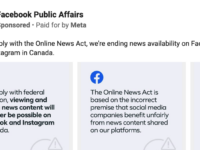
For months, supporters of Bill C-18, the Online News Act, assured the government that Meta and Google were bluffing when they warned that a bill based on mandated payments for links was unworkable and they would comply with it by removing links to news from their platforms. However, what has been readily apparent for months became reality yesterday: Meta is now actively blocking news links and sharing on its Facebook and Instagram platforms. The announcement does not reference Threads, but it would not surprise if news links are ultimately blocked on that platform as well. The company says that the blocking will take several weeks to fully roll out to all users, suggesting that it has learned from the over-blocking mistakes made in Australia and is proceeding more cautiously in Canada. By the end of the month, the world’s largest social media platform will become a news desert in Canada, with links to all news – both Canadian and foreign – blocked on the platform.
Post Tagged with: "meta"
What If It Isn’t a Bluff?!: The Consequences of the Government’s Epic Bill C-18 Miscalculation Begin to Set In
As Bill C-18 made its way through the legislative process, the government and the media lobby groups supporting the bill insisted that Google and Meta were bluffing when they warned that legislation premised on mandated payments for links could lead the companies to stop Canadian news linking or sharing on their platforms. Proponents would point to the Australian experience or claim that links to Canadian news were simply too valuable for the platforms to walk away. Compromise amendments were ignored in favour of tough talk about not backing down, the platforms were investigated for daring to test link blocking, and MPs and Senators acted as stenographers for media lobby groups by introducing amendments that now leave the government with even less flexibility in the regulatory process.
Over the past week, the reality appears to have begun to seep in.

Caving on Bill C-18: Government Outlines Planned Regulations that Signal Willingness to Cast Aside Core Principles of the Online News Act
Canadian Heritage Minister Pablo Rodriguez has insisted for months that Bill C-18, the Online News Act, is a market-based approach that would leave it to the Internet platforms and Canadian media outlets to negotiate deals based on the principle of mandated payments for links. Faced with the prospect of Meta and Google’s recent announcements that they would block news links in order to comply with the legislation, it would appear that the government has caved on the bill as it searches for a face-saving compromise. Rodriguez and Prime Minister Trudeau had tough talk last week, but behind the scenes they were seemingly ready to cast aside the core principles that they claimed were essential to the legislation.

Trudeau Likens Bill C-18 Battle To World War Two Fight for Democracy as Government Suspends Meta Advertising (But Not Liberal Party Ads)
The government moved to escalate the battle over Bill C-18 yesterday, announcing that it was suspending advertising on Meta’s Facebook and Instagram platforms due the company’s decision to comply with the bill by blocking news sharing and its reluctance to further negotiate the issue. While the ad ban applies to federal government advertising, Liberal party officials confirmed they plan to continue political advertising on the social networks, suggesting that principled opposition ends when there might be a political cost involved. At issue is roughly $11 million in annual advertising by the federal government, a sum that pales in comparison to the Parliamentary Budget Officer’s estimate of at least $100 million in payments in Canada for news links from Meta alone.

A Massive Own-Goal for the Government: Google to Stop News Links in Canada Due to Bill C-18
The worst case scenario for Canadian Heritage Minister Pablo Rodriguez, the Canadian news sector, and the Canadian public has come to pass: Google has announced that it will block news links in Canada in response to the mandated payment for links approach established in Bill C-18. The decision, which the company says will be implemented before the law takes effect, will cover search, Google News, and Google Discover. The decision – which government seemingly tried to avoid with last minute discussions with Google executives after it became apparent that the risks of exit were real – will have lasting and enormously damaging consequences for Canadians and represents a remarkable own-goal by Rodriguez who has managed to take millions away from the news sector and left everyone in a far worse position than if he had done nothing at all.

Recent Posts
 Still Not a Privacy Law: Bill C-25’s Political Party Privacy Provisions Fall Short Again
  Could Bill C-22 Make Canadians Less Safe? The Systemic Vulnerability Gap in Canada’s New Surveillance Law
  Why the Verdict on Social Media Defective Design Harming Children Gets the Instinct Right But the Law Wrong
  Scoping in the Tech Giants: Bill C-22’s International Production Order and the Shift to a Less Privacy-Protective Cross-Border Disclosure System
  The Law Bytes Podcast, Episode 263: The Lawful Access Act Roundtable With David Fraser and Robert Diab
