As MPs prepare for a new Parliamentary session next week, sources indicate that Liberal MP Dan McTeague is promoting a new IP and Anti-Counterfeiting Caucus. In a letter to MPs, McTeague points to the recent Committee reports on counterfeiting and argues that: From the findings of these reports and from […]
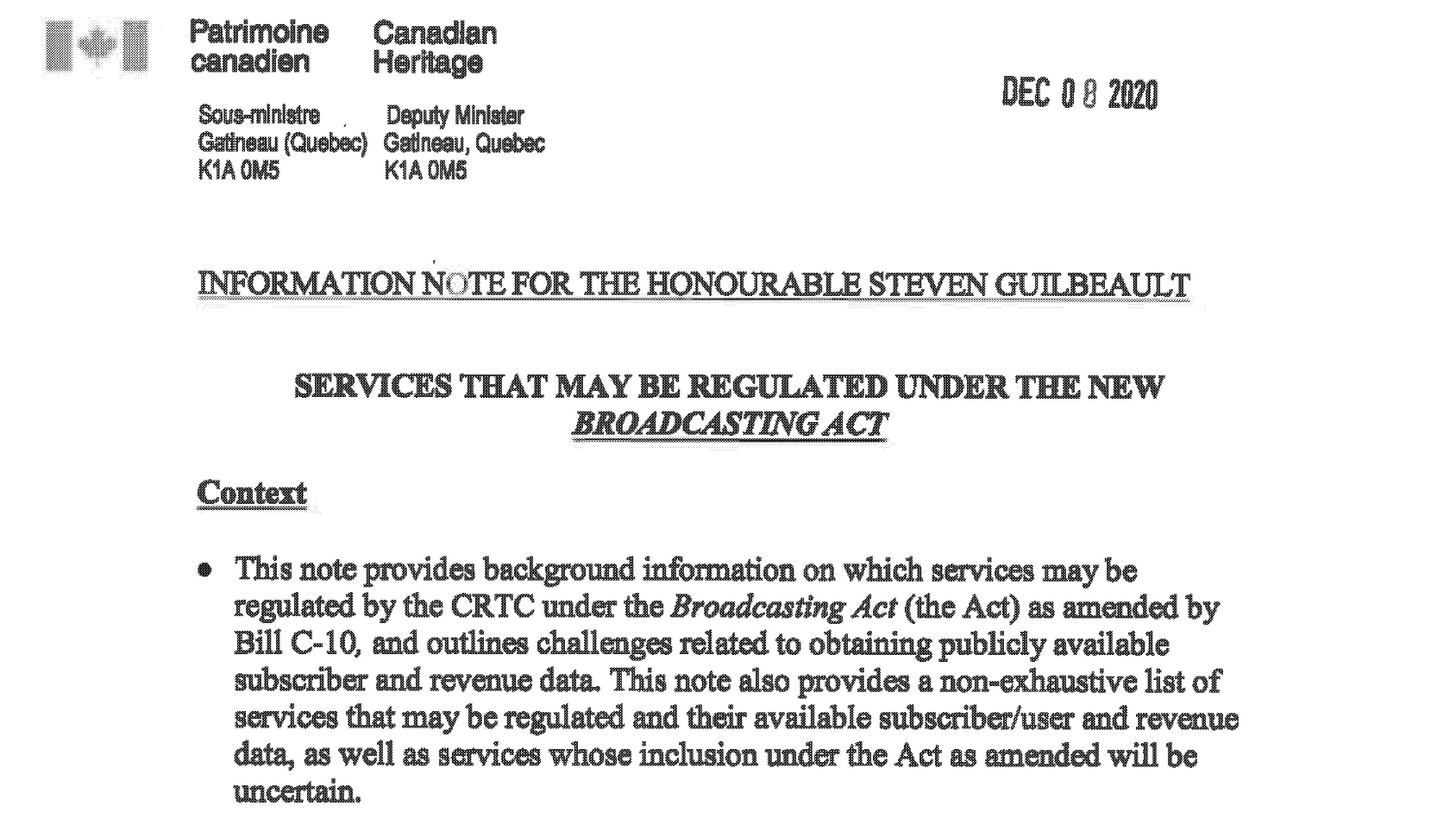
Canadian Heritage Memorandum, December 8, 2020, ATIP A-2020-00498
Bill C-10
Misleading RCMP Data Undermines Counterfeiting Claims
My weekly Law Bytes column (Toronto Star version, Ottawa Citizen version, homepage version) focuses on the growing attention paid to counterfeiting and the use of misleading data as part of the debate. The RCMP has been the single most prominent source for claims about the impact of counterfeiting in Canada since its 2005 Economic Crime Report pegged the counterfeiting cost at between $10 to 30 billion dollars annually. The $30 billion figure has assumed a life of its own with groups lobbying for tougher anti-counterfeiting measures regularly raising it as evidence of the dire need for Canadian action. U.S. Ambassador to Canada David Wilkins cited the figure in a March 2007 speech critical of Canadian law, while the Canadian Anti-Counterfeiting Network, Canada's leading anti-counterfeiting lobby, reported in April that the "RCMP estimates that the cost to the Canadian economy from counterfeiting and piracy is in the billions."
Yet despite the reliance on this figure – the Industry Committee referenced it in its final report – a closer examination reveals that the RCMP data is fatally flawed. Responding to an Access to Information Act request for the sources behind the $30 billion claim, Canada's national police force last week admitted that the figures were based on "open source documents found on the Internet." In other words, the RCMP did not conduct any independent research on the scope or impact of counterfeiting in Canada, but rather merely searched for news stories on the Internet and then stood silent while lobby groups trumpeted the figure before Parliament.
A careful examination of the documents relied upon by the RCMP reveal two sources in particular that appear responsible for the $30 billion claim.
Misleading RCMP Data Undermines Counterfeiting Claims
Appeared in the Toronto Star on September 17, 2007 as Misleading Data Undermine Counterfeiting Claims Canadian politicians have paid a great deal attention to counterfeiting over the past year. The issue, which focuses primarily on fake clothing, handbags, pharmaceuticals, and entertainment products, played a prominent role in the recent summit […]
A Nation of Outlaws
Stephen Mihm in the Boston Globe on "what's happening halfway around the world [in China] may be disturbing, even disgraceful, but it's hardly foreign. A century and a half ago, another fast-growing nation had a reputation for sacrificing standards to its pursuit of profit, and it was the United States."
The SPP on IP
The Security and Prosperity Partnership of North America, which brings together the leaders of Canada, the U.S. and Mexico, concluded this afternoon with a series of new agreements and strategies. Given the U.S. involvement, it should come as no surprise to find that an Intellectual Property Action Strategy forms a core part of the summit's final documentation. The document, which focuses on counterfeiting and piracy, includes three broad action items:
- "Detect and Deter Trade in Pirated and Counterfeit Goods," including developing best practices for enforcement, creating an enforcement network, increase collaboration on IP enforcement, and increased attention on border enforcement. Note that "digital piracy" is specifically identified as an issue for future work.
- "Public Awareness and Outreach," which includes greater co-operation between government and industry with increased information sharing. Lobby groups such as the Canadian Anti-Counterfeiting Network will conduct joint seminars with its US and Mexican counterparts on best practices and enforcement. The strategy also envisions policy roundtables and public awareness campaigns. The three countries will combine on a new website that will post articles about IP enforcement around the world, while industry has promised to develop a code of ethics for online transactions as well as a database on the benefits of IP and the dangers of counterfeiting and piracy.
- "Measuring Piracy and Counterfeiting," which includes developing baseline data on these issues, highlighting the effects of IP in each country's economy, and facilitating the collection of counterfeiting and piracy data.
All of these measures were entirely predictable, given that they are precisely what the North American Competitiveness Council recommended earlier this year. With that in mind, it bears noting what else the NACC recommended for completion by 2008, since it telegraphs what is on the horizon.

Recent Posts
 A Canary’s Song: What Antisemitism Reveals About the Health of Canadian Democracy
  Elbows Up With Europe Too: Why Canada’s Pivot to the EU Raises the Same Digital Sovereignty Questions as the U.S.
  A Century After Keeping Jewish Students Out, Universities Are Letting Them Be Pushed Out
  The Lessons of 9/11 We Forgot After October 7th
  Named to Canadian Lawyer’s Top 25 Most Influential Lawyers
