
Canada has formally ratified the WIPO Copyright Treaty and the WIPO Performances and Phonograms Treaty. The ratification was a key part of the copyright reform process, leading to contentious debate over the Canadian approach to providing legal protection for digital locks. The treaties will enter into force on August 13, […]

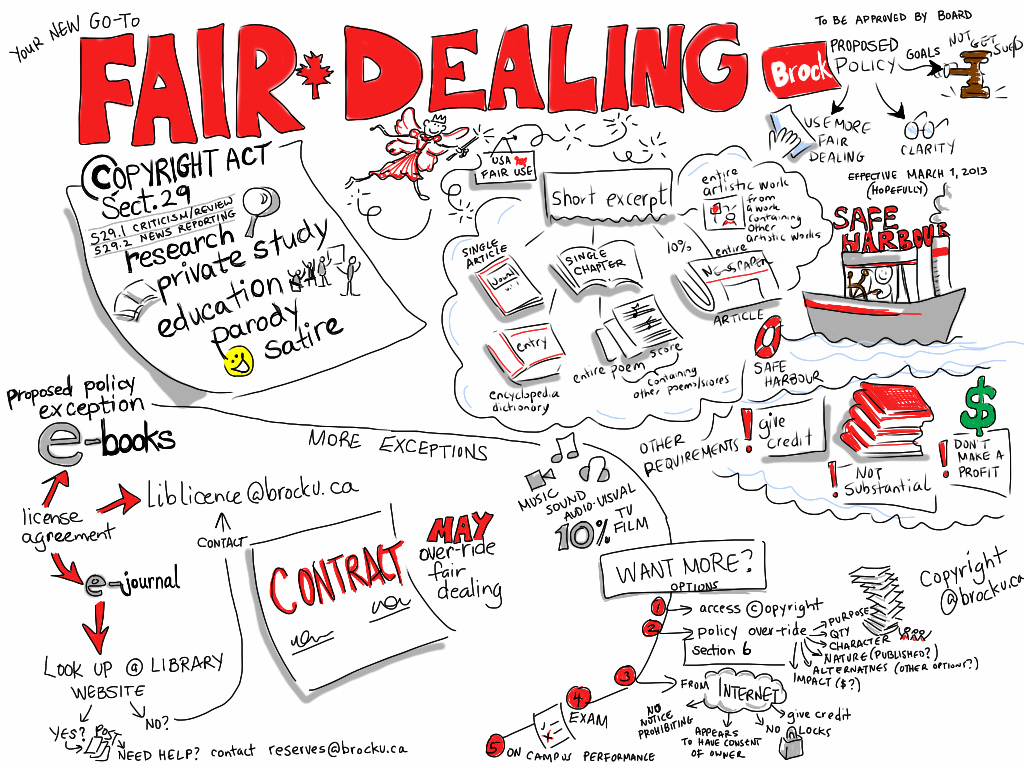
Fair Dealing by Giulia Forsythe (CC BY-NC-SA 2.0) https://flic.kr/p/dRkXwP
Copyright
The Copyright Board of Canada Music Streaming Decision: The Good, the Bad, and the Ugly
The Copyright Board of Canada issued its long-awaited music streaming decision late last week, setting royalties to be paid by Internet music streaming services such as Pandora for non-interactive and semi-interactive streaming for the years 2009 to 2012. This covers passive Internet radio services and services that allow users to influence what they listen to. Given that Pandora left the Canadian market over high tariff rates, the outcome of the decision was destined to be a key determinant over whether many of the missing Internet music streaming services enter the Canadian market.
For fans of Pandora or similar services, the decision brings good news. The board largely rejected the arguments of Re:Sound, the collective responsible for the tariff and settled on rates close to what the Internet services were seeking. While the collective argued for rates similar to those found in the U.S., the Board ruled that the U.S. was not a suitable comparison.
Moreover, it rejected arguments that this form of music streaming cannibalizes music sales, concluding that exposure to music through non-interactive and semi-interactive streaming may increase sales:
Has Canada Caved on Copyright Term Extension in the TPP?
The Trans Pacific Partnership negotiations resume next week and while an agreement does not appear imminent, reports from Japan indicate that the copyright term issue may have been resolved. Japan and Canada are two of several TPP countries whose term of copyright protection is life of the author plus 50 years. According to the Japan News, those countries (which also include New Zealand, Malaysia, Vietnam, and Brunei) are prepared to cave to U.S. pressure to extend the term of copyright to life of the author plus 70 years:
Among the 12 countries, Japan, Canada and four other countries protect an author’s copyright for 50 years after their death, the United States and four other countries for 70 years and Mexico for 100 years. Following the agreement, Japan will extend its duration by 20 years.
Copyright Board Indicates It Will Not Include Mandatory Delete Rule in Tariff
The Copyright Board of Canada has issued an order in the tariff proceedings with Access Copyright that indicates its preliminary view is that it will not support the collective’s demand for a provision that would require deletion of digital copies made under a copying tariff where an institution stops relying […]
Appointment of New Copyright Board of Canada Chair Offers Chance for Change
Copyright Board of Canada chair William J. Vancise will see his term come to an end this month, opening the door for the government to start the process of reforming the much-criticized board. Vancise has served the maximum two terms as chair, with his time marked by the Supreme Court of Canada’s rejection of the board’s approach to fair dealing, ongoing frustration from stakeholders about board administrative processes, and the failure of the board to broaden its approach by becoming more inclusive of the public.
The exclusion of the public stands in sharp contrast to the CRTC and Competition Bureau, which have both taken steps in recent years to involve the public more directly in policy making activities, hearings, and other issues. By contrast, the Copyright Board does little to encourage public participation, despite the fact that its decision often have an impact that extends beyond the parties before it. When asked recently about the accessibility and participation concerns, the board pointed to an internal working group as evidence that it regularly reviews its practices and compared itself to the Federal Court of Appeal, noting that “of course they [the public] don’t participate, because they don’t really belong there, per se.”