While the U.S. movie studios demand that Canada reform its copyright laws, the Canadian Press reports that they just killed a negotiated labour settlement that was to have provided new rights and compensation to Canadian performers. Justice Minister Rob Nicholson might want to remind them of that the next time […]
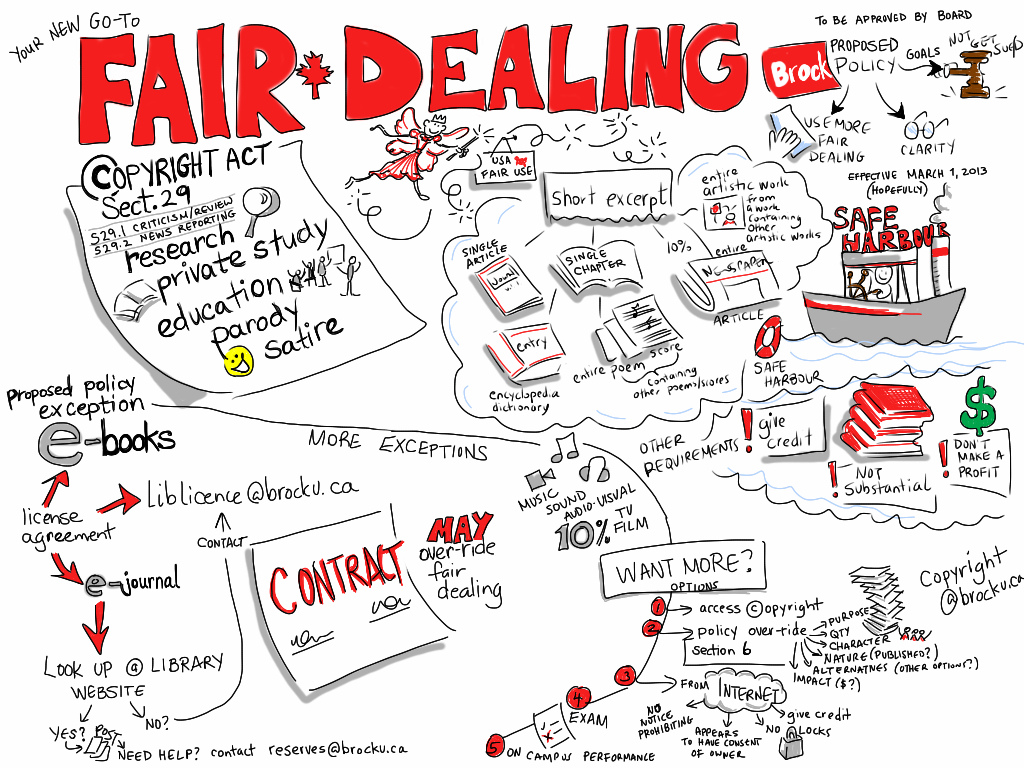
Fair Dealing by Giulia Forsythe (CC BY-NC-SA 2.0) https://flic.kr/p/dRkXwP
Copyright
Another Day, Another Movie Statistic
The NY Times reports on the Canadian camcording issue, using the figure of "30 – 40 percent" of pirated DVDs sourced to Canada. Moreover, there now yet another reason for why the Canadian camcording is a particular problem – "industry officials acknowledge that Canadian pirates offer technically superior work."
The Recording Industry’s Digital Strategy Out of Tune
My weekly Law Bytes column (Toronto Star version, homepage version) begins with the following:
Ten years ago, as the Internet began to mushroom in popularity and emerging technologies enabled consumers to make near-perfect copies of digital content, the recording industry emphasized a two-pronged strategy in response to the changing business environment. First, it focused on copy-control technologies, often referred to as digital rights management (DRM), that many in the industry believed would allow it re-assert control over music copying. Second, it lobbied the Canadian government for a private copying levy to compensate for the music copying that it could not control.
While the industry’s approach proved successful on the legal front – the 1996 World Intellectual Property Organization’s Internet Treaties established legal protections for DRM and Ottawa introduced a private copying levy on blank media such as cassettes and CDs in 1997 – the strategy’s effectiveness has long been subject to debate. The week of February 5th may ultimately be viewed as the beginning of the end of that debate. That week, which began with Apple CEO Steve Jobs calling on the industry to drop DRM and concluded with the Canadian Private Copying Collective (CPCC), the collective that administers the private copying levy, applying for its dramatic expansion, leaves little doubt that the recording industry got it wrong.
The column proceeds to discuss the failure of DRM and the mounting pressure on the industry to drop it.
Recording Industry’s Digital Strategy Out of Tune
Appeared in the Toronto Star on February 19, 2007 as Recording Industry's Off-Key Strategy Ten years ago, as the Internet began to mushroom in popularity and emerging technologies enabled consumers to make near-perfect copies of digital content, the recording industry embarked on a two-pronged strategy in response to the changing […]
Hollywood and DRM
The Wall Street Journal reports that the Hollywood movie studios are internally debating the merits of dropping DRM.


Michael Geist on Substack
Recent Posts
The Law Bytes Podcast, Episode 282: Udbhav Tiwari on Why Signal May Exit Canada Over Bill C-22’s Encryption and Metadata Retention Rules

From Making Web Giants Pay to Paying Media Giants: Budget 2026 Replaces the Government’s Internet Platform Strategy With $1.5 Billion in Taxpayer Dollars for Culture and News

Has the Government Read Its Own Bill? What Three Days of House Debate Revealed About Bill C-34 Before the Committee Hearings Begin
Surveillance By Design: Government Officials Say Lawful Access Could Reach Gaming Platforms, Daycares and AI Services

Canada’s First Digital Trade Agreement: Why the Canada-EU Deal Will Likely Follow Europe’s Template and What That Means for Canadian Digital Law