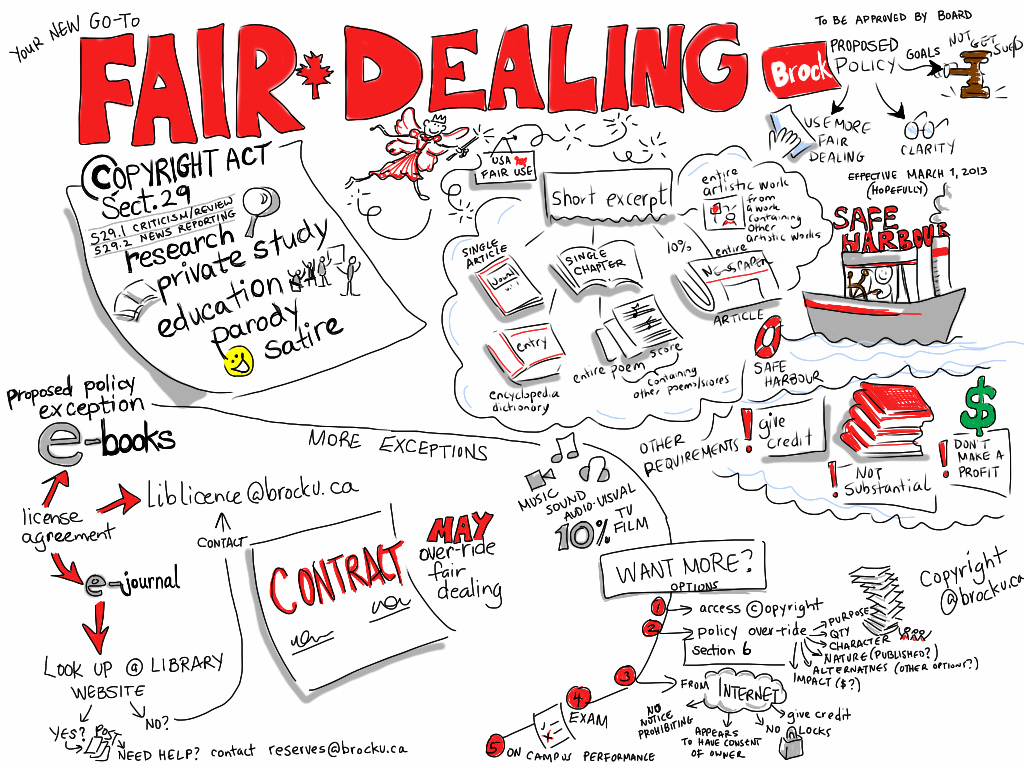
Fair Dealing by Giulia Forsythe (CC BY-NC-SA 2.0) https://flic.kr/p/dRkXwP

Fair Dealing by Giulia Forsythe (CC BY-NC-SA 2.0) https://flic.kr/p/dRkXwP

Copyright

Copy Taste by Maik Meid (CC BY-SA 2.0) https://flic.kr/p/ezjkBi

Fairness Confirmed: Copyright Board Deals Another Blow to Access Copyright

In the aftermath of the Supreme Court of Canada’s 2012 copyright pentalogy that strongly affirmed the importance of user’s rights and the need for a broad, liberal interpretation for fair dealing, Access Copyright insisted that the decisions did not mean what they said. While educational groups developed reasonable fair dealing guidelines based on the decisions (along with earlier decisions such as the CCH case and the inclusion of education within the fair dealing purposes in 2012 reforms), Access Copyright argued that the copying required its licence and that fair dealing guidelines based on general percentages could not be used.

Last Friday, the Copyright Board of Canada issued its latest decision on the application of fair dealing to educational copying, providing yet another resounding blow to Access Copyright’s view of copyright. The Board created a tariff for copying in K-12 schools that was a fraction of what the copyright collective had wanted. It initially asked for $15 per full time student. By the time the issues had been fully assessed, the Board granted a tariff of $2.46 per student for 2010-2012 and $2.41 for 2013-2015. That rate is not only far lower than Access Copyright had demanded, but is nearly half of what was previously certified for the period from 2005-2009 (which was set at $4.81). The Board minced no words in explaining the reduction:

Read more ›

February 22, 2016 8 comments News
The Trouble With the TPP, Day 34: PMO Was Advised Canada at a Negotiating Disadvantage

The Trouble With the TPP, Day 34: PMO Was Advised Canada at a Negotiating Disadvantage

Price of Entry, one of the early Trouble with the TPP series posts, discussed some of the conditions of entry for Canada into the TPP negotiations. These included the absence of “veto authority”, which meant that Canada could not hold up any chapter if it was the only country opposing a provision. This ultimately had a significant impact on the intellectual property chapter, where Canada had little choice but to cave on several issues.

Conditions of entry were not the only disadvantage faced by the Canadian negotiators. According to an internal email I recently obtained under the Access to Information Act, Canadian officials were aware that they were at a disadvantage relative to the U.S. in the late stages of the negotiations. The email dated July 9, 2015, was sent to Kirsten Hillman, Canada’s lead TPP negotiator, and Christine Hogan, the International Trade Deputy Minister. It notes that the U.S. had cleared access to the full negotiating text for a wide range of advisors, including business groups and public advocates, but infers that Canada had not done the same. It continues:

I hope the political side lets you do something similar or at least hold technical briefings, or the US will effectively drive the narrative and put you at a disadvantage.

Read more ›

February 19, 2016 20 comments News
treaty enforcement by Sarah Deer (CC BY 2.0) https://flic.kr/p/4AfLUo

The Trouble With the TPP, Day 25: The Treaties Within the Treaty

This week’s signing of the TPP in New Zealand provides a useful reminder that a potential ratification means committing to far more than just one (very large) trade agreement. One of the Troubles with the TPP is that the intellectual property chapter requires all countries to ratify or accede to as many as nine international IP treaties. In other words, the treaties within the treaty are a core part of the obligations that come with TPP.

Article 18.7 specifies that all countries have already ratified or acceded to three IP treaties: the Patent Cooperation Treaty, Paris Convention, and Berne Convention. More notably, there are as many as six additional treaties that must be ratified or acceded in order to ratify the TPP:

Read more ›

February 5, 2016 2 comments News
Freeland Signs TPP

The Trouble With the TPP, Day 24: Missing Balance on IP Border Measures

The day after Canada signed the TPP (and a Leger poll found huge opposition to the agreement’s IP and ISDS provisions), the shift toward consultation and study can continue in earnest. Chrystia Freeland, Canada’s Minister of International Trade, used the signing to emphasize once again that signing is not the same as ratifying and that the government is committed to a robust Parliamentary and public review of the agreement.

The Trouble with the TPP series continues today with another example of the lack of balance in the text. An earlier post noted how in the TPP  rights holders’ provision are often mandatory, while those for users are treated as optional. The lopsided approach is also evident in the border measures rules. This week I discussed the expansion of border measures provisions without court oversight, which could lead to customs officials being asked to make difficult legal assessments on whether to detain goods entering the country.

Read more ›

February 4, 2016 1 comment News
cc-logo by Open Democracy (CC BY-SA 2.0) https://flic.kr/p/PVs1Z

Fair Access: Striking the Right Balance on Education and Copyright

Academic Matters, a semi-annual publication that explores issues related to higher education, has just published a pair of essays on education, fair dealing, copyright, and collective licensing. Roanie Levy, the Executive Director of Access Copyright, wrote an essay in support of the role of her copyright collective. I wrote the other essay, arguing that emerging forms of access for copyrighted works lessens the value of the Access Copyright licence.

The full piece – Fair Access: Striking the Right Balance on Education and Copyright – can be found here.  I conclude that:

any [copyright law] review must account for the millions being paid by educational institutions for access and the modest interpretations of fair dealing law in Canada, which have resulted in copying guidelines that are still more restrictive than those found in some other countries. Indeed, a fair review of the current system reveals that the problem facing Access Copyright is not that copies are not valued, but rather that in light of new forms of access and the evolution of the law, its licence is no longer valuable. 

Read more ›

January 22, 2016 2 comments News