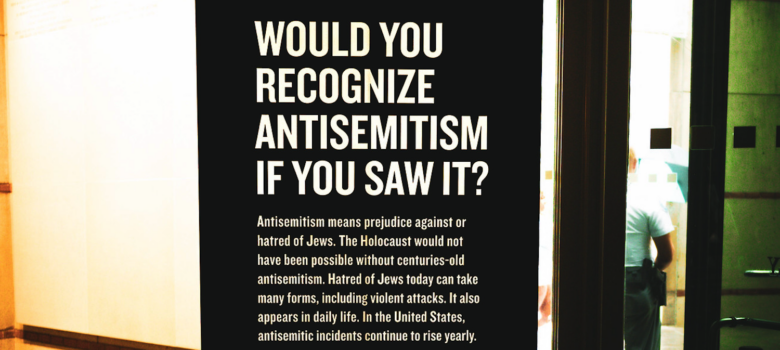
The devastating consequences of the rise of antisemitism is in the spotlight this week in the wake of the horrific Chanukah Massacre in Australia over the weekend. In addition to my post on the issue, I appeared yesterday on CBC Radio’s syndication, conducting 14 interviews in rapid succession with stations from coast to coast [clip here]. Most of the interviews followed a similar script, focusing on the rise of antisemitism in Canada as documented by Statistics Canada, lamented the troubling range of violent antisemitic incidents (including the Ottawa grocery store stabbing and the Toronto intimidation marches in Jewish neighbourhoods), and described life as Jew in Canada in 2025, which invariably necessitates a police presence at schools and synagogues alongside measures to hide Jewish symbols and identity in public.
The conversations often concluded by focusing on what leaders can do to help address the issue. My response identified a few things, but topping the list was the need to call out antisemitism without qualification. That should not be hard – if you can’t call out antisemitism, you can’t deal with it – but too often leaders avoid references to antisemitism or couch it with an “all hate matters” message that invokes Islamophobia and other forms of hate. Islamophobia and all forms of hate do matter, but given the exceptional levels of antisemitism – Jews face religiously motivated hate crimes at levels that far exceed any other religion – there must be a willingness to call out antisemitism without qualifiers or caveats.
Unfortunately, too often that doesn’t happen. For example, in the immediate aftermath of the Bondi Beach massacre, Australian Prime Minister Anthony Albanese made no mention of Jews being the target or antisemitism. Sadly, this kind of thing isn’t unusual: when a Montreal Jewish man was beaten in front of his children this summer, Prime Minister Carney referenced the heinous act of violence but not antisemitism. When synagogues in Halifax were vandalized, police said “hatred will not be tolerated” without reference to antisemitism or Jewish targets.
Even when antisemitism is mentioned, often there are efforts to reference others form of hate at the same time. For example, when there was an outbreak of attacks against synagogues and schools, then Prime Minister Justin Trudeau warned against antisemitism and Islamophobia (this approach dates back years for Trudeau). When a Jewish business was targeted in Toronto, Mayor Olivia Chow responded by saying “There is no place in our city for antisemitism, Islamophobia, hate, intimidation and harassment of any kind.” Similarly, when shots were fired at a Jewish school in Toronto, Ottawa deputy mayor Sean Devine responded that “No one in Canada should accept such violence, whether it’s antisemitism, Islamophobia, or any other form of racism.” It is notable that reverse is rarely true: if a mosque is the target, there is no rush to reference antisemitism alongside Islamophobia.
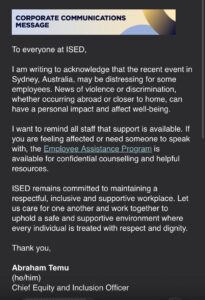
The reluctance to unequivocally call out antisemitism or invoking caveats or broader framing extends beyond political leaders. This week, a source sent me the message distributed by the Chief Equity and Inclusion Officer at ISED in the wake of the Australia massacre. The message references only the “recent event” in Australia with no mention of Jews, Chanukah, or antisemitism. If the message was meant to provide assurance of support, it had the opposite effect, leaving Jewish recipients unseen with the anodyne message.
The need to call out antisemitism is particularly important given insidious efforts to deny its existence or call into question the motivations behind it. Too often we are told that antisemitism is being weaponized (as if anyone would ever say something similar about hate targeting another group) or that it is “justified” on the grounds that it is anti-Zionist political speech (which frequently strays into antisemitism). The consequences of these excuses is the violence we see in Canada and around the world. As I noted earlier this week, the Bondi Beach Chanukah Massacre does not shock. Rather, it is an inevitable consequence of the willingness to tolerate what would be intolerable in any other circumstance. If Canada does not confront antisemitism directly, we should not be shocked should similar events unfold here.








Yes, you are right . But if politicians in Canada wont call it out directly, and take appropriate action, what should we do?
Pingback: Confronting Antisemitism in Canada: If Leaders Won’t Call It Out Without Qualifiers, They … – Press Services
Powerful and sobering point—minimizing or trend gamesexcusing antisemitism only enables harm, making direct confrontation essential to prevent further violence.
This is a very important topic. Thank you for raising it. It is extremely important to talk about these things nowadays