
The stunning collapse of FTX, one of the world’s leading crypto exchanges, has not only shaken the crypto world but called into question the future of blockchain and digital assets. In a year of repeated failures and crashes, the calls for increased regulation are getting louder. Ryan Clements is a law professor at the University of Calgary, where he holds the chair in Business Law and Regulation and specializes in the regulation of fintech, blockchain and crypto-assets. He’s written extensively on crypto regulatory issues, including an expert report on Canadian cryptocurrency governance for the Public Order Emergency Commission. He joins the Law Bytes podcast to provide some background into the growth of crypto, the collapses of Luna and FTX, and where Canada sits on the regulatory spectrum.
 Articles by: Michael Geist

Money for Nothing: Government Quietly Expands Bill C-18 Eligibility to Broadcasters That May Not Even Produce News Content
Later today, the Canadian Heritage committee will continue its clause-by-clause review of Bill C-18, the Online News Act. The committee is virtually certain to expand the eligibility of news outlets, responding to concerns that the current criteria may exclude smaller, independent outlets from benefiting from the bill’s mandatory payment/arbitration system. However, earlier this week, just as the committee was hearing that the bill covers quotes with links to news content by users in Facebook posts, it quietly expanded the scope of the definition of “eligible news business” in a manner that opened the eligibility door to some organizations that may not even produce news content. As a result, the bill faces another potential trade challenge as it evolves into a straight subsidy model in which the bulk of the payments go from Internet companies to Canadian broadcasters with little regard for value or any notion of actually use of news content.
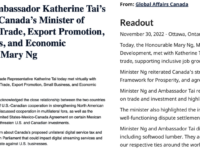
A Tale of Two Readouts: U.S. Escalates Trade Concerns With Canadian Digital Policy as Canada Seeks To Downplay the Issue
Canadian International Trade Minister Mary Ng and U.S. Trade Representative Katherine Tai met yesterday to discuss Canada-U.S. Trade issues and concerns regarding Canada’s digital policy – most notably a proposed digital sales tax and Bills C-11 and C-18 – continue to mount. The U.S. raised digital policy concern over the summer, specifically citing Bill C-11 with a reference to “pending legislation in the Canadian Parliament that could impact digital streaming services.” The latest readout suggests that the concerns are growing, as the U.S. now cites both Bills C-11 and C-18 by raising “pending legislation in the Canadian Parliament that could impact digital streaming services and online news sharing and discriminate against U.S. businesses.”
NorthSec: What Lies Behind Canada’s Internet Regulation Reversal?
I spoke at NSEC2022, where I discussed Canada’s shift toward heavier internet regulation, including online streaming and broadcasting, news media, online harms, privacy, taxation, and increased government involvement in digital markets. The link to the video can be found here.

Freedom of Expression for a Price: Government Confirms Bill C-18 Requires Platform Payment for User Posts That Include News Quotes and Hyperlinks
The longstanding debate over whether Bill C-18, the Online News Act, requires payment for linking came to an end yesterday. Government officials admitted that even basic quotes from news articles that include a hyperlink to the original source would scope user posts into the law and require platforms such as Google and Facebook to negotiate payment for the links. As noted below, even that position may understate the impact of the bill, which appears to also cover a user post of a news quote without a link. In other words, merely quoting a few sentences from a news article on an Internet platform is treated as making news content available, which triggers a requirement for the platforms to negotiate payment. This position runs counter to Canada’s copyright obligations under the Berne Convention and has no place in a country committed to freedom of expression.

Recent Posts
 Elbows Up With Europe Too: Why Canada’s Pivot to the EU Raises the Same Digital Sovereignty Questions as the U.S.
  A Century After Keeping Jewish Students Out, Universities Are Letting Them Be Pushed Out
  The Lessons of 9/11 We Forgot After October 7th
  Named to Canadian Lawyer’s Top 25 Most Influential Lawyers
  Be Careful What You Wish For: Why Asking Google Maps to Defy the U.S. on Lake Ontario Would Undermine Canadian Digital Sovereignty
