Blog

fight antisemitism by Julia Tulke CC BY-NC-SA 2.0 https://flic.kr/p/njohj3

Words Are Not Enough: Countering Relentless Antisemitic Violence in Canada With Action

On a hot August day nearly 32 years ago, I was married at the Shaarei Shomayim synagogue in Toronto. My Globe and Mail op-ed notes that I leafed through my wedding album this weekend as I grappled with the news that gunfire targeted the synagogue on Friday night, the third such attack on a synagogue in Toronto in a matter of days. The photos of my grandparents – Holocaust survivors who rebuilt their lives in Canada – looked back at me as if to warn that the risks are real.

The gun violence sparked the usual political tweets denouncing the shooting, pledging support, and unconvincingly stating that antisemitism has no place in Canada. Yet the predominant emotion that would have once greeted this news – shock – is no more. Over the past two-and-a-half years, Canadian Jewish communities from coast to coast have faced relentless antisemitic incidents: schools hit with gunfire, synagogues firebombed, community centres and old-age homes vandalized, hospitals protested, summer camps threatened, Jewish students and campus groups vilified, and Jewish-owned businesses boycotted.


Read more ›

March 11, 2026 3 comments Columns
2023 US-Canada Summit by Eurasia Group https://flic.kr/p/2osjLzX CC BY 2.0

Why the Online Harms Act is the Wrong Way to Regulate AI Chatbots

In the wake of reports that AI Minister Evan Solomon may press AI companies such as OpenAI to more aggressively report potential safety risks identified in private chats to law enforcement, attention has quickly turned to the Online Harms Act as a potential regulatory solution. The Online Harms Act or Bill C-63, died on the order paper last year, but is expected to return in some form in the coming months. Given that the Act is tailor made to address online harms, it isn’t surprising that some would suggest that it could be expanded to cover AI chatbots.

Yet the law was deliberately designed to avoid doing what politicians want the AI companies to do as it expressly exempted private communications and proactive monitoring from its scope. Indeed, applying the Online Harms Act to AI chatbots would not simply extend existing online safety rules to a new technology. It would require dismantling core privacy safeguards which were added after the government’s earlier online harms proposal faced widespread criticism for encouraging platform monitoring and rapid reporting to law enforcement. In effect, proposals to use online harms to regulate AI chatbots risks reviving many of the same surveillance concerns that forced the government back to the drawing board just a few years ago.

Read more ›

March 4, 2026 3 comments News
OpenAI logo by ishmael daro https://flic.kr/p/2oZaMAk CC BY 2.0

More Transparency Not Police Reporting: Navigating the Safety-Privacy Balance for AI ChatBots

My Globe and Mail op-ed begins by noting that AI Minister Evan Solomon summoned executives from OpenAI to Ottawa last week to explain why the company declined to alert police that it had flagged the account of Jesse Van Rootselaar, the Tumbler Ridge shooter who killed eight people earlier this month. The company stopped short of warning authorities, concluding that the account activity did not meet its standard of an “imminent and credible risk of serious physical harm to others.” After the meeting, Mr. Solomon expressed disappointment with OpenAI, saying the company had not presented “substantial new safety protocols.” Justice Minister Sean Fraser said it expects OpenAI to make changes, or else the government would step in to regulate artificial intelligence companies.

The desire to hold someone responsible for the potential prevention of the Tumbler Ridge tragedy is understandable. Add in the mounting pressure for AI regulation, and OpenAI makes for a perfect target for blame and threats of government action. Yet holding AI chatbots liable for reporting to police what users privately post in their conversations creates its own risks, undermining privacy and effectively encouraging heightened corporate surveillance.

Read more ›

March 3, 2026 1 comment Columns
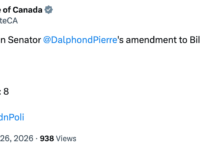
SenateCA tweet, https://x.com/SenateCA/status/2027197059397275879

Nobody Wants This: Senate Rejects Government’s Anti-Privacy Plan for Political Parties By Sending Bill Back to the House With a Sunset Clause

Faced with a bill that would leave political parties subject to weaker privacy rules than virtually any other major organization in Canada, the Senate voted yesterday to amend the bill by including a sunset clause on the privacy provisions that gives that the government three years to come up with something better. The change is designed to allow the new rules, which as the Senate heard repeatedly from experts and privacy commissioners are not real privacy rules at all, to apply immediately but expire in three years. This will have the effect of killing a B.C. privacy challenge that sparked the legislation in the first place. The bill heads back to the House of Commons, where the government can either accept the change and have the bill pass or reject the change and send it back again to the Senate. If it is sent back, the Senate is unlikely to oppose the privacy elements in the bill again.

Read more ›

February 27, 2026 2 comments News
Privacy Please by ricky montalvo (CC BY-ND 2.0) https://flic.kr/p/8RF3Ez

Time for the Government to Fix Its Political Party Privacy Blunder: Kill Bill C-4’s Disastrous Privacy Rules

Just weeks after last year’s election, Mark Carney’s government committed not one, but two privacy blunders in rapid succession. First, Bill C-2 – literally the first substantive bill of the new government – buried lawful access provisions in an omnibus “border measures” bill that would have established unprecedented warrantless access to the personal of information of Canadians. Second, days later it introduced Bill C-4, which was framed as affordability measures bill but included provisions that exempt political parties from the application of privacy protections. The bizarre assault on privacy felt like an opportunistic attempt to insert unpopular rules in the hope that few were paying attention. The strategy was failure: the government ultimately introduced a new border measures bill with lawful access removed (new lawful access rules are expected in their own bill this year) and now a Senate committee which studied the Bill C-4 privacy rules has recommended that they be killed, removed from the bill, or subject to a two-year sunset clause.

Read more ›

February 18, 2026 6 comments News