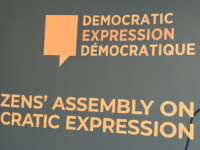
The Canadian Parliament is set to resume this week and it’s a safe bet that Internet regulation will be part of the legislative agenda in the coming months. One of the toughest policy issues involve misinformation, which can be difficult to define and potentially to regulate. The Canadian Commission on Democratic Expression was established in spring 2020 with a three-year mandate to better understand, anticipate, and respond to the effects of new digital technologies on public life and Canadian democracy. As part of its work, it created a Citizens’ Assembly comprised of Canadians from across the country who recently gathered for several days to debate disinformation online. Last week, I was honoured to deliver a dinner speech to the group followed by a facilitated discussion. This week’s podcast features a recording of that lecture with the slides posted here.
Search Results for "Law Bytes" : 862

The Conservative Election Platform: Freedom of Expression Commitment Tainted By Support for Payments for Links, Restrictions on Fair Dealing
The Conservative Party released its election platform yesterday, providing a lengthy document that covers a myriad of policy issues. From a digital policy perspective, there are positions sprinkled throughout the document, covering everything from a new innovation policy (an issue that the Liberals de-emphasized over the past two years and the Conservatives are right to target) to labour rights for gig workers.
On many issues, the reality is the policy platform isn’t all that different from the Liberal government’s approach.
Episode 93: Lex Gill on the RCMP, Clearview AI and Canada’s History of Surveillance
Earlier this month, the Privacy Commissioner of Canada released a scathing report on the RCMP’s use of facial recognition technology, particularly its work with Clearview AI. The report was particularly damaging as the Commissioner found that the RCMP wasn’t truthful when it said it didn’t work with Clearview AI and then gave inaccurate information on the number of uses when it was revealed that it did. In fact, even after these findings, the RCMP still rejected the Privacy Commissioner’s findings that it violated the Privacy Act.
Lex Gill is a Montreal-based lawyer where she is an affiliate at the Citizen Lab and teaches at McGill University’s Faculty of Law. She has also worked at the Canadian Civil Liberties Association and the Canadian Internet Policy and Public Interest Clinic. Lex joins the podcast to discuss the Commissioner’s findings and to explain why this is best viewed as part of a long cycle of surveillance that has often targeted social movements or vulnerable populations.

My Appearance Before the Senate Committee on Transport and Communications: Why Copyright Reform Isn’t the Answer to the Challenges Faced by the News Media Sector
Yesterday I took a break from talking about Bill C-10 to appear before the Senate Standing Committee on Transport and Communications as part of its study on Bill S-225, Senator Claude Carignan’s bill that proposes copyright reform as a mechanism to address the challenges faced by the news media sector (the bill is the focus of this week’s Lawbytes podcast, featuring a conversation with Senator Paula Simons). I was joined by representatives from News Media Canada and Facebook, which made for an engaging discussion. My opening statement is posted below:

The Broadcasting Act Betrayal: The Long Term Consequences of the Guilbeault Gag Order
Several weeks after Canadian Heritage Minister Steven Guilbeault introduced Bill C-10, I started a 20 part blog post series called the Broadcasting Act Blunder (podcast edition here). The series examined many of concerns with the bill, including issues such as over-broad regulation and discoverability requirements that would only garner public attention many months later. I thought about that series yesterday as I watched Guilbeault try in the House of Commons to defend the indefensible: a gag order on committee review of the bill, the first such order in two decades. While the bill is in dire need of fixing, what occurred yesterday was far worse than a blunder. It was a betrayal. A betrayal of the government’s commitment to “strengthen Parliamentary committees so that they can better scrutinize legislation.” A betrayal of the promise to do things differently from previous governments. A betrayal of Canada’s values as a Parliamentary democracy.

Recent Posts
 Going Through the Motions: How Parliament Is Shutting Down Study and Debate on Political Party Privacy
  Why The Senate Got Antisemitism Only Half-Right
  The Government Doubles Down on News Sector Support: Fiscal Update Opens the Door to Tens of Millions in Tax Credits for Bell, Rogers and Corus
  The Illusion of Protection: Why Canada’s Growing Push to Ban Social Media for Kids Won’t Work
  The Law Bytes Podcast, Episode 266: Justin Safayeni on the Ontario Government’s Overnight Evisceration of Access to Information
