Since the Carney government took power, it has shown an odd pre-occupation with preserving the power of federal political parties to use the personal information of millions of Canadians under fewer restrictions than those faced by practically any other organization in the country. It started with the quick introduction of Bill C-4, an “affordability measures” bill that buried provisions exempting parties from provincial privacy laws and substituted a weak system that applied retroactively to the year 2000. The Senate found the approach so deficient that it sent the bill back with a sunset clause requiring something better within three years, only for the government to reject the amendment and rush the bill to royal assent within hours. Now political party privacy is back in another bill, and the government is back to trying to shut down study and debate. The apparent hope is to pass rules that do not meet modern privacy standards and hope no one notices.
Bill C-25, the Strong and Free Elections Act, which I wrote about last month when it was first introduced, includes a political party privacy framework that falls well short of what Canadians should expect, with no purpose limitation, no consent requirement, no right of access or correction, no retention limits, and no role for the Privacy Commissioner of Canada. The bill layers on incremental improvements drawn from the earlier Bill C-65, such as security safeguards, breach notification to affected individuals, and contractual protections for transfers, while leaving critical gaps in place. The provisions are notable structured as policy-based requirements rather than direct statutory obligations, which means that enforcement depends on a party first adopting a policy and then breaching its own policy, an inversion of how privacy law operates everywhere else in the country. Since the bill was introduced, the House second-reading debate and the committee study schedule signal that the political parties have little interest in revisiting it.
The first sign came from the second reading debate on April 24th, the last before the bill went to committee. Government MPs never raised the privacy provisions. Conservative and Bloc speakers were largely silent as well, with one notable exception. David Bexte, a Conservative MP from Bow River, included political party privacy in a list of concerns near the end of his speech, pointing to Rocky’s Bakery in Strathmore as a comparator. He noted that when a customer provides a credit card at his local bakery, a full set of privacy laws kicks in to protect that data. Political parties collect vastly more data on Canadians, including political views, demographic profiles, and behavioural data used for micro-targeting, yet operate outside any equivalent oversight. His obvious conclusion was that “we need real oversight of political party data by the Privacy Commissioner.”
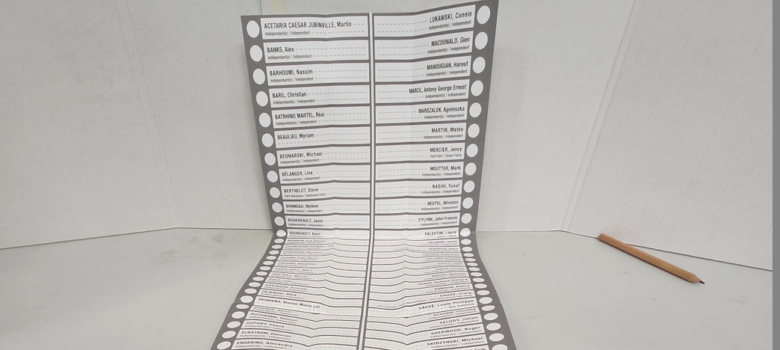
The second sign comes from the Procedure and House Affairs Committee’s study schedule of Bill C-25, which suggests there is little appetite for genuinely revisiting the privacy questions. In fact, there is little interest in studying any aspect of the bill, which includes a complete overhaul of foreign interference rules, deepfake offences, third party financing reforms, expanded administrative monetary penalties, new investigative powers for the Commissioner of Canada Elections, the longest ballot reforms, and the political party privacy framework. The committee has set just three meetings on the bill, one with the minister and officials on May 5 and two with witnesses on May 7 and May 26, with clause-by-clause consideration to follow on May 28. The deadline for witness submissions is today at noon, leaving outside experts roughly a day’s notice to prepare and submit briefs. When the Finance Committee studied Bill C-4 last fall, it refused to hear a single witness on the privacy provisions despite briefs from the Privacy Commissioner of Canada and the Commissioner of Canada Elections, limiting its consideration of the entire privacy section to a thirty-second description from a government official. It looks like the PROC committee may be headed in much the same direction.
None of this reflects the views of those who actually work in privacy law. I participated this week in an Osler AccessPrivacy debate on political party privacy with Adam Kardash and Colin Bennett, and the conversation reinforced what has been evident since the Bill C-4 hearings, namely that the Canadian privacy community can find no rationale for treating Canadians’ privacy interests with respect to political parties so differently from how their privacy is treated in nearly every other context. Privacy commissioners, civil liberties organizations, academic experts, and the Commissioner of Canada Elections have all concluded that the present framework does not provide meaningful privacy protection. Only the political parties themselves seem to disagree.
Taken together, the two signs from the past two weeks tell Canadians how this will play out. The House debate generated almost no engagement and the committee’s compressed study schedule leaves little room for serious privacy review. The pattern from Bill C-4 is being repeated once again as both the government and the opposition bet that few Canadians will pay attention to the embarrassingly weak privacy rules and the efforts to short-circuit expert witnesses and public debate.
Related posts:
 Still Not a Privacy Law: Bill C-25’s Political Party Privacy Provisions Fall Short Again
 How the Liberal and Conservative Parties Have Quietly Colluded to Undermine the Privacy Rights of Canadians
 Time for the Government to Fix Its Political Party Privacy Blunder: Kill Bill C-4’s Disastrous Privacy Rules
 Nobody Wants This: Senate Rejects Government’s Anti-Privacy Plan for Political Parties By Sending Bill Back to the House With a Sunset Clause







It is deeply concerning to see the legislative study on political party privacy being curtailed. Transparency and robust debate are the foundations of a healthy democracy, especially regarding how personal data is handled. Analyzing these complex policy shifts requires the same level of focus and independent critical thinking as mastering advanced 1-player games. Thank you, Michael, for consistently shedding light on these critical digital rights issues in Canada!
Three meetings to study a bill this sweeping really is just going through the motions. The bakery comparison from the Bow River MP lands well: it is hard to explain why a small shop faces a full set of privacy laws while parties collecting political views and behavioural data face almost none. Structuring enforcement around a party breaching its own policy seems especially toothless.