
Meta’s announcement this week that it has started to block news links in Canada on both Facebook and Instagram due to Bill C-18’s mandated payments for links approach has sparked a flurry of commentary and coverage. News outlets such as Le Devoir have joined the Globe and Mail in expressing doubt about the government’s approach, news coverage has examined why the Meta ad boycott hasn’t taken off (hint: the government’s own party is still launching new ads) or why the Australian experience hasn’t been replicated in Canada (hint: different law, different time). Meanwhile, the political response has been discouraging with the government pretending to forget the Conservatives’ actual vote against Bill C-18 in the House of Commons, while the Conservatives insist on calling Bill C-18 a censorship bill when it isn’t. But perhaps the most interesting response is the speculation about what comes next. I don’t think anyone really knows, but this post offers a few possibilities.
Post Tagged with: "meta"

The Lose-Lose-Lose-Lose Bill C-18 Outcome: Meta Blocking News Links on Facebook and Instagram in Canada
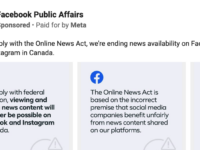
For months, supporters of Bill C-18, the Online News Act, assured the government that Meta and Google were bluffing when they warned that a bill based on mandated payments for links was unworkable and they would comply with it by removing links to news from their platforms. However, what has been readily apparent for months became reality yesterday: Meta is now actively blocking news links and sharing on its Facebook and Instagram platforms. The announcement does not reference Threads, but it would not surprise if news links are ultimately blocked on that platform as well. The company says that the blocking will take several weeks to fully roll out to all users, suggesting that it has learned from the over-blocking mistakes made in Australia and is proceeding more cautiously in Canada. By the end of the month, the world’s largest social media platform will become a news desert in Canada, with links to all news – both Canadian and foreign – blocked on the platform.
What If It Isn’t a Bluff?!: The Consequences of the Government’s Epic Bill C-18 Miscalculation Begin to Set In
As Bill C-18 made its way through the legislative process, the government and the media lobby groups supporting the bill insisted that Google and Meta were bluffing when they warned that legislation premised on mandated payments for links could lead the companies to stop Canadian news linking or sharing on their platforms. Proponents would point to the Australian experience or claim that links to Canadian news were simply too valuable for the platforms to walk away. Compromise amendments were ignored in favour of tough talk about not backing down, the platforms were investigated for daring to test link blocking, and MPs and Senators acted as stenographers for media lobby groups by introducing amendments that now leave the government with even less flexibility in the regulatory process.
Over the past week, the reality appears to have begun to seep in.

Caving on Bill C-18: Government Outlines Planned Regulations that Signal Willingness to Cast Aside Core Principles of the Online News Act
Canadian Heritage Minister Pablo Rodriguez has insisted for months that Bill C-18, the Online News Act, is a market-based approach that would leave it to the Internet platforms and Canadian media outlets to negotiate deals based on the principle of mandated payments for links. Faced with the prospect of Meta and Google’s recent announcements that they would block news links in order to comply with the legislation, it would appear that the government has caved on the bill as it searches for a face-saving compromise. Rodriguez and Prime Minister Trudeau had tough talk last week, but behind the scenes they were seemingly ready to cast aside the core principles that they claimed were essential to the legislation.

Trudeau Likens Bill C-18 Battle To World War Two Fight for Democracy as Government Suspends Meta Advertising (But Not Liberal Party Ads)
The government moved to escalate the battle over Bill C-18 yesterday, announcing that it was suspending advertising on Meta’s Facebook and Instagram platforms due the company’s decision to comply with the bill by blocking news sharing and its reluctance to further negotiate the issue. While the ad ban applies to federal government advertising, Liberal party officials confirmed they plan to continue political advertising on the social networks, suggesting that principled opposition ends when there might be a political cost involved. At issue is roughly $11 million in annual advertising by the federal government, a sum that pales in comparison to the Parliamentary Budget Officer’s estimate of at least $100 million in payments in Canada for news links from Meta alone.

Recent Posts
 The Missing Charter Statement: Why Hasn’t the Government Explained How Bill C-34’s Social Media Ban Complies with the Charter?
  Three Years After October 7th: Living With the Shockwaves
  What If the U.S. Demanded This? The Cloud Provider Conditions Behind Canada’s EU Digital Pivot
  Ontario is Done Waiting for Universities to Act on Campus Antisemitism
  Is Compromise on Encryption Possible? Why Bill C-22’s “Minor Opening” Leaves the Central Question Unanswered
