Post Tagged with: "openai"

2023 US-Canada Summit by Eurasia Group https://flic.kr/p/2osjLzX CC BY 2.0

Why the Online Harms Act is the Wrong Way to Regulate AI Chatbots

In the wake of reports that AI Minister Evan Solomon may press AI companies such as OpenAI to more aggressively report potential safety risks identified in private chats to law enforcement, attention has quickly turned to the Online Harms Act as a potential regulatory solution. The Online Harms Act or Bill C-63, died on the order paper last year, but is expected to return in some form in the coming months. Given that the Act is tailor made to address online harms, it isn’t surprising that some would suggest that it could be expanded to cover AI chatbots.

Yet the law was deliberately designed to avoid doing what politicians want the AI companies to do as it expressly exempted private communications and proactive monitoring from its scope. Indeed, applying the Online Harms Act to AI chatbots would not simply extend existing online safety rules to a new technology. It would require dismantling core privacy safeguards which were added after the government’s earlier online harms proposal faced widespread criticism for encouraging platform monitoring and rapid reporting to law enforcement. In effect, proposals to use online harms to regulate AI chatbots risks reviving many of the same surveillance concerns that forced the government back to the drawing board just a few years ago.


Read more ›

March 4, 2026 4 comments News
OpenAI logo by ishmael daro https://flic.kr/p/2oZaMAk CC BY 2.0

More Transparency Not Police Reporting: Navigating the Safety-Privacy Balance for AI ChatBots

My Globe and Mail op-ed begins by noting that AI Minister Evan Solomon summoned executives from OpenAI to Ottawa last week to explain why the company declined to alert police that it had flagged the account of Jesse Van Rootselaar, the Tumbler Ridge shooter who killed eight people earlier this month. The company stopped short of warning authorities, concluding that the account activity did not meet its standard of an “imminent and credible risk of serious physical harm to others.” After the meeting, Mr. Solomon expressed disappointment with OpenAI, saying the company had not presented “substantial new safety protocols.” Justice Minister Sean Fraser said it expects OpenAI to make changes, or else the government would step in to regulate artificial intelligence companies.

The desire to hold someone responsible for the potential prevention of the Tumbler Ridge tragedy is understandable. Add in the mounting pressure for AI regulation, and OpenAI makes for a perfect target for blame and threats of government action. Yet holding AI chatbots liable for reporting to police what users privately post in their conversations creates its own risks, undermining privacy and effectively encouraging heightened corporate surveillance.

Read more ›

March 3, 2026 2 comments Columns
What a great read by @stephen_wolfram@twitter.com 😎 “What is ChatGPT doing… and why does it work?” by David Roessli  CC BY-NC-SA 2.0 https://flic.kr/p/2oEJVLM

The Law Bytes Podcast, Episode 259: The Privacy and Surveillance Risks of AI Chatbot Reporting to Police

Over the past ten days, Canada has witnessed one of the fastest-moving technology policy debates in recent memory. What began as reporting about a tragic act of violence – the shootings in Tumbler Ridge, BC –  quickly evolved into questions about AI safety, corporate responsibility, police reporting obligations, and now potential AI regulation.

This week’s Law Bytes podcast is a bit different from the norm. Building off my Globe and Mail op-ed, I walk through what has happened thus far, examine the potential policy responses, and explain why both the Online Harms Act and current AI legislative models are poorly suited to this problem, and argue that Canada instead needs to start thinking seriously instead about an AI Transparency Act.

Read more ›

March 2, 2026 2 comments Podcasts
ChatGPT Plus by Daniel Foster, CC BY-NC-SA 2.0 https://flic.kr/p/2oxGiWi

The Law Bytes Podcast, Episode 222: Robert Diab on Canadian Media’s Copyright Lawsuit Against OpenAI

Canada’s largest media companies came together recently to file a copyright infringement lawsuit against OpenAI, the owners of ChatGPT. I wrote about the suit, suggesting that the primary motivation behind the suit was likely the hope to kickstart settlement discussions with the hope of a licence. Robert Diab, a law professor at Thompson Rivers University, raised similar thoughts in his own piece on the lawsuit. Robert joins the Law Bytes podcast to discuss the case and its implications for copyright and AI in Canada.

Read more ›

December 9, 2024 7 comments Podcasts
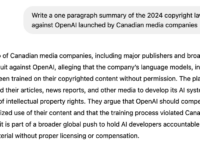
ChatGPT response, December 2024

Canadian Media Companies Target OpenAI in Copyright Lawsuit But Weak Claims Suggest Settlement the Real Goal

Canada’s largest media companies, including the Globe and Mail, Toronto Star, Postmedia, CBC, and Canadian Press, came together last week to file a copyright infringement lawsuit against OpenAI, the owners of ChatGPT. The lawsuit is the first high profile Canadian claim lodged against the enormously popular AI service, though there have been similar suits filed elsewhere, notably including a New York Times lawsuit launched last year. While the lawsuit itself isn’t a huge surprise, the relatively weak, narrow scope of the claims discussed below are. Unlike comparable lawsuits, the Canadian media companies claim is largely limited to data scraping, which may be the weakest copyright claim. Moreover, the companies say they have no actual knowledge of when, where, or how their data was accessed, an acknowledgement that doesn’t inspire confidence when there is evidence available if you know where to look.

So why file this lawsuit? The claim is sprinkled with the most obvious reason: the Canadian media companies want a settlement that involves OpenAI paying licence fees for the inclusion of their content in its large language models and the lawsuit is designed to kickstart negotiations. The companies aren’t hiding the ball as there are repeated references along the lines of at all times, Open AI was and is well aware of its obligations to obtain a valid licence to use the Works. It has already entered into licensing agreements with several content creators, including other news media organizations.” The takeaway is that Canadian media companies want to licence their stuff too, much like the licensing agreements with global media companies such as News Corp, Financial Times, Hearst, Axel Springer, Le Monde, and the Associated Press.

Read more ›

December 3, 2024 10 comments News