
Canadian Heritage Minister Steven Guilbeault has told the Wire Report (sub req) that he expects Bill C-10, his Internet regulation bill, to pass through the House and Senate by early 2021 and for the CRTC to establish the regulatory specifics within nine months so that the system is in place by the end of next year. Guilbeault says that he isn’t concerned that the process could drag out for years and create significant industry uncertainty, indicating that “I think this is a really high profile issue. I’m not sure that these companies want to bear the public scrutiny of…trying to delay and delay the implementation of this.”
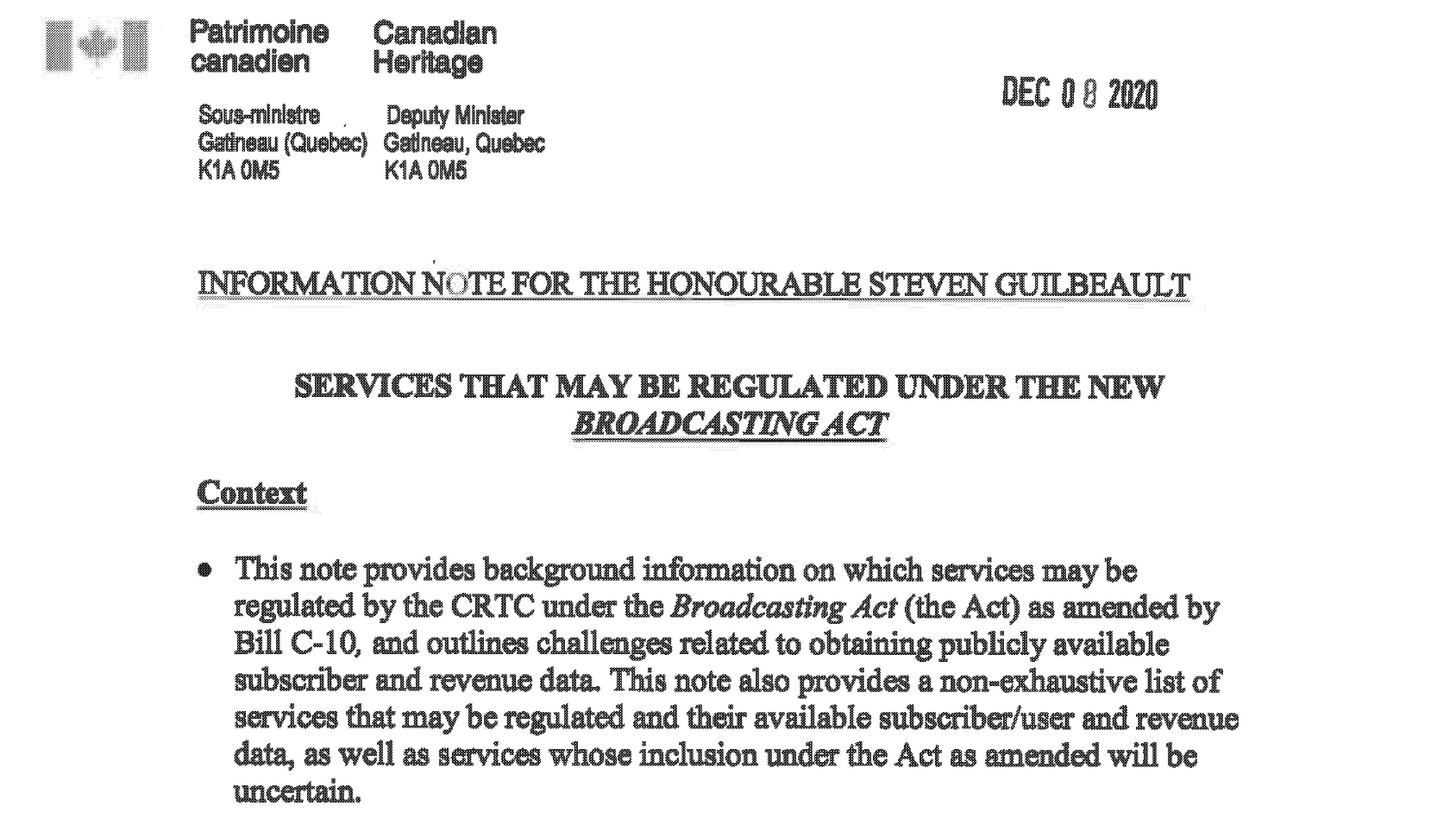
Canadian Heritage Memorandum, December 8, 2020, ATIP A-2020-00498
Bill C-10

The Government’s Internet Regulation Bill: Why Bill C-10 Will Mean a CRTC-Approved Netflix Service, Reduced Consumer Choice, and Less Investment in Canadian Culture
Canadian Heritage Minister Steven Guilbeault tabled his “get money from web giants” Internet regulation bill this morning. As expected, Bill C-10 hands massive new powers to Canada’s telecom and broadcast regulator (the CRTC) to regulate online streaming services, opening the door to mandated Cancon payments, discoverability requirements, and confidential information disclosures all backed by new fining powers. Given that many of the details will be sorted out by the CRTC, the specifics will take years to unfold. In the short term, the bill creates considerable marketplace uncertainty that could lead to reduced spending on Canadian film and television production and delayed entry into Canada of new services. Once the policies are in place, the end result will be CRTC-approved versions of Netflix, Disney+, or Amazon Prime in which the regulator decides how these services promote Canadian content to their subscribers.

“You’re Misleading Us”: Canadian Anti-Counterfeiting Network Calls for Elimination of Court Oversight For Border Seizures
Bell’s promotion of a site blocking system in Canada – rejected by the CRTC on jurisdictional grounds – was grounded in the view that it could establish a mandated blocking approach without court orders. That placed the Canadian proposal off-side the vast majority of site blocking systems around the world, but it also pointed to mounting efforts to exclude the courts from the realm of copyright enforcement. For example, the Canadian Anti-Counterfeiting Network recently appeared before the Industry committee to argue for legislative reforms that would eliminate court oversight for seizures at the border. In its place, the group argued that customs authorities should be empowered to seize and destroy goods without court review.

Just Passing Through: Why Canadian Anti-Counterfeiting Law Should Not Permit In-Transit Shipment Searches
As Canadian officials prepare for the forthcoming NAFTA renegotiation, changes to Canada’s border measures provisions seem likely to surface as a U.S. demand. Late last month, the USTR released its annual Special 301 report and the issue of Canadian anti-counterfeiting law – in particular, the absence of provisions to allow for the search of in-transit shipments that are not bound for Canada – topped the list of concerns. The U.S. report states:
The United States remains deeply concerned that Canada does not provide customs officials with the ability to detain, seize, and destroy pirated and counterfeit goods that are moving in transit or are transshipped through Canada. As a result, the United States strongly urges Canada to provide its customs officials with full ex officio authority to address the serious problem of pirated and counterfeit goods entering our highly integrated supply chains.
The U.S. position has garnered some support in Canada. For example, a recent Globe and Mail editorial urged the government to change the 2014 anti-counterfeiting law by granting customs agents the power to search and seize shipments that are not bound for Canada.

The Trouble With the TPP, Day 24: Missing Balance on IP Border Measures
The day after Canada signed the TPP (and a Leger poll found huge opposition to the agreement’s IP and ISDS provisions), the shift toward consultation and study can continue in earnest. Chrystia Freeland, Canada’s Minister of International Trade, used the signing to emphasize once again that signing is not the same as ratifying and that the government is committed to a robust Parliamentary and public review of the agreement.
The Trouble with the TPP series continues today with another example of the lack of balance in the text. An earlier post noted how in the TPP rights holders’ provision are often mandatory, while those for users are treated as optional. The lopsided approach is also evident in the border measures rules. This week I discussed the expansion of border measures provisions without court oversight, which could lead to customs officials being asked to make difficult legal assessments on whether to detain goods entering the country.

Recent Posts
 Years of Uncertainty: Bill C-22’s Missing Regulations and Secret Ministerial Orders
  The Missing Charter Statement: Why Hasn’t the Government Explained How Bill C-34’s Social Media Ban Complies with the Charter?
  Three Years After October 7th: Living With the Shockwaves
  What If the U.S. Demanded This? The Cloud Provider Conditions Behind Canada’s EU Digital Pivot
  Ontario is Done Waiting for Universities to Act on Campus Antisemitism
