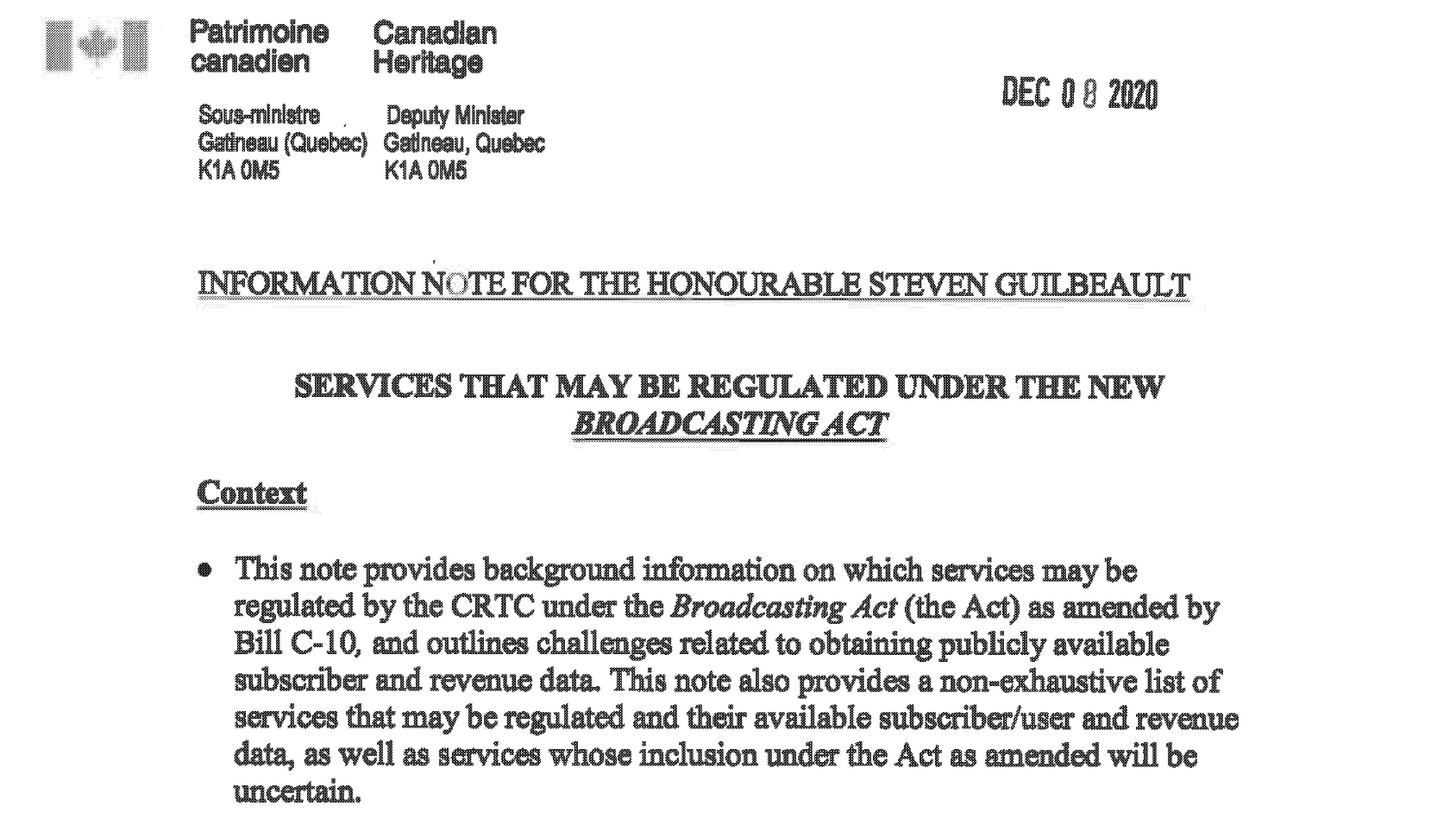
Canadian Heritage Memorandum, December 8, 2020, ATIP A-2020-00498

Canadian Heritage Memorandum, December 8, 2020, ATIP A-2020-00498

Bill C-10

Canadian Chamber of Commerce Floats Fake $30 Billion Counterfeiting Claim

This week the Canadian IP Council, the Canadian Chamber of Commerce’s IP lobby arm, issued a release placing Canadian counterfeiting costs at $30 billion per year. That figure is being used to lobby the government to enact new border measure provisions that could lead to the searching of luggage as travellers enter Canada. It is tempting to dismiss the claims on the basis that the policy rationale makes no sense – if counterfeit toothpaste is indeed “coming across the border in droves” as the Chamber claims, searching traveller luggage won’t address that issue. Moreover, it should be noted that even the Anti-Counterfeiting Trade Agreement features an exception for de minimis imports that an individual might carry as it recognizes that addressing counterfeiting concerns does not involve targeting individuals. Yet given the decision to resurrect the bogus $30 billion figure, it is important to again call attention to its origins and how it is simply a fabrication.

[Update: New post with the Chamber’s response and more fake figures]

Several years ago I examined the source of the $30 billion claim, which has been repeated on many occasions over the years. The review started with an Access to Information request with the RCMP for the source of the $30 billion claim, which was found in a 2005 report. The RCMP responded that the figure was based on “open source documents found on the Internet.” What were these documents? The RCMP provided two:

First, a March 2005 CTV news story reported unsubstantiated claims by the International Anti-Counterfeiting Coalition, a global anti-counterfeiting lobby group made up predominantly of brand owners and law firms, that some of its members believe that 20 percent of the Canadian market is “pirate product.”  That 20 percent figure – raised without the support of any evidence whatsoever – appears to have been used by IACC to peg the cost of counterfeiting in Canada at $20 billion per year.

Second, a 2005 powerpoint presentation by Jayson Myers, then the Chief Economist for the Canadian Manufacturing and Exporters, included a single bullet point that “estimated direct losses in Canada between $20 billion and $30 billion annually.” The source for this claim?  According to Mr. Myers, it is simply 3 to 4 percent of the value of Canada’s two-way trade.

In recent years, the RCMP has backed away from the $30 billion claim. In its August 2010 report on IP crime, it declined to set a figure, acknowledging that the numbers “have been subject to debate in recent years.”


Read more ›

June 8, 2011 21 comments News

U.S. Confirmed as “Lone Hold Out” on ACTA Transparency

KEI has obtained a new document under the U.S. Freedom of Information Act that confirms that the U.S. was the “lone hold out” in disclosing drafts of the Anti-Counterfeiting Trade Agreement during the Summer of 2010.

Read more ›

April 27, 2011 Comments are Disabled News

Burberry, Louis Vuitton Seek Millions in Damages For Counterfeiting Using Current Canadian Law

Burberry and Louis Vuitton have filed lawsuits against three Canadian companies seeking millions in damages for selling counterfeit handbags and other products. The lawsuit relies on current trademark and copyright law.

Read more ›

March 10, 2011 6 comments News

European Commission Sued Over ACTA Secrecy

The European Commission has revealed that it is currently being sued over ACTA secrecy.  In October 2010, MEP Marietje Schaake asked several questions of the EC including one on non-transparency.  The EC’s response now includes “since this issue is currently the object of a court case lodged by an Member […]

Read more ›

January 27, 2011 Comments are Disabled News

Wikileaks ACTA Cables Reveal Concern With U.S. Secrecy Demands

The Guardian has posted two Wikileaks cables that focus on the Anti-Counterfeiting Trade Agreement.  The first is from Italy in November 2008.   It provides a useful reminder that the U.S. at one time hoped to conclude the ACTA negotiations by the end of 2008 (and the George Bush term).  The cable quotes the Italian head of the IP office within the Ministry of Foreign Affairs as saying that timeline was unrealistic:

European countries are likely to ask for a slowdown in negotiations because of opposition to the EU commission’s involvement in negotiating portions of the treaty, disagreements over the confidentiality level of the negotiations, and the absence of geographical indications from the agreement.

The official also noted opposition among member states with the European Commission negotiating criminal matters and ongoing frustration with the level of secrecy associated with ACTA that made it impossible to properly consult stakeholders:

The level of confidentiality in these ACTA negotiations has been set at a higher level than is customary for non-security agreements. According to Mazza, it is impossible for member states to conduct necessary consultations with IPR stakeholders and legislatures under this level of confidentiality. He said that before the next round of ACTA discussions, this point will have to be renegotiated.

The official characterized ACTA as “TRIPS Plus” and noted (correctly) that geographic indications was likely to become a major sticking point.

Read more ›

December 22, 2010 5 comments News