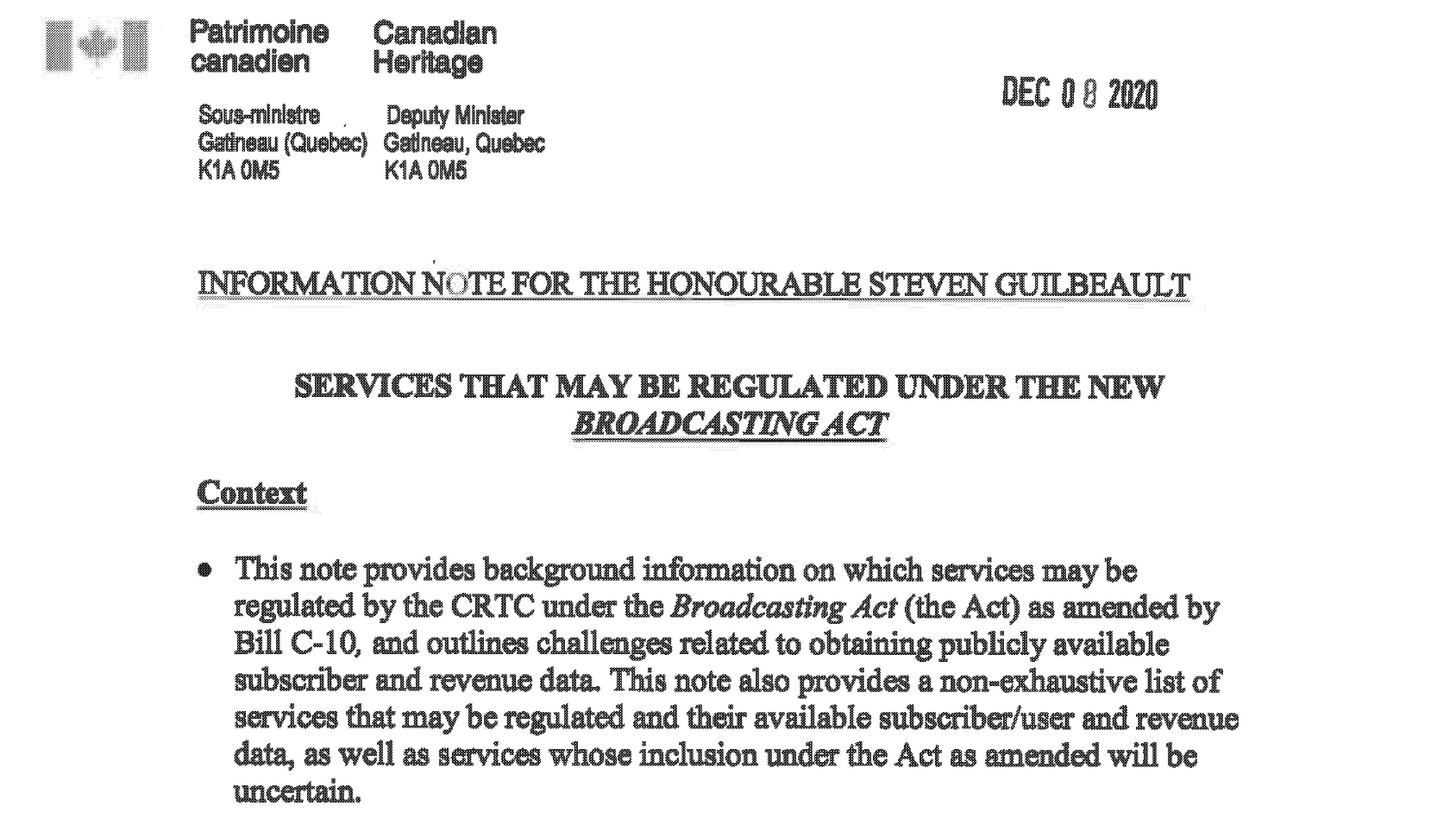
Canadian Heritage Memorandum, December 8, 2020, ATIP A-2020-00498

Canadian Heritage Memorandum, December 8, 2020, ATIP A-2020-00498

Bill C-10

Putting Together the ACTA Puzzle: Privacy, P2P Major Targets

Negotiations on the Anti-Counterfeiting Trade Agreement resume next month in Morocco, but as the discussions drag on, details on the proposed treaty are beginning to emerge.  Obtaining information through official channels such as Freedom of Information requests has been very difficult; however, there is little doubt that lobby groups have been privy to inside information and so reliable sources have begun to sketch a fairly detailed outline of the proposed treaty.

There is some good news from the details that have started to emerge.  First, the treaty is far from complete as there are six main chapters and some key elements have yet to be discussed.  Moreover, it is clear that there is significant disagreement on many aspects of the treaty with the U.S. and Japan jointly proposing language and many countries responding with potential changes or even recommendations that the language be dropped altogether. 

If that is the good news, the bad news is that most other fears about the scope of ACTA are real.  The proposed treaty appears to have six main chapters: (1) Initial Provisions and Definitions; (2) Enforcement of IPR; (3) International Cooperation; (4) Enforcement Practices; (5) Institutional Arrangements; and (6) Final Provisions.  Most of the discussion to date has centred on the Enforcement of Intellectual Property Rights chapter.  As for the other chapters, the U.S. has supplied some proposed definitions and Canada supplied a "non-paper" on the institutional arrangements once a treaty is concluded that calls for the creation of an "ACTA Oversight Council" that would meet each year to discuss implementations, best practices, and assist other governments who are considering joining ACTA.

The work on Enforcement of IPR is broken down into four sections – civil enforcement, border measures, criminal enforcement, and Rights Management Technology/the Internet.


Read more ›

February 3, 2009 6 comments News

The Chamber of Commerce’s Counterfeit Claims

The Canadian Chamber of Commerce's IP lobbying arm, the Canadian IP Council (members include CRIA and major pharmaceutical companies), will release a new set of recommendations for Canadian IP reform tomorrow.  Based on their past comments, it is reasonable to expect that the report to claim that Canadian IP law is outdated and that combating counterfeiting and piracy will require WIPO ratification, new criminal provisions, and stronger border measures.  As evidence, the report will claim that a conservative estimate of the costs of Canadian counterfeiting is $22 billion per year.  As discussed last week, notwithstanding opposition from local chapters like Hamilton, the Chamber has emerged as a leading lobby group with regular meetings, the promotion of ACTA, and repeated claims about the scope of Canadian counterfeiting.

While no one should be supportive of counterfeiting, the reality is that there have been numerous arrests in recent weeks, suggesting that Canadian law is not exactly powerless to combat counterfeiting.  Moreover, data from the U.S. Customs and Border Protection Service indicates that Canada is not a major source of counterfeit goods as we did not rank among the top ten sources of seizures in 2008.  Most troubling, however, is the Chamber's consistent reliance on unsubstantiated data that has no credibility. 

Read more ›

February 2, 2009 3 comments News

Canada’s Private ACTA Talking Points

While the Canadian government has dutifully followed the U.S. line on ACTA with bland releases following each of the four 2008 negotiation sessions, newly obtained documents under the Access to Information Act reveal that the Canadian delegation may be speaking out on some of the public concerns that have been raised around transparency and the exclusion of many countries from the negotiation process [download here].  The documents include several noteworthy revelations:

First, the documents confirm that the leaked ACTA document from last year was indeed the ACTA Discussion Paper distributed among governments.  At the time, there was some question as to whether this was an industry wish-list or a government document.  The Canadian documents confirm that this was a government document, a suggested intervention notes that "we would like to raise the issue of communications.  As you all know by now, the ACTA Discussion Paper has been leaked . . . "

Second, the documents reveal that Canada submitted two "non-papers" to the other countries in advance of the first round of negotiations last year.  The two papers focused on (1) institutional and procedural issues to be addressed during the negotiations and (2) institutional issues following the negotiation of ACTA. 

Third, the documents include suggested interventions for the Geneva meeting last June. 

Read more ›

January 29, 2009 4 comments News

RCMP Arrests Three For Pirated DVD Sales

The RMCP in Hamilton have arrested four men for violating the Copyright Act by selling pirated DVDs.

Read more ›

January 29, 2009 5 comments News

Why the U.S. Lost Its WTO IP Complaint Against China. Badly.

The World Trade Organization yesterday released its much-anticipated decision involving a U.S. complaint against China over its protection and enforcement of intellectual property rights.  The U.S. quickly proclaimed victory, with newspaper headlines trumpeting the WTO panel's requirement that China reform elements of its intellectual property laws.  For its part, China was conciliatory and offered to work with the international community to resolve the concerns raised by the decision.  Reuters notes that the Chinese reaction is far less combative than it has been other issues.

Why the muted response?  I suspect that it is because anyone who bothers to work through the 147 page decision will find that the headlines get it wrong.  The U.S. did not win this case, but rather lost badly. China is required to amend elements of its copyright law, but on the big issues of this case – border measures and IP enforcement – almost all of the contested laws were upheld as valid.  Further, the ramifications of this case extend well beyond China's laws into other areas such as ACTA, since it points to the considerable flexiblity that countries have in meeting their international obligations on these issues.

The case centred on three key issues:

Read more ›

January 27, 2009 15 comments News