Ariel Katz reports that the University of Toronto has notified Access Copyright that it will not extend the current licence agreement. It points to a range of factors – the SCC decisions, copyright reform, and open access among them – to argue that there should be substantial reductions in the […]
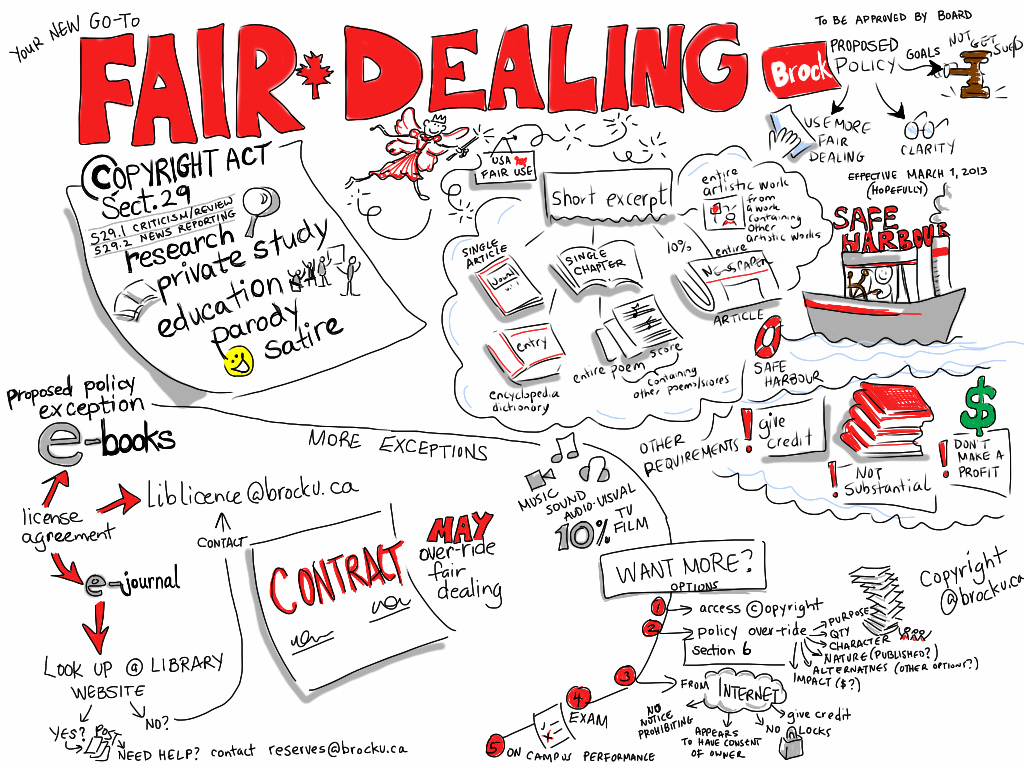
Fair Dealing by Giulia Forsythe (CC BY-NC-SA 2.0) https://flic.kr/p/dRkXwP
Copyright
The Trouble with the Trans Pacific Partnership: My Appearance before the International Trade Committee
Earlier this week, I was invited to appear before the House of Commons Standing Committee on International Trade to discuss the benefits of the Trans Pacific Partnership, a proposed trade agreement involving the U.S., Canada, Australia, New Zealand, and a handful of other Asian and South American countries. My comments were critical of the proposed agreement as I focused on two issues: copyright and secrecy. The opening comments sparked a lively debate, with the NDP MPs tabling documents I obtained under the Access to Information Act detailing inside access to TPP information for select stakeholders and the Conservative MPs alternately questioning the validity of leaked texts and providing assurances that draft text could change before the final agreement is concluded. I’ll post the transcript once it is available. In the meantime, my opening remarks are posted below.
Podcast on Intellectual Property
I talked to Robert Harris on his podcast about Intellectual Property. Listen to the audio here.
Canadian Library Association on Access Copyright Lawsuit
The Canadian Library Association issued a statement late last week on the Access Copyright lawsuit filed against York University, urging it to abandon the lawsuit and pointing to several legal concerns.
Next on the Canadian Copyright Reform Agenda: Clean Up the Mess at the Copyright Board
With the latest phase of Canadian copyright reform now complete, the government may soon turn to the question of what comes next. Given last year’s major legislative overhaul and the landmark series of copyright decisions from the Supreme Court of Canada, significant substantive changes are unlikely to be on the agenda for the foreseeable future.
Instead, my weekly technology law column (Toronto Star version, homepage version) argues that it is time for the government to set its sights on the Copyright Board of Canada, a relatively obscure regulatory body that sets the fees to be paid for the use of copyright works. The Board is largely unknown in public circles, but it has played a pivotal role in establishing the costs associated with private copying (including a one-time iPod levy), educational copying, and the use of music by Canadian broadcasters.
The litany of complaints about the Board has mounted in recent years: the public rarely participates in its activities due to high costs, it moves painfully slowly by only issuing a handful of decisions each year, and its rules encourage copyright collectives and users to establish extreme positions that make market-driven settlements more difficult.
Moreover, over the past ten months, the Supreme Court has ruled that its approach to fair dealing was unreasonable, the Board itself admitted to palpable error in a decision that resulted in a hugely inflated tariff, and it has ignored the will of Parliament in reshaping Canadian copyright law. The Board may keep a steady stream of lawyers and economists busy, but it is time to acknowledge that it is broken.

Recent Posts
 A Standard That Doesn’t Exist: Parliamentary Secretary for Justice Offers Misleading Defence of Bill C-22’s Lower Threshold for Subscriber Information
  More Surveillance Demands to Come?: Government Admits Bill C-22’s Lawful Access Provisions Could Be Expanded
  Win, Lose or Draw?: The Federal Court of Appeal Overrules a Key Copyright Case on Procedural Grounds
  The Lawful Access Debate Begins: Canadians Should Pay Attention to What the Government Isn’t Saying
  The Global Battle for Data Control: How the 2026 U.S. Report on Trade Barriers Targets Data Sovereignty Worldwide
