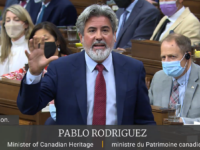
Canadian Heritage Minister Pablo Rodriguez is on the defensive as he tries to defend Bill C-18 in the wake of both Google and Facebook signalling that they may remove Canadian news from search results and social media sharing in light of the government’s approach that creates mandated payments for links. Rodriguez appeared on CBC yesterday and had no answers for the questions about what he will do if the companies walk away from news given government estimates that they could be on the hook for 35% of the news expenditures of every news outlet in Canada if they continue to link to their news content. More notably, he contradicted both his own bill and his own department officials when he told Postmedia that “C-18 has nothing to do with how Facebook makes news available to Canadians.” For those who followed months of gaslighting with Bill C-11, this comment will provide a sense of deja-vu since Rodriguez sometimes leaves the impression has only read media lines, rather than his own legislation.
Archive for March, 2023
Nuanced: Michael Geist on the Importance of Freedom of Expression Online
I appeared on the Nuanced podcast hosted by Aaron Pete on March 15, 2023. In the episode, we discussed Bills C-11 and C-18 and how Canada’s internet-regulation agenda could affect creators and users. The link to the episode is here.
The Dean Blundell Show: DBS One On One with Professor Michael Geist On Bill C-18/C-11
I appeared on the The Dean Blundell Show on March 16, 2023. There, I discussed Bills C-11 and C-18, including their potential impacts on internet regulation, freedom of expression, and digital content creation. The link to the video can be found here.

The Law Bytes Podcast, Episode 159: Fenwick McKelvey on the Rapid Spread of Government TikTok Bans
TikTok may be enormously popular, but according to the growing number of government, there are concerns regarding links between the app and the Chinese government. That has led to a rapid spread bans of the TikTok app on government devices not only at the federal level, but at provincial and municipal governments and even at universities for university-owned devices. But is TikTok unique in this regard? How to reconcile the government’s insistence that TikTok contribute to Cancon in Bill C-11 with it banning the app due to security risks? Are the privacy concerns more about TikTok or the government’s inaction on privacy reform?
Fenwick McKelvey is an Associate Professor in Information and Communication Technology Policy in the Department of Communication Studies at Concordia University and the co-director of the Applied AI Institute. He returns to the Law Bytes podcast to talk about the TikTok bans, the state of Canadian policy in addressing the concerns, and why we may be heading for more geo-political battles over digital policy.

The Consequence of Mandated Payments for Links: Facebook Confirms It Will Drop News Sharing in Canada Under Bill C-18
Google has been in the spotlight for the past few weeks with reports that it has been testing removal news links from search results. The move sparked outrage from MPs, who grilled executives earlier today at Canadian Heritage committee. But now it appears Google has company: the Globe and Mail reports that Facebook has confirmed that it will remove news sharing from its platforms if Bill C-18 passes in its current form. The decision, which would affect Meta platforms Facebook and Instagram, should not come as a surprise since it warned that it was considering the possibility last fall. In fact, the case for Facebook blocking news sharing is even stronger than Google given that news constitutes only three percent of news feeds on the platform and the experience in Australia was that its removal had little impact on user engagement.

Recent Posts
 Regulator First, Rules Later: Bill C-34 Debate Shows the Government Wants a Digital Safety Commission Before It Figures Out What It Will Do
  Making the Case Against Its Own Bill: What the Government’s Bill C-34 Charter Statement Reveals About the Constitutional Vulnerability of the Social Media Ban
  “Position Has Not Changed”: The Canadian Government Reaffirms That Antisemitism Includes Anti-Zionism
  The Law Bytes Podcast, Episode 279: My Keynote on Digital Sovereignty: Control, Choice, and Connection
  The What, Me Worry? Consultation: Media Quietly Tells Government It Wants Even More Funding With Little Concern for Independence Risks
