I appeared on the Breakfast Television on August 11, 2023. There, I discussed Meta’s decision to block Canadian news links in response to Bill C-18, the short- and long-term effects of the ban, and whether other tech giants might follow suit. The link to the video can be found here.
Archive for August 11th, 2023
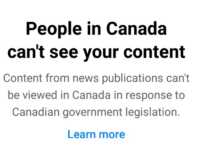
Why Is Meta Blocking All News Links? Because Bill C-18 Covers All News Outlets
Blocking of news links on Facebook and Instagram in Canada has becomes increasingly widespread in recent days, leading to a growing number of public comments from media outlets and reporters expressing surprise or shock about the scope of the link blocking. Indeed, outlets with blocked links include university student newspapers, radio stations, and foreign news outlets. While there may have been some errors (Facebook has a page to seek review of any blocked link decision), the inclusion of a very wide range of Canadian and foreign news outlets is no accident. Rather, it reflects the government’s Bill C-18 approach, which effectively covers all news outlets worldwide whose links are accessed in Canada. The Canadian government could have adopted a more targeted approach – for example, limiting the scope to news links from those news outlets eligible to negotiate agreements with Internet platforms under the law – but it instead went for the broadest possible approach that includes foreign news outlets with little or no connection to Canada.

Recent Posts
 The Missing Charter Statement: Why Hasn’t the Government Explained How Bill C-34’s Social Media Ban Complies with the Charter?
  Three Years After October 7th: Living With the Shockwaves
  What If the U.S. Demanded This? The Cloud Provider Conditions Behind Canada’s EU Digital Pivot
  Ontario is Done Waiting for Universities to Act on Campus Antisemitism
  Is Compromise on Encryption Possible? Why Bill C-22’s “Minor Opening” Leaves the Central Question Unanswered
