Appeared in the Toronto Star on June 13, 2016 as Security Agencies Need to Fess Up About Illegal Privacy Breaches Three years ago this month, Edward Snowden shocked the world with a series of disclosures that revealed a myriad of U.S. government-backed surveillance programs. The Snowden revelations sparked a global […]
 Articles by: Michael Geist

Why the Privacy Commissioner Doesn’t Need Legal Reforms To Require Transparency Reports
Privacy Commissioner of Canada Daniel Therrien was in the news this week as he expressed concern with the evasiveness of Canada’s spy agencies and the ongoing refusal of some of Canada’s telecom companies (namely Bell) to issue transparency reports. I’ll have more to say about privacy and government agencies in my technology law column next week, but on the issue of telecom transparency reports, I believe that Therrien already has the necessary legal mandate to act now. Therrien urged all telecom companies to release transparency reports, noting:
“I think Canadians are telling us, first of all, that they would much prefer that data be shared from telcos to government only with a warrant, with a court authorization. But when that does not happen, Canadians expect that there be transparency…frankly, if there’s not more progress I will continue to call for legislation on this issue.”
I wrote about why Canada’s telecom transparency reporting still falls short late last month, emphasizing that a non-binding approach to transparency reporting has been a failure.
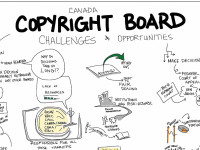
Former Copyright Board Chair Vancise Takes Aim at the Board Critics
The Honourable William Vancise, the former Chair of the Copyright Board of Canada, recently delivered a combative (and entertaining) speech at an ALAI conference in which he took the critics of the board head on. Although the conference was focused on the future of the Copyright Board, many lawyers who regularly appear before the board seemed reluctant to air their concerns in public. Instead, it fell to Vancise to liven the proceedings. The board has posted the speech online and it is well worth a read. I was in the audience and came in for criticism for this 2013 article titled It’s Time to Admit the Copyright Board is Broken.
Vancise reserved his strongest criticism for Music Canada and its lobbying campaign against Tariff 8:

The TPP’s Impact on Canadian Culture Emerging as Political Issue
Earlier this year, I posted on the cultural implications of the TPP, noting that the agreement represents a departure from trade deals by creating restrictions on Canadian cultural policy. Assuming services such as Netflix argue that any mandated Cancon contribution is discriminatory if they do not also receive the benefits accorded to established broadcasters or broadcast distributors, the TPP will effectively ban applying Cancon contributions to exempt entities.
Now it appears that the implications of the TPP for Canadian cultural policy are beginning to attract attention. Question period in the House of Commons featured the following exchange this week:

Industry Canada to Foreign Affairs After CETA Leaks: Can We Get a Copy of the Text?
As the Canada – EU Trade Agreement faces mounting opposition in Europe, it is worth looking back at the late stages of CETA negotiations that occurred after an October 2013 announcement that a deal had been reached. That announcement did not include a release of the text, which was still the subject of months of negotiations. In fact, long after the initial announcement, there were reports that European concerns with investor-state dispute settlement provisions were about to derail the entire agreement. By July 2014, it was obvious that CETA was in jeopardy. In August 2014, there were more assurances from the Canadian government about an agreement, but still no text. That same month, the agreement finally did become public, but only after a German public television leaked it online.
Documents obtained under the Access to Information Act show that Canadian government officials scrambled to respond. While the official line will be familiar – “Canada does not comment on the leaks of purported negotiating texts” – internally, officials were left scrambling as the agreement leaked in real time. In fact, after learning that additional appendices and materials had leaked online, Canadian official joked that “they’re scanning as fast as they can.”

Recent Posts
 The What, Me Worry? Consultation: Media Quietly Tells Government It Wants Even More Funding With Little Concern for Independence Risks
  Years of Uncertainty: Bill C-22’s Missing Regulations and Secret Ministerial Orders
  The Missing Charter Statement: Why Hasn’t the Government Explained How Bill C-34’s Social Media Ban Complies with the Charter?
  Three Years After October 7th: Living With the Shockwaves
  What If the U.S. Demanded This? The Cloud Provider Conditions Behind Canada’s EU Digital Pivot
