Post Tagged with: "charter"

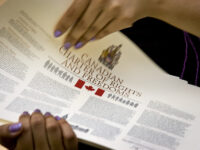
Every_Canadian_Needs_A_Copy by Marc Lostracci, CC BY 2.0 , via Wikimedia Commons https://commons.wikimedia.org/wiki/File:Every_Canadian_Needs_A_Copy.jpg

Why the Government’s Plan for a Social Media Ban in Bill C-34 Is Unconstitutional

he debate over the government’s proposed social media ban for under 16s has raised several difficult questions, including doubts about whether it will work, which services it will cover, and what risks to privacy mandating age verification could create. But beyond the operational questions is a more fundamental one: is the ban constitutional? Bill C-34 contains some signals that the government knows there are serious constitutional vulnerabilities, given the obvious implications for freedom of expression that come from blocking an entire cohort of Canadians from accessing information and expressing themselves on social media. The bill contains several provisions that are seemingly designed to act as safeguards that could be used to argue that the ban is proportionate. These include guidance on age verification technologies to address privacy concerns, promises that the verification obligation does not require measures that “unreasonably or disproportionately” limit expression, a requirement that the new Digital Safety Commission consider freedom of expression, equality, and privacy when it establishes regulations and guidelines, and the ability for services to seek a ban exemption if they can demonstrate adequate safeguards for children.

Even with these measures, the ban might still be found to be unconstitutional. But if you think they provide a plausible argument that the ban can be justified (as Emily Laidlaw argues here), the problem is that none will be operational when the ban takes effect. In other words, there is a major disconnect between the law the government says it is establishing and the one it plans to implement. If the safeguards are not implemented and millions of Canadians are required to verify their age to express themselves on social media, I believe the ban is likely to face an immediate court challenge and that a court will rule it violates the Charter of Rights and Freedoms.


Read more ›

July 16, 2026 10 comments News
Protect Charter Rights by Moon Angel https://flic.kr/p/8hRLeA (CC BY-SA 2.0)

A Standard That Doesn’t Exist: Parliamentary Secretary for Justice Offers Misleading Defence of Bill C-22’s Lower Threshold for Subscriber Information

The lawful access debate continued for a third day on Friday with Bloc MP Claude DeBellefeuille asking Patricia Lattanzio, the Parliamentary Secretary to the Minister of Justice, a critical question: why has the government chosen “the lowest possible threshold for obtaining information, that of reasonable grounds to suspect, rather than the more stringent threshold of reasonable grounds to believe.” She added that she did not understand the choice and would like a clear answer (I focused on this issue in a previous post). In keeping with the government’s discouraging defence of lawful access thus far (my posts on day one and day two of debate) Lattanzio’s response went for deception rather than clarity. After noting that reasonable grounds to suspect already appears in parts of the Criminal Code, she offered the government’s substantive defence of the lower threshold in a single sentence: “We also think that ‘reasonable grounds to suspect’ is higher than the threshold of mere suspicion.” The problem is that mere suspicion isn’t a threshold for search at all, but rather the standard the courts point to when a search is unconstitutional.

Read more ›

April 18, 2026 1 comment News
Twitter by Solen Feyissa https://flic.kr/p/2jL9hdX (CC BY-SA 2.0)

Federal Court Approves Consent Order Requiring Minister Steven Guilbeault to Unblock Ezra Levant on Twitter

The Federal Court has approved a consent order requiring Environment and Climate Change Minister Steven Guilbeault to unblock Rebel News publisher Ezra Levant on Twitter. The order stems from a 2021 lawsuit filed by Levant which argued that blocking “violated the Applicants’ constitutional rights under section 2(b) of the Canadian Charter of Rights and Freedoms in blocking access to official governmental Twitter accounts, and thereby limiting the Applicants’ ability to, inter alia, access and communicate important information, participate in public debate, and express views on matters of public concern.” The order also includes a $20,000 cost award to Levant. Regardless of your views of either Levant or Guilbeault, the principle that government ministers should not block access to their feeds given the implications for freedom of expression is an important one.

Read more ›

September 12, 2023 5 comments News

One Phone Call is Not Enough: Court Rules You Have the Right to Google a Lawyer

Hollywood crime dramas are infamous for the scene when an accused is taken to a local police station and permitted a single phone call to contact a relative or lawyer. While the storyline is myth – there is no limit on the number of phone calls available to an accused or detainee – a recent Alberta case established a new, real requirement for law enforcement. After a 19-year old struggled to find a lawyer using the telephone, the court ruled that police must provide an accused with Internet access in order to exercise their right to counsel.

Christopher McKay, who faced a driving while under the influence charge, told police that he wanted to exercise his right to legal counsel. McKay’s cellphone and other personal belongings were placed in a police locker when he arrived at the station. McKay was told there was a toll-free number available to contact a lawyer as well as White and Yellow pages that could be consulted. He called the toll-free number but was unable to find assistance.

My weekly technology law column (Toronto Star version, homepage version) notes that what followed was the product of a demographic deeply familiar Hollywood movies and reliant on the Internet. McKay assumed that he had used his single phone call and did not consider using directory assistance (411), which he did not think was a “viable search engine.” Instead, he noted that Google was his main method to search for information.

Read more ›

February 19, 2013 17 comments Columns

Supreme Court To Hear Case Challenging Constitutionality of Privacy Law

The Supreme Court of Canada yesterday granted leave for what could be the most important privacy case in years as it addresses “whether the Personal Information Protection Act [Alberta’s private sector privacy law] is contrary to s.2(b) of the Charter and if so, whether it constitutes a reasonable limit in […]

Read more ›

October 26, 2012 1 comment News