
Second reading debate on Bill C-34, the Safe Social Media Act, began yesterday in the House of Commons, with the government pressing opposition MPs on whether they support creating the Digital Safety Commission, its proposed Internet regulator. While there was some broad acknowledgement that someone needs to administer the regulatory plan, it was striking to see the government focus on the regulator rather than the regulation. Liberal MP Kevin Lamoureux asked Conservative critic Rachael Thomas whether “in principle, the Conservative Party recognizes the value of having such a commission” and later asked Bloc critic Martin Champoux whether his party sees “the principle of having that commission as a positive thing.” When Culture Minister Marc Miller was asked what standards a platform would need to meet for an exemption to the under-16 social media ban, he responded that the way to protect kids is “to make sure we have a regulator in place that can put together precisely these guidelines.” That is a bug, not a feature of a bill that, as I wrote when the bill was tabled, punts roughly 50 key decisions to cabinet and a commission that does not yet exist. The initial debate confirms that the government plans to build the regulator first and work out the details later.
Post Tagged with: "commission"

The Commission: How Bill C-34 Creates an Internet Super-Regulator That Will Touch the Lives of Millions of Canadians
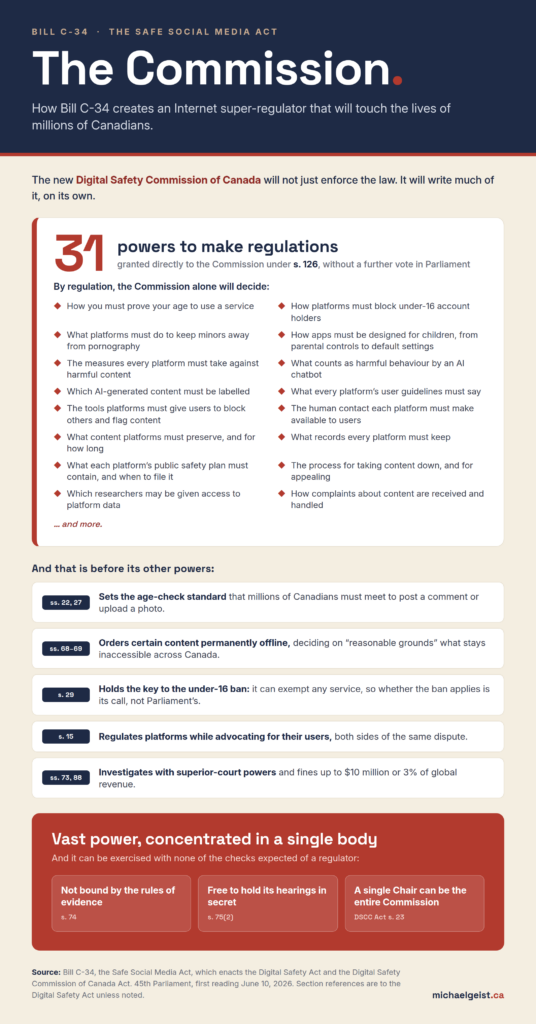
The proposed kids’ social media ban is capturing the headlines, but lost in the debate over Bill C-34 is that its most consequential element may be the creation and powers of the government agency the bill establishes to oversee the entire system. The Digital Safety Commission of Canada will be a super-regulator of the Internet, with greater influence over the daily lives of Canadians than perhaps any other regulator in the country. The breadth of its influence can’t be overstated: it will set the standards that millions of Canadians must satisfy to verify their age in order to use social media services. It will establish what platforms must do about harmful content, including the removal of certain material. It will determine whether the age-gating requirement may be lifted for any given service. It will both regulate the platforms and advocate for their users, dual roles that raise obvious fairness concerns. And it will exercise investigative and adjudicative powers, complete with penalties, hearings, and formal, law-enforcement-style investigations. Yet despite all those powers, it will not be bound by the rules of evidence, will be free to conduct its hearings in secret, and, at least in the beginning, will be capable of operating as a one-person body in which the Commission and its Chair are one and the same individual. The full scope of the new powers is illustrated in the infographic below.
Recent Posts
 Has the Government Read Its Own Bill? What Three Days of House Debate Revealed About Bill C-34 Before the Committee Hearings Begin
 Surveillance By Design: Government Officials Say Lawful Access Could Reach Gaming Platforms, Daycares and AI Services
 Canada’s First Digital Trade Agreement: Why the Canada-EU Deal Will Likely Follow Europe’s Template and What That Means for Canadian Digital Law
 The Law Bytes Podcast, Episode 281: Mikolaj Barczentewicz on Europe’s Digital Sovereignty Push, CADA, and the Implications for Canada
 Ofcom Did the Work Canada Plans to Skip: What the UK’s Age Verification Report Reveals About the Bill C-34 Social Media Ban
