
The debate over Bill C-34’s social media ban for those under sixteen has largely focused on the impact on users, including mandated age verification for millions, the privacy risks of verification technologies, and experience elsewhere suggesting the policy is ineffective. Defenders of the ban have characterized the Canadian approach as a “soft ban” that will allow social media companies to obtain exemptions provided they meet yet-to-be-determined safety standards. This approach is said to create incentives for companies to address safety concerns and qualify for the exemption. But a closer look at the bill reveals that the approach does not work, as even “safe” services will be required to implement age verification for tens of millions of users. By the time the Digital Safety Commission has figured anything out, the services will have verified most of the country and likely lost users in the process. This is true not only for services that require significant design changes, but even those services that today would be widely acknowledged to be safe for children.
Post Tagged with: "digital safety commission"

New Rights, New Powers, Long Delays: Bill C-36’s Seven-Step Process for Privacy Reform to Take Effect
The government’s recently tabled privacy reform bill would modernize many aspects of Canadian privacy law, including establishing privacy as a fundamental right in the purpose clause of the new law, creating a data mobility right for individuals that would enable them to move their data from one company to another, and giving businesses the potential to use approved codes of practice. These and many other changes will be subject to intense debate at committee, but the biggest challenge facing the bill is the long sequence of steps required for it to take effect. The government may claim that privacy is an urgent priority, and its recent national AI strategy, overseen by AI Minister Evan Solomon, declares trust to be its “north star”, yet a careful review of Bill C-36 confirms that the law will take years to take effect. This post and the accompanying infographic unpack the many steps built into the bill that, cumulatively, are likely to result in no substantive privacy reforms for Canadians until 2030 or later.

Canada’s Digital Super-Regulator: Bill C-36 Pushes Out the Privacy Commissioner and Hands Private Sector Privacy to an Overloaded Commission
In the last act of an incredibly intense digital policy stretch, the government today tabled new private sector privacy legislation in the form of Bill C-36, the Protecting Privacy and Consumer Data Act. It is a big bill, and my initial take will be divided into two: this post will focus on the seismic shift the bill creates for privacy administration and enforcement, and a second post (hopefully tomorrow) will discuss the substantive changes and additions. I start with the enforcement side because the most consequential feature of C-36 is the question of who will administer the rules. The bill firmly cements the Digital Safety Commission as a new digital super-regulator in Canada, stripping the Privacy Commissioner of authority over private sector privacy law and handing it instead to the same five-member commission the government created a few days ago to police online harms. I believe the approach is unprecedented among peer countries and will have negative repercussions for Canada’s standing in the privacy world. Indeed, removing an Agent of Parliament from private-sector privacy enforcement after decades isn’t something you tuck into a lengthy bill, but rather requires extended public consultation and analysis on how best to ensure Canada has effective privacy enforcement. This is a stunning abrogation of good policy development and a poorly conceived vision of the breadth and importance of privacy.

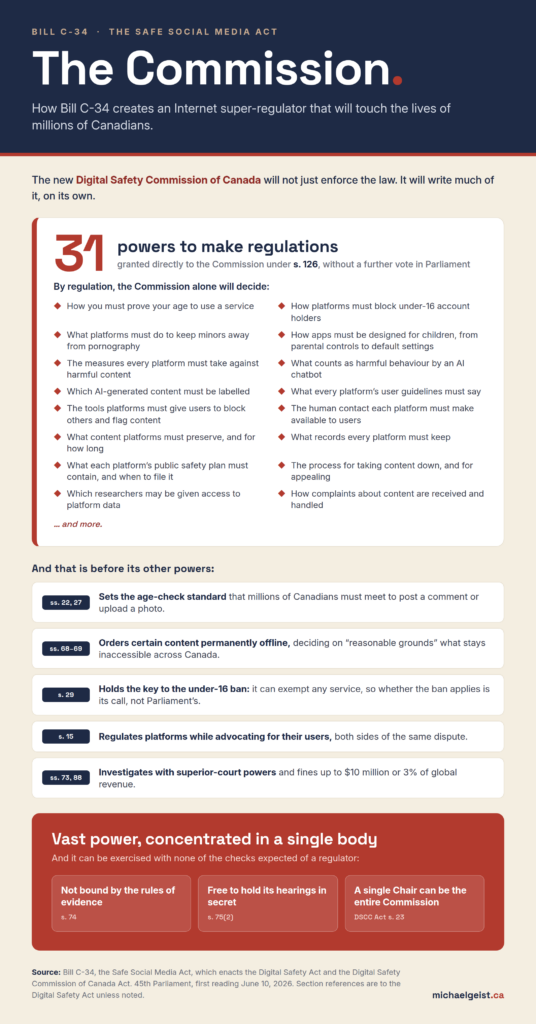
The Commission: How Bill C-34 Creates an Internet Super-Regulator That Will Touch the Lives of Millions of Canadians
The proposed kids’ social media ban is capturing the headlines, but lost in the debate over Bill C-34 is that its most consequential element may be the creation and powers of the government agency the bill establishes to oversee the entire system. The Digital Safety Commission of Canada will be a super-regulator of the Internet, with greater influence over the daily lives of Canadians than perhaps any other regulator in the country. The breadth of its influence can’t be overstated: it will set the standards that millions of Canadians must satisfy to verify their age in order to use social media services. It will establish what platforms must do about harmful content, including the removal of certain material. It will determine whether the age-gating requirement may be lifted for any given service. It will both regulate the platforms and advocate for their users, dual roles that raise obvious fairness concerns. And it will exercise investigative and adjudicative powers, complete with penalties, hearings, and formal, law-enforcement-style investigations. Yet despite all those powers, it will not be bound by the rules of evidence, will be free to conduct its hearings in secret, and, at least in the beginning, will be capable of operating as a one-person body in which the Commission and its Chair are one and the same individual. The full scope of the new powers is illustrated in the infographic below.

The Exemption Illusion: Why the Government’s Plan to Fast Track Bill C-34’s Kids’ Social Media Ban Means No Standards, No Privacy Review, and No Enforcement
One of the most heavily promoted features of Bill C-34, the government’s Safe Social Media Act, is that its social media ban for those under 16 comes with a potential exemption for platforms that satisfy the new Digital Safety Commission that they provide adequate safeguards for children. But based on comments from government officials, it appears the exemption is an illusion, at least for years to come. The legislation carefully sets out how the ban is supposed to work, but officials at a technical briefing on the bill this week described a very different plan that involves moving quickly after Royal Assent with regulations to bring the ban into force without waiting for the Digital Safety Commission to be fully operational. No Commission means no age verification standards, no privacy review, no exemption, and no effective enforcement. It also creates huge risks since the initial start of the ban is when tens of millions of Canadians would be required to verify their age, yet the government is sidelining the privacy protections written into its own bill and essentially conceding that the ban is unlikely to carry any real consequences for those services that fail to comply when it first takes effect.

Recent Posts
 Ontario is Done Waiting for Universities to Act on Campus Antisemitism
  Is Compromise on Encryption Possible? Why Bill C-22’s “Minor Opening” Leaves the Central Question Unanswered
  The Wrong Target: Why the CBC Should Be Asking About the Yom Kippur Protesters, Not the Journalist Who Reported on Them
  Buried in Bill C-39: The Enabling Digital Trade Act Brings Canada Its First Federal Electronic Trade Documents Law
  A Definition That Meets the Moment: Federal Government Recognizes Antisemitism Includes Anti-Zionism
