Post Tagged with: "fair dealing"

CBC News advertising board, CBC Broadcast Centre, Toronto, Southern Ontario, Canada by Pranav Bhatt (CC BY-NC-SA 2.0) https://flic.kr/p/9HBz23

Broadcaster Copyright Misuse and Collusion?: Why Criticism Over the Government’s Political Ad Copyright Exception May Be Pointed in the Wrong Direction

The Canadian Thanksgiving weekend featured escalating rhetoric over the government’s proposed copyright exception for political advertising with claims of fascism, censorship, expropriation, and more. The commentary bears almost no relationship to reality. The truth is that the government and the broadcasters both agree that the current law already permits use without authorization. For all the claims of “theft”, the copyright owner (broadcasters) and user (political parties) both agree that the works can be used without further permission or payment. As Ariel Katz points out this morning, the bigger issue may well be whether Canada’s broadcasters violated the Competition Act by conspiring to not air perfectly lawful political advertisements.

I wrote about the controversy in my weekly technology law column (Toronto Star version, homepage version), but the debate can be boiled down to three issues.

Read more ›

October 14, 2014 22 comments Columns
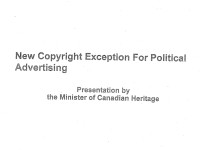
New Copyright Exception for Political Advertising, Presentation by Minister of Canadian Heritage

The Government’s Political Advertising Copyright Exception: Fine Print Shows Proposal Privileges Politicians’ Speech Rights Over the Public

Last night I posted on reports that the Canadian government is considering a new copyright exception for political advertising.  While many have been harshly critical of the plans, I’ve noted that political speech is critically important and that copyright law should not be used to stifle it.  My post argues that the law may already cover some of the uses and that if changes are needed, a better approach would be to adopt a fair use provision in Canada.

I have now obtained a copy of the document that was presented by the Minister of Canadian Heritage. The document is obviously consistent with the media reports, but provides significantly more detail and raises several additional questions and concerns.

Read more ›

October 9, 2014 10 comments News
Fair Dealing by Giulia Forsythe (CC BY-NC-SA 2.0) https://flic.kr/p/dRkXwP

Why Isn’t Fair Dealing Enough?: Government Considering Copyright Exception to Cover Political Advertising

Reports from CTV and the Globe and Mail indicate that the government is planning to introduce a new copyright exception for political advertising. The reports suggest that the exception would permit the use of news content in political advertising without authorization provided that it meets three conditions:

News content would have to meet three criteria for this exemption, the cabinet memo says. It would have to be published or made available through TV broadcasts or platforms such as YouTube. It would have to be obtained from a news source such as a news program or newspaper or periodical. And it would have to feature a political actor operating in that person’s capacity as a politician, or relate to a political issue.

While the reports sparked an immediate reaction claiming the government is legalizing theft, my view is that copyright law should not be used to stifle legitimate speech. Political speech – even noxious attack ads – surely qualifies as important speech that merits protection (see this CDT analysis for similar concerns in the US). I am not a fan of attack ads, but attempts to use copyright to claim absolute rights over the use of a portion of a video clip is surely counter to basic principles of fair dealing (in Canada) or fair use.

Read more ›

October 8, 2014 15 comments News

Appointment of New Copyright Board of Canada Chair Offers Chance for Change

Copyright Board of Canada chair William J. Vancise will see his term come to an end this month, opening the door for the government to start the process of reforming the much-criticized board. Vancise has served the maximum two terms as chair, with his time marked by the Supreme Court of Canada’s rejection of the board’s approach to fair dealing, ongoing frustration from stakeholders about board administrative processes, and the failure of the board to broaden its approach by becoming more inclusive of the public.

The exclusion of the public stands in sharp contrast to the CRTC and Competition Bureau, which have both taken steps in recent years to involve the public more directly in policy making activities, hearings, and other issues. By contrast, the Copyright Board does little to encourage public participation, despite the fact that its decision often have an impact that extends beyond the parties before it. When asked recently about the accessibility and participation concerns, the board pointed to an internal working group as evidence that it regularly reviews its practices and compared itself to the Federal Court of Appeal, noting that “of course they [the public] don’t participate, because they don’t really belong there, per se.”

Read more ›

May 8, 2014 1 comment News

Access Copyright Urges Copyright Board to Ignore Bill C-11’s Expansion of Fair Dealing

As I noted in a post yesterday, Access Copyright has filed its response to the Copyright Board of Canada’s series of questions about fair dealing and education in the tariff proceedings involving Canadian post-secondary institutions. Yesterday’s post focused on how Access Copyright has urged the Copyright Board to ignore the Supreme Court of Canada’s ruling on the relevance of licences to a fair dealing analysis. Today’s post examines the collective’s response to the Copyright Board’s question on the effect of the fair dealing legislative change in Bill C-32/C-11. Access Copyright engages in revisionist history as it seeks to hide its extensive lobbying campaign that warned that the reforms would permit mass copying without compensation.

For two years during the debates over the bill, Access Copyright stood as the most vocal opponent of the expansion of the fair dealing purposes to include education. Given its frequent public comments and lobbying efforts on the bill, one would think its response to the Copyright Board, would be pretty straight-forward. For example, it created a copyright reform website – CopyrightGetitRight.ca – that warned:

the education exception will permit mass, industrial-scale copying (equivalent to millions of books every year) without compensation to the creators and publishers who invested their creativity, skill, money and effort to produce this content.

Read more ›

April 17, 2014 6 comments News