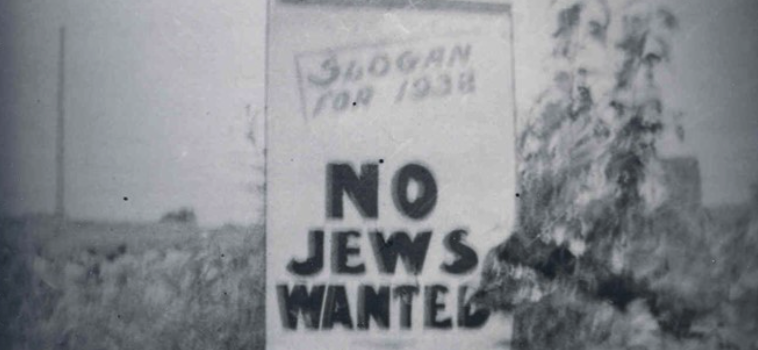
In 1926, McGill University’s dean of arts, Ira MacKay, urged the university to establish a quota on the admission of Jewish students, writing that “the Jewish people are of no use to us in this country” and that “as a race of men their traditions and practices do not fit in with a high civilization in a very new country.” McGill proceeded to increase admission requirements for Jewish applicants and informally establish quotas for students applying to medicine and law, restrictions that would last for years and be mirrored in other institutions such as the University of Manitoba.
My The Hub op-ed notes the ugliness of naked antisemitism once felt like ancient history in Canada, but as students are heading back to class, new studies and reports have confirmed that a century after open quotas and discrimination, the Jewish experience on campus is once again under threat.
The federally commissioned Campus Antisemitism and Student Experiences (CASE) report, released last month and based on a survey of roughly 900 Jewish students and recent graduates (I served on its advisory board), found that 95.7 percent experienced or witnessed at least one antisemitic incident over the previous year. Students documented widespread Holocaust denial, harassment, and efforts to silence and intimidate.
The CASE report was consistent with the results of an external review of Toronto Metropolitan University by retired Ontario Court of Appeal justice Mary Lou Benotto. The review documented recurring antisemitism and harassment of Jewish students and faculty, including hiding Jewish identifiers for fear of physical assault and Shabbat dinners that now require security risk assessments. It concluded that the university possessed policies capable of addressing much of the conduct but failed to apply them consistently, creating a perception that there were few consequences for violating the rules.
The reports confirm that the problem is not limited to interactions between fellow students. Professors have an obligation to uphold campus codes and to foster safe academic environments for all students. But students now tell stories of professors saying that Jews belong in Poland and need to go back, or linking to Holocaust denial websites as mandatory reading material. This demonization of Jews in and outside the classroom has echoes of the antisemitism that was rife on Canadian campuses a century ago.
None of these findings should come as a surprise. The Ontario government’s Bill 166 requires universities to compile and report campus discrimination and harassment. TMU’s first Bill 166 report, quietly presented to its board of governors months before the release of the Benotto review, showed Jewish community members as the largest single identified community in the university’s complaint data. Nor is TMU an outlier. Antisemitism was the largest source of complaints under Bill 166’s anti-hate categories in the University of Toronto’s Annual Report on Complaints of Discrimination and Discriminatory Harassment, delivered to its governing council in December 2025.
And this comes on top of a Senate report from earlier this year that also found widespread antisemitism on campuses and recommended that the government support “improved capacity to identify and respond to hate, bias, and antisemitic incidents.”
Despite the evidence, there seems to be more effort to question the data than to address the problem, as critics have sought to shift the discussion to methodology and the definition of antisemitism found in the reports. But set aside every question touching Israel or Zionism, the data still documents Holocaust denial, intimidation and threats directed at Jews, and reports of physical violence.
When TMU confronted Egerton Ryerson’s residential schools legacy several years ago, its board adopted all 22 task force recommendations immediately. Yet now, when the issue is antisemitism, the report was held for nearly two weeks, released with findings redacted, and referred to a new task force to review the review and only report back in 2027.
Moreover, given that nearly half of the new task force members have signed public petitions opposing some of the report’s central recommendations, it is difficult to avoid the conclusion that the goal is to bury them.
A century after a McGill dean urged quotas on Jewish students, there is now overwhelming evidence that antisemitism has returned to Canadian campuses. In 2026, rather than keeping Jewish students out through restrictive admissions processes, there are those who would push them out through relentless harassment and discrimination, backed by institutional cowardice. With a new academic year beginning, there is an urgent need for universities to act and for governments to step in should they fail to do so.









TMU’s documents paint an ugly picture, but what’s more alarming is what has *not* been published:
The document we’ve been calling the “Benotto Report” does not represent Justice Benotto’s complete findings. The eight pages of recommendations that came out of the November 5 incident, including the entire section titled “The Role of the University,” has been hidden by the university. (Benotto’s office has stated the redactions were for “unknown reasons.”) At present, the public is incapable of understanding how serious the problem is at TMU, nor what the Rae task force is even going to be discussing, beyond what has been released selectively.
The January 2026 anti-hate report has a denominator problem: 2/3 of the complaints did not progress beyond the preliminary stage. How many of *these* unreported complaints relate to antisemitism, Islamophobia, anti-Black racism, anti-Asian racism, anti-Indigenous racism and others? From the reported data, we have no way to know, even though the Minister’s Directive specifically requires these figures to be reported. If you want to know that all complaints are treated equitably, that’s where you will find your answers.
I am hardly a fan of government intervention, in higher education or elsewhere. I would rather live in a society where statutes like Bill 166 are not necessary. But unfortunately, we do not appear to live in that dream of a society.
What a thought-provoking post, Michael! It’s disheartening to see how history repeats itself in academia. I can relate—being marginalized for any reason during my own university years felt so alienating. Thank you for bringing attention to this issue! Have you checked out Pips Hint? They have some interesting takes on educational equity that might complement this discussion: Pips Hint