
I need to start this post by making it clear that I am a supporter of publicly funded broadcasting and the CBC. With the increased use of paywalls and dramatic shifts in the media landscape, there is value in a public broadcaster that fills the gaps in the privately owned media world by ensuring that all Canadians have open, freely available access to reliable news. That requires embracing all forms of distribution, maintaining steadfast independence, and limiting direct competitive overlap with the private side that is currently facing significant digital transition challenges. This should be an easy value proposition for the CBC and one that would provide a compelling case for public funding. Yet the CBC’s approach to Bill C-18 and other government digital policies seems determined to do the opposite and, in doing so, threatens its future support.
 Articles by: Michael Geist

The Bill C-18 Regulation Fake-Out: Setting the Record Straight on When Bill C-18 Takes Effect and the Regulation Making Process
The rhetoric around Bill C-18 has escalated in recent days in light of the awful wildfires in NWT and British Columbia. In my view, the issues associated with these tragic events have little to do with Meta blocking news links and the attempt to bring it into the conversation is a transparent attempt to score political points (the connectivity issues with some NWT communities completely taken offline for days is somehow never mentioned). The reality is that Meta was asked about just this scenario at committee and it made it clear that it would not block any non-news outlet links. That is precisely what has been happening and the government’s legislative choices should be the starting point for understanding why compliance with the law involves blocking a very broad range of news links that extend beyond even those sources that are defined as “eligible news outlets”.
The government and supporters of Bill C-18 talking points now emphasize two things in relation to Meta blocking news links: the law has yet to take effect and there is room to address their concerns in the regulation-making process. Both of these claims are incredibly deceptive, relying on the assumption that most won’t bother to read the actual legislation. If they did, they would see that (1) the law has received royal assent and can take effect anytime and (2) the regulation making process addresses only a small subset of Bill C-18 issues with most of the core issues finalized. In other words, the time to shape the law and address many of the key concerns was before the government repeatedly cut off debate in order to ensure it that received royal assent before the summer break.
The News Forum: Did Bill C-18 Achieve What It Set Out To Do?
I appeared on The News Forum on August 14, 2023. There, I discussed why the government passed Bill C-18 and what the loss of access to news means for democracy. The link to the video can be found here.
Breakfast Television: An expert’s opinion on how long Meta’s Canadian news ban will last
I appeared on the Breakfast Television on August 11, 2023. There, I discussed Meta’s decision to block Canadian news links in response to Bill C-18, the short- and long-term effects of the ban, and whether other tech giants might follow suit. The link to the video can be found here.
Why Is Meta Blocking All News Links? Because Bill C-18 Covers All News Outlets
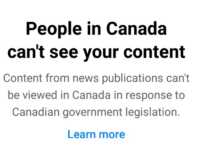
Blocking of news links on Facebook and Instagram in Canada has becomes increasingly widespread in recent days, leading to a growing number of public comments from media outlets and reporters expressing surprise or shock about the scope of the link blocking. Indeed, outlets with blocked links include university student newspapers, radio stations, and foreign news outlets. While there may have been some errors (Facebook has a page to seek review of any blocked link decision), the inclusion of a very wide range of Canadian and foreign news outlets is no accident. Rather, it reflects the government’s Bill C-18 approach, which effectively covers all news outlets worldwide whose links are accessed in Canada. The Canadian government could have adopted a more targeted approach – for example, limiting the scope to news links from those news outlets eligible to negotiate agreements with Internet platforms under the law – but it instead went for the broadest possible approach that includes foreign news outlets with little or no connection to Canada.

Recent Posts
 Big Money, Bigger Design Changes: What the Meta Settlement Means for Canada, Bill C-34, and the Age Verification and Privacy Risks That Remain
  Unleashing the Trolls: Ontario Court Opens the Door to Liability for Influencers Who Weaponize Their Audiences
  Why Ottawa Will Likely Join the U.S. in Opposing the Quebec Online Streaming Law at the Centre of the Trade Battle
  Online Harms’ Forgotten Generation: Why the Government Needs to Pay Attention to Protecting Seniors
  Culture Off the Table? What the Collapsed Canada-U.S. Trade Talks Reveal About the Carney Government’s Cultural Policy
