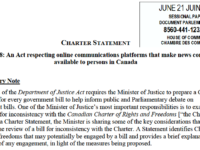
Last Tuesday, Justice Minister David Lametti tabled his department’s Charter statement for Bill C-18, the Online News Act. A link to the statement appeared briefly on the department’s website, but by the end of the week reference to the Bill C-18 Charter statement was removed from the Justice site altogether. As of this morning, there is still no reference to the statement, even though it is a public document having been tabled in the House of Commons. In fact, I have now obtained a copy of the Charter statement and posted it publicly here with an embed below. The department will presumably re-post the statement at some point and it would be useful to confirm that it remains unchanged and provide an explanation for the online removal (I asked and did not get a response). [UPDATE: Hours after this blog post went live, the government posted the Charter statement.]
Latest Posts

The Law Bytes Podcast, Episode 132: Ryan Black on the Government’s Latest Attempt at Privacy Law Reform
Parliament is now on break for the summer, but just prior to heading out of Ottawa, the government introduced Bill C-27. The privacy reform bill that is really three bills in one: a reform of PIPEDA, a bill to create a new privacy tribunal, and an artificial intelligence regulation bill. What’s in the bill from a privacy perspective and what’s changed? Is this bill any likelier to become law than an earlier bill that failed to even advance to committee hearings? To help sort through the privacy aspects of Bill C-27, Ryan Black, a Vancouver-based partner with the law firm DLA Piper (Canada), joins the Law Bytes podcast to discuss everything from changes to consent requirements to how the law will be enforced.

CRTC Chair Ian Scott Confirms Bill C-11 Can Be Used To Pressure Internet Platforms to Manipulate Algorithms
The Senate Standing Committee on Transport and Communications held an exceptionally important hearing as part of its Bill C-11 pre-study (which is about to change into a Bill C-11 study) last night featuring Canadian Heritage officials and CRTC Chair Ian Scott. I will have a second post on the officials, who struggled to provide clear answers to basic questions on everything from how to identify what counts as Cancon for user content (Youtube’s Content ID was suggested) to the absence of thresholds for what is covered by the bill (there are no thresholds and the government wants the ability to also target small streamers). But the key moment of the day came in questioning Scott about the discoverability and the potential for algorithmic manipulation.

The Law Bytes Podcast, Episode 131: The Bill C-11 Clause-by-Clause Review – What “An Affront to Democracy” Sounds Like
Last week, the Standing Committee on Canadian Heritage rushed through the clause-by-clause review of Bill C-11 in a manner that should not be forgotten or normalized. Despite the absence of any actual deadline, the government insisted that just three two hour sessions be allocated to full clause-by-clause review of the bill. Once the government-imposed deadline arrived at 9:00 pm, the committee moved to voting on the remaining proposed amendments without any debate, discussion, questions for department officials, or public disclosure of what was being voted on. This week’s Law Bytes podcast features clips from a hearing that one Member of Parliament described as “an affront to democracy”.

Bill C-11 Enters a Danger Zone: Government Shifts from Ignoring Witnesses on User Content Regulation to Dismissing Criticisms as “Misinformation”
The Standing Committee on Canadian Heritage heard from a total of 48 witnesses as individuals or representing organizations during its study of Bill C-11 (excluding the CRTC and government officials). Of those 48, at least 16 either raised concerns about the regulation of user content in the bill or disputed government claims about its effect. Liberal, NDP and Bloc MPs proposed and voted for amendments in Bill C-11 raised by a single witness or organization, but somehow the testimony of one-third of the witnesses, which included creators, consumer groups, independent experts, Internet platforms, and industry associations. was ignored.
The government’s decision to ignore the overwhelming majority of testimony on the issue of regulating user content damages the credibility of the committee Bill C-11 review and makes the forthcoming Senate study on the bill even more essential. But the government went beyond just ignoring witness testimony yesterday in the House of Commons. It now claims those views constitute “misinformation.” Tim Louis, a Liberal MP who is on the Standing Committee on Canadian Heritage and sat through hours of testimony, said this in the House of Commons yesterday:

Recent Posts
 A Canary’s Song: What Antisemitism Reveals About the Health of Canadian Democracy
  Elbows Up With Europe Too: Why Canada’s Pivot to the EU Raises the Same Digital Sovereignty Questions as the U.S.
  A Century After Keeping Jewish Students Out, Universities Are Letting Them Be Pushed Out
  The Lessons of 9/11 We Forgot After October 7th
  Named to Canadian Lawyer’s Top 25 Most Influential Lawyers
