Bill C-34, the government’s Safe Social Media Act, was touted as its approach to online age verification, adding a mandated age check for social media account creation for those under-16 and age verification for under-18s for access to pornographic content, all overseen by a new Digital Safety Commission. But it now appears the government is prepared to let Bill S-209, Senator Julie Miville-Dechêne’s age verification and website-blocking bill, proceed alongside it, creating new complications with inconsistent definitions and expanded regulatory powers. Bill S-209, which I have warned about since its predecessor Bill S-210 and opposed before a Senate committee last fall, passed the Senate in April and received its first hour of second reading debate in the House of Commons last month. The Liberals previously opposed Bill S-210, citing privacy and freedom of expression concerns, but this time the government supported sending the bill to committee and the House has now referred it on division to the Standing Committee on Human Resources, Skills and Social Development and the Status of Persons with Disabilities. The shift surprised even the bill’s sponsor, and it opens the door to a two-pronged regulatory model that doubles down on age verification, features inconsistent definitions of pornography, establishes a second penalty regime, and could give the future Digital Safety Commission the power to seek website-blocking orders.
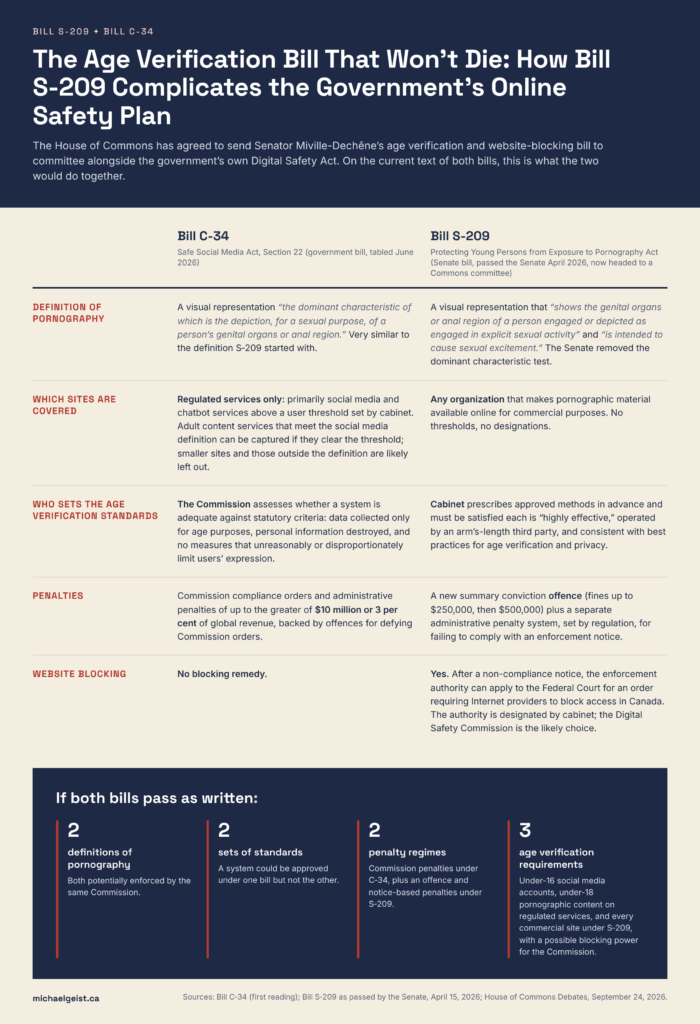
The differences between the two bills raise a range of issues. First, the definition of pornographic content is different. Bill C-34 defines pornographic content as a visual representation “the dominant characteristic of which is the depiction, for a sexual purpose, of a person’s genital organs or anal region.” That is very similar to the definition Bill S-209 initially used, which the Senate later amended by removing the dominant characteristic test, requiring that the person be “engaged or depicted as engaged in explicit sexual activity,” and that the material be “intended to cause sexual excitement.” As a result, if both bills become law, the Digital Safety Commission would potentially enforce two statutory definitions of pornography for age verification purposes (the DSC would administer Bill C-34 and would likely regulate Bill S-209).
The bills also differ in which sites they cover. Section 22 of Bill C-34 requires age verification or age-estimation measures only on “regulated services,” which primarily means social media and chatbot services that exceed a user threshold set by cabinet. Adult content services that meet the social media definition can be captured if they clear the threshold, which likely leaves out smaller sites or those that do not meet the social media definition. By contrast, Bill S-209 applies to any organization that makes pornographic material available online for commercial purposes without any thresholds or designations. The broader coverage helps explain why supporters of the bill want both passed.
The age-verification standards also differ with the Commission establishing the rules in Bill C-34 and cabinet doing so in Bill S-209. Bill C-34 identifies a series of criteria for the Commission to consider in assessing whether the age verification system is adequate. These include limiting data collection to age-verification purposes, destroying personal information, and an express rule that operators need not implement measures that unreasonably or disproportionately limit users’ expression. But under S-209, cabinet sets the standards, not the Commission. A site that wants to rely on its age verification system must implement a method prescribed by cabinet in advance, and cabinet must be satisfied before prescribing any method that is “highly effective,” operated by an arm’s-length third party, and consistent with best practices for age verification and privacy. The two bills would co-exist with different regulatory standards applied to the same age verification systems, raising the possibility that an age verification system could be approved under one bill but not the other.
The penalties and enforcement powers also differ, even though the same regulator would likely administer them. Bill C-34 enforces its age verification obligations through Commission compliance orders and administrative penalties of up to the greater of $10 million and three per cent of global revenue, backed by offences for defying Commission orders. Bill S-209 adds a summary conviction offence for making pornographic material available to a young person, with fines of up to $250,000 for a first offence and $500,000 thereafter, a separate administrative penalty system to be set by regulation for failing to comply with an enforcement notice, and the potential to apply to the Federal Court for a website blocking order. If designated under S-209, the Commission would issue non-compliance notices and seek Federal Court blocking orders, an enforcement power that appears nowhere in Bill C-34.
The concern with age verification mandates is that they tend to expand. The dual paths of Bills C-34 and S-209 are a case in point: C-34 already contains two age verification requirements, one for the under-16 social media ban and one for under-18s for pornographic content on regulated services. Bill S-209 would add a third requirement covering a broader range of sites with differing standards for the age verification system and even more powers for the Digital Safety Commission. Politicians may not want to say no to laws perceived as protecting kids, but they need to say no to an incoherent, inconsistent regulatory plan with multiple bills, definitions, and standards.
Related posts:
 Taking Stock of Bill C-34: Five Things to Know About the Government’s Plan for a Kids’ Social Media Ban, Mandated Age Verification, and AI Chatbot Rules
 Big Money, Bigger Design Changes: What the Meta Settlement Means for Canada, Bill C-34, and the Age Verification and Privacy Risks That Remain
 Yet Another Trade Battle Brewing: Why a Kids’ Social Media Ban Could Put Canada on a Collision Course With the U.S.
 The Wrong Ban: The Heritage Committee Backed a Targeted Ad Ban for Kids and Stopped Short of a Social Media Ban, Yet the Government Chose the Reverse