
With opposition to Bill C-22, the lawful access bill, mounting, Public Safety Minister Gary Anandasangaree has turned to social media with a video defending the bill as one that “respects Canadian privacy and Charter rights.” The video signals that the government has noticed the growing public concern. But the case against the bill, which I argued in committee testimony last week and in a series of earlier posts, raises at least four issues on which the government has not engaged: mandated metadata retention (which is ignored in its Charter Statement), a lower threshold for access to subscriber information that hurts privacy, security risks now alarming Canada’s closest allies, and an oversight architecture the oversight body itself says is incomplete.
Latest Posts

The Law Bytes Podcast, Episode 268: Sara Grimes on the Moral Panic Behind Banning Kids from Social Media and AI Chatbots
The question of children’s social media and AI chatbot ban has emerged as one of the most talked-about digital policy issues in recent memory. Premiers, the Liberal convention, and the media have all jumped on board. But has the debate been driven by misinformation, leading to a moral panic? Dr. Sara Grimes has been working on children’s rights and digital policy for over twenty years. As the Wolfe Chair in Scientific and Technological Literacy and a Full Professor in the Department of Art History and Communication Studies at McGill University, she brings a unique perspective to the issue, having applied a children’s rights lens to areas such as social media regulation and age verification technologies. She joins the Law Bytes podcast to discuss her work and perspectives on the hot digital issue of the moment.
U.S. Congressional Leaders Warn Canadian Lawful Access Plans Harm U.S. National Security and Economic Interests
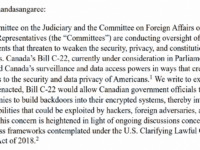
Just as Bill C-22, the Lawful Access Act, is under study at the House Standing Committee on Public Safety and National Security (I review my appearance yesterday in this post) U.S. Congressional leaders have written to Public Safety Minister Gary Anandasangaree warning that the bill threatens to harm “U.S. national security and economic interests by undermining trust in American technology and inviting reciprocal demands from other nations.” The message is clear: U.S. leaders are concerned that lawful access demands go so far as to compromise the privacy not only of Canadians, but of Americans too.

Government Has a Choice: Why an AI Chatbot Ban for Kids is an Even Worse Idea Than a Social Media Ban
The frenzy to ban kids from social media continues to grow with Culture Minister Marc Miller telling a House of Commons committee that the government has no choice but to act. Miller’s comments are consistent with the federal Liberal policy convention vote backing a minimum age of 16 and Manitoba Premier Wab Kinew announcing that his government will be the first in Canada to ban kids from both social media and AI chatbots. The problem, as I documented in detail last week, is that good intentions do not make for good policy. In this case, a social media ban is bad policy because it does not address the underlying problems with the platforms, evidence to date suggests it doesn’t work, and it creates its own harms. But the bad policy does not end there, as the possibility of extending that same framework to AI chatbots is now squarely on the table. This post examines the implications of a ban on kids’ use of AI chatbots, arguing that such an approach is even worse than a social media ban. To be clear, regulation of AI chatbots is needed, but a ban leaves the genuine concerns associated with AI chatbots largely untouched.

Wilful Blindness?: How the Lawful Access Charter Statement Skips Bill C-22’s Most Constitutionally Vulnerable Provisions
The committee hearings on Bill C-22, the lawful access bill, kick off later today with an appearance by Justice Minister Sean Fraser and Public Safety Minister Gary Anandasangaree, who will presumably use the opportunity to affirm their support for the bill and reject concerns that certain elements are inconsistent with the Charter of Rights and Freedoms. That position reflects the government’s Charter statement on the bill, which was released late last month. The statement walks through the Charter implications of new provisions such as the confirmation of service demand, yet what makes it particularly notable is that it avoids addressing some of the bill’s biggest concerns altogether with scant or no attention paid to mandated metadata collection and the risks associated with systemic vulnerabilities. Indeed, it is as if the government believes that if it ignores the potential violation of fundamental rights, the issue magically disappears.

Recent Posts
 Elbows Up With Europe Too: Why Canada’s Pivot to the EU Raises the Same Digital Sovereignty Questions as the U.S.
  A Century After Keeping Jewish Students Out, Universities Are Letting Them Be Pushed Out
  The Lessons of 9/11 We Forgot After October 7th
  Named to Canadian Lawyer’s Top 25 Most Influential Lawyers
  Be Careful What You Wish For: Why Asking Google Maps to Defy the U.S. on Lake Ontario Would Undermine Canadian Digital Sovereignty
