Search Results for "c-11" : 443

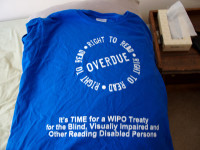
Treaty for the Blind T-Shirts by Timothy Vollmer (CC BY 2.0) https://flic.kr/p/5SXhgK

House of Commons Fast Tracks Copyright Bill To Implement Marrakesh Treaty

Bill C-11, the copyright bill that will allow Canada to accede to an international copyright treaty that will improve access for the blind and visually impaired, was fast tracked on Tuesday with unanimous approval to consider the bill read, studied, and passed three times. There will be no House of Commons committee hearings on the bill, which now heads to the Senate for approval. The bill received first reading at the Senate today. With no hearings and little debate, the bill will pass quickly without any changes.  I wrote about Bill C-11 last month, noting that it is a positive step forward but that some provisions may be unduly restrictive when compared to the implementation approach recommended by some copyright groups.

One of the most notable provisions (which was raised by Carla Qualtrough, the Minister of Sport and Persons with Disabilities) is that the bill amends Canada’s anti-circumvention rules by expanding the exception on digital locks. NDP MP Charlie Angus, a veteran of the copyright battles on Parliament Hill, seized on the issue to ask whether the government would address the remaining digital lock restrictions. The answer from Minister Qaultrough: yes.


Read more ›

May 18, 2016 — 3 comments — News
paywall_nyt by Christoph Borer (CC BY-ND 2.0) https://flic.kr/p/czkcBm

Flawed Copyright Case Places Spotlight on Canada’s Digital Lock Problem

Does asking a friend for a copy of a newspaper article from a subscription website constitute copyright infringement? According to an Ottawa small claims court, it does.

The court recently issued a deeply flawed copyright ruling, providing a timely warning about the dangers of Canada’s restrictive digital lock rules that were enacted by the Conservatives over the strong objection of many copyright watchers.

My weekly technology law column (Toronto Star version, homepage version) notes that the case involved the president of the Canadian Vintners Association (CVA), who received an email from Blacklock’s Reporter, an Ottawa-based political publication, advising that he was quoted in an article discussing a recent appearance before a House of Commons committee. The man did not subscribe to the publication, which places its content behind a paywall, so he contacted a member of the association who was a subscriber and asked if he could see a copy of the article. When Blacklock’s Reporter learned that he had received a copy from the subscriber, it demanded that he pay for a full subscription or face a copyright infringement lawsuit.

Read more ›

November 10, 2015 — 9 comments — Columns
Początek marszu by Piotr Drabik (CC BY 2.0) https://flic.kr/p/ocTafz

Canada’s Non-Commercial Copyright Fail: Why Did YouTube Mute a Holocaust Memorial Video?

Holocaust Remembrance Day (Yom HaShoah) starts tonight with events planned around the world. Last year, my daughter Jordan participated in the March of the Living, an annual event that brings thousands of people from around the world to the concentration camps in Poland. The experience had a profound effect and since her return she has become increasingly active within the March of the Living organization including joining the Ottawa board of directors. As part of tonight’s Holocaust remembrance event in Ottawa, she was asked to create a video to commemorate last year’s trip including interviews with participants, pictures, and video. She spent hours interviewing 18 participants on their experience and worked through hundreds of photos and hours of video to create a five-minute snapshot.

Last week, she posted the video to YouTube in anticipation of tonight’s event. Within hours, she received a message from the event organizer’s wondering why so few interviews appeared on the video. When she looked into the issue, she found that YouTube had muted the audio track with interviews after a couple of minutes (at 2:14 to be precise). The reason? The video includes some copyrighted background music. YouTube’s approach when it matches audio to a copyrighted work is to mute the non-music track, though it provides an option to fill out a fair dealing/fair use claim. Jordan did that, pointing out that Section 29.21 of the Canadian Copyright Act provides specific protection for non-commercial user generated content.  The provision states:

Read more ›

April 15, 2015 — 12 comments — News
TPP rally. Ottawa, Canada, June 10 2014 by SumofUs (CC BY 2.0) https://flic.kr/p/o8zuy7

The Price of Admission to the TPP Talks Revealed: U.S. Demanded Canada Pass Anti-Counterfeiting Legislation

In the years leading up to Canada’s entry into the Trans Pacific Partnership negotiations, there was considerable speculation about demands imposed by the U.S. For example, I wrote in 2012 about two reported demands: that Canada was stuck with any chapters concluded before entry and that it would not have any veto authority. This meant that if all other countries agreed on a particular provision, Canada would be required to accept it.

Yesterday, Industry Minister James Moore provided the first official confirmation of at least one other condition of admission to the talks: anti-counterfeiting legislation. Bill C-8, the anti-counterfeiting bill that focuses on providing new border measures provisions such as enhanced search and seizure powers for customs agents without court oversight, is really a bill about satisfying U.S. demands for TPP entry. According to Moore:

Read more ›

November 28, 2014 — 3 comments — News

Access Copyright Urges Copyright Board to Ignore Supreme Court Ruling on Fair Dealing

Access Copyright has filed its response to the Copyright Board of Canada’s series of questions about fair dealing and education in the tariff proceedings involving Canadian post-secondary institutions. I have several posts planned about the 40 page response, which continues the copyright collective’s longstanding battle against fair dealing. This one focuses on Access Copyright’s astonishing effort to urge the Copyright Board to reject the Supreme Court of Canada’s clear ruling on the relevance of licensing within the context of fair dealing.

Access Copyright has frequently argued that the availability of a licence should trump fair dealing. For example, in the 2001 copyright consultation it stated:

As a rule, where collective licensing is in place there should be no exception or limitation to a right for which the holder has a legitimate interest. As defined in the Act, anytime that a licence to reproduce a work is available from a collective society within a reasonable time, for a reasonable price and with reasonable effort, it is commercially available.

Access Copyright reiterated its position in its 2003 intervention in the Law Society of Upper Canada v. CCH Canadian case.  It argued:

Read more ›

April 16, 2014 — 4 comments — News