
Earlier today, the Liberal party convention approved (subject to a final vote) two stunning policy resolutions with enormous implications for freedom of expression. First, as discussed yesterday, it approved a resolution that seeks to “hold on-line information services accountable for the veracity of material published on their platforms and to limit publication only to material whose sources can be traced.” If enacted, the policy would undermine freedom of the press and could even spark widespread censorship on Internet platforms. In addition, it passed a resolution to develop “truth in political advertising” legislation to be administered by an oversight body. There are legitimate concerns about the “truthiness” of all political parties communications, but political truth oversight bodies carries great risk and is unlikely to foster enhanced public trust.
Post Tagged with: "c-18"
Liberal Party Policy Proposal Would Limit Online Publication to Material “Whose Sources Can Be Traced”
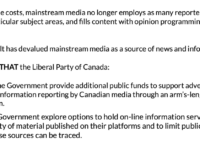
The Liberal Party policy convention is underway in Ottawa with delegates preparing to debate a series of policy proposals that could ultimately make their way into their national election platforms. Party members voted on the top 20 proposals for discussion and included one involving the media and online information that seems obviously unconstitutional and a direct threat to a freedom of the press. The proposal, purportedly aimed at addressing misinformation, calls for more government funding for the media and that the government explore options to “hold on-line information services accountable for the veracity of material published on their platforms and to limit publication only to material whose sources can be traced.”
Fixing Bill C-18: My Appearance Before the Senate Standing Committee on Transportation and Communication
I was pleased to appear yesterday before the Senate Standing Committee on Transportation and Communication on Bill C-18. The discussion focused on a wide range of issues, including the risks of mandating payments for links, the non-compliance with international copyright obligations, why the CBC should not be included in the payment for links system, and how a fund would be a better approach. My opening statement, which tried to identify some fixes to the bill, is posted below as text and as a Youtube video.

Why the Twitter – CBC Labelling Battle is a Distraction From the Real Problems with Government Media Policy and the Public Broadcaster
Twitter and the CBC were in the spotlight yesterday with Twitter’s decision to add a “government funded media” label to the CBC Twitter account. The label is defined by Twitter as a media organization “where the government provides some or all of the outlet’s funding and may have varying degrees of government involvement over editorial content.” CBC responded by tweeting it would pause its Twitter activities because suggesting that its journalism was anything other than impartial and independent was untrue. The government funding for CBC is undeniable, but the inclusion of “government involvement over editorial content” is apt to mislead. The Broadcasting Act provides guidance on the kinds of content to be found on CBC, but there is an important difference between general policy objectives and specific involvement over editorial content. In fact, Twitter has another label for “publicly funded media” accounts that appear to be better suited to the CBC since it covers “media organizations that receive funding from license fees, individual contributions, public financing, and commercial financing” but makes no reference to editorial content.
The Twitter-CBC labelling battle offers more heat than light since it does little to address the underlying problems with media independence in Canada and the CBC (much less the tire fire that is Twitter). Instead, it simply provides fodder for CBC critics to point to the Twitter label and argue for “defunding the CBC” (at least the English language part of it) and CBC defenders to proclaim that they will stand up for the public broadcaster against unfair smears. That debate distracts from serious underlying problems with government media policy and the public broadcaster.

The Law Bytes Podcast, Episode 161: Canadian Chamber of Commerce President Perrin Beatty on Why the Government’s Bill C-18 Motion Establishes a Dangerous, Undemocratic Precedent
Bill C-18, the online news bill whose foundation is mandated payments for links, has unsurprisingly sparked reaction from Google and Facebook that raises the possibility of stopping linking to Canadian news. In an act of obvious retribution, the government responded to the companies response with a motion from Parliamentary Secretary to the Minister of Canadian Heritage Chris Bittle that demanded a wide range of internal and external documents dating back years and even looped in the private correspondence of companies, NGOs, journalists and potentially of thousands of Canadians. At committee, Liberal MP Anthony Housefather introduced a motion that removed some of the most problematic elements, but still left in place what is best described as a fishing expedition.
Perrin Beatty is a former Cabinet Minister under Prime Ministers Clark and Mulroney, was named President of the CBC by Jean Chretien, and is now the President and CEO of the Canadian Chamber of Commerce. His members are split in their views of Bill C-18, but not on the motion at Heritage committee. He joins the Law Bytes podcast to discuss the concerns with the motion and the dangerous precedent it sets.

Recent Posts
 The Wrong Ban: The Heritage Committee Backed a Targeted Ad Ban for Kids and Stopped Short of a Social Media Ban, Yet the Government Chose the Reverse
  Regulator First, Rules Later: Bill C-34 Debate Shows the Government Wants a Digital Safety Commission Before It Figures Out What It Will Do
  Making the Case Against Its Own Bill: What the Government’s Bill C-34 Charter Statement Reveals About the Constitutional Vulnerability of the Social Media Ban
  “Position Has Not Changed”: The Canadian Government Reaffirms That Antisemitism Includes Anti-Zionism
  The Law Bytes Podcast, Episode 279: My Keynote on Digital Sovereignty: Control, Choice, and Connection
