Post Tagged with: "canadian heritage"

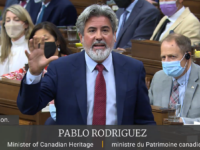
Rodriguez screen shot, House of Commons, May 30, 2022, https://parlvu.parl.gc.ca/Harmony/en/PowerBrowser/PowerBrowserV2/20220530/-1/36984

The Documents Don’t Lie, Even If It Appears Pablo Rodriguez Does: ATIP Reveals His Office Was Informed Within Minutes of CMAC/Marouf Termination Notice

When national concern broke out over Canadian Heritage funding an anti-semite as part of its anti-hate program in August 2022, then Heritage Minister Pablo Rodriguez was nowhere to be found. While specific responsibility for the program lay with cabinet colleague Ahmed Hussen, internal documents obtained under the Access to Information Act reveal that Rodriguez’s office was well aware of the issue. But when Rodriguez appeared before the Canadian Heritage committee last fall and was asked about the issue, he said he knew nothing about it until August 22, 2022. As I posted yesterday, that testimony appears to be false as his chief of staff, deputy minister, and office personnel raised concerns nearly a week before that date.

In fact, additional documents obtained under ATIP indicate that Rodriguez’s office was kept abreast of major developments for days, including immediately being informed on August 19th that Canadian Heritage legal personnel had served Marouf’s organization with notice that it was terminating the contribution contract.


Read more ›

September 29, 2023 3 comments News
The Need for Truthful Accountability: What ATIP Records Tell Us About Pablo Rodriguez and Canadian Heritage Funding an Anti-Semite

The Need for Truthful Accountability: What ATIP Records Tell Us About Pablo Rodriguez and Canadian Heritage Funding an Anti-Semite

The past few days have been painful to watch as Canadian politicians grapple with the aftermath of recognizing and applauding a Nazi in the House of Commons. The episode and its response brings back memories from last year’s discouraging response to revelations that Canadian Heritage’s anti-hate program had provided funding to Laith Marouf, a known anti-semite. While there are obvious differences, the commonality lies in the pain to the Jewish community and the reticence for full-throated apologies and public engagement, misplaced hope that the issue will just recede from public attention, slow commitments to ensure it does not happen again, and reluctanc

Read more ›

September 28, 2023 1 comment News
Wrong Way by Jack Zalium https://flic.kr/p/7CxM1P (CC BY-NC 2.0)

Why the Government’s Draft Bill C-18 Regulations Don’t Work: The 4% Link Tax is Not a Cap. It’s a Floor.

The Online News Act has quickly emerged as one of the government’s biggest policy failures with Canadian news outlets facing lost traffic, lost revenues, and lost competition. The source of the Bill C-18 failure was the government’s seeming inability or unwillingness to game plan the potential outcomes of the law, rejecting criticisms and calls for a “Plan B” by instead relying on the hope that the policy measures would simply unfold as they did in Australia. That obviously has not happened, leading to the growing realization that Meta’s blocking of news links, which has already gone on far longer than it did in Australia, is not a bluff. With Meta out of news in Canada, the government is hoping to salvage the law by convincing Google to pay at least $172 million for news links. Unfortunately, the draft regulations released by Canadian Heritage Minister Pascale St-Onge suffer from the same failures as the law, namely an inability to game plan the potential outcomes of the regulations. 

I’ve already written about how the draft regulations will do little to ensure more spending on journalism and how they are stacked against small, independent and digital first news outlets. But as I read analysis that suggests that Google got what it wanted – a cap on liability – I fear that the regulations are badly misunderstood. In fact, if you assess the competing policy objectives in the regulations and consider how they might actually play out, it becomes hard to avoid the conclusion that they don’t work and may well lead Google to walk away from news in Canada.

Read more ›

September 14, 2023 7 comments News
Full–Time Equivalent FTE by Alpha Photo (CC BY-NC 2.0) https://flic.kr/p/2og938P

Why the Government’s Bill C-18 Draft Regulations Are Stacked Against Small, Independent, and Digital-First Media Outlets

The problems with government’s Bill C-18 draft regulations involve more than just what amounts to a 4% link tax on Google and Meta alongside little effort to ensure the resulting revenues are used to support spending on journalists and news content. As noted in previous posts, the draft regulations put an end to the claim that the Online News Act involves compensation for news creation since the standards are now simply a function of Internet platform revenues, not news production costs.  Given the global implications of a 4% tax on revenues to support media, that approach likely further cements Meta’s decision to comply with the law by stopping news links and increases the chances that Google follows suit.

But the concerns with the draft regulations do not end there. Indeed, the regulations revive the frustration of many smaller, independent and digital-first news outlets who feared that Bill C-18 would harm them competitively by receiving less support relative to larger companies such as Bell, Rogers, the CBC, and Postmedia or be excluded altogether.

Read more ›

September 6, 2023 4 comments News
Journalists on duty on Yan Arief https://flic.kr/p/39u1L1 (CC BY-SA 2.0)

Why The Government’s Bill C-18 Draft Regulations Do Little to Ensure More Spending on Journalists or News Content

The government released its draft Bill C-18 regulations on Friday ahead of the Labour Day weekend, but ironically those regulations do very little to ensure that new funding will be allocated toward employing journalists. While the regulations establish what amounts to a minimum 4% link tax on Google and Meta if they link to news content, they set no minimum requirements to spend the resulting revenues on journalists or news content. In fact, the government specifically dictates to the CRTC that the legislative requirement that an “appropriate portion of the compensation will be used for the production of local, regional and national news content” will involve no minimum amount and the agreements need only reference that “some” of the compensation will be used for that purpose. As a result, in the best case scenario for the government in which the Internet platforms pay for links by reaching commercial agreements with news outlets, the big beneficiaries such as Bell, Rogers, the CBC, and Postmedia would be free to spend the vast majority of the money generated by those deals on executive salaries, debt repayment, or any other purpose.

Read more ›

September 5, 2023 10 comments News